
A Collision of Beliefs: Mining the Digital Battlegrounds of Religious Conflict
A Collision of Beliefs: Investigating Linguistic Features for Religious Conflicts Identification on Tumblr
This paper presents the first systematic study to identify religious conflicts on Tumblr by analyzing user-generated content across nine linguistic dimensions. Utilizing a custom-built dataset of over 107,000 posts, the authors employ Natural Language Processing (NLP) and Linguistic Inquiry and Word Count (LIWC) to categorize subjective sentiments like "Annoyance," "Sarcasm," and "Insult."
TL;DR
As spiritual and religious discourse moves from the pulpit to the smartphone, identifying societal tensions has become a data science challenge. This paper investigates how linguistic features on Tumblr—ranging from emotional range to specific word counts—can automatically identify religious conflicts. By analyzing a massive dataset of 107k+ posts, the researchers have moved beyond simple "hate speech" detection to map a complex spectrum of 9 conflict dimensions, including sarcasm, defense, and disappointment.
Contextual Positioning
While social scientists have spent decades conducting manual offline surveys to gauge religious friction, this work marks a pivotal shift toward Automated Security Informatics. It positions itself as a technical bridge, applying NLP to the messy, multilingual, and multimedia world of Tumblr to provide a real-time pulse of religious sentiment.
The "Tumblr" Advantage: Why This Platform?
Unlike Twitter’s (historical) character limits, Tumblr allows for long-form expressive "feels" and anonymous interactions. This provides a unique dataset where bloggers are more likely to reveal deep-seated biases, use reaction GIFs, and engage in descriptive arguments that are far richer for linguistic analysis than 280-character snippets.
Methodology: Decoding Emotional DNA
The authors didn't just look for "bad words." They built a pipeline to extract the underlying intent of the bloggers.
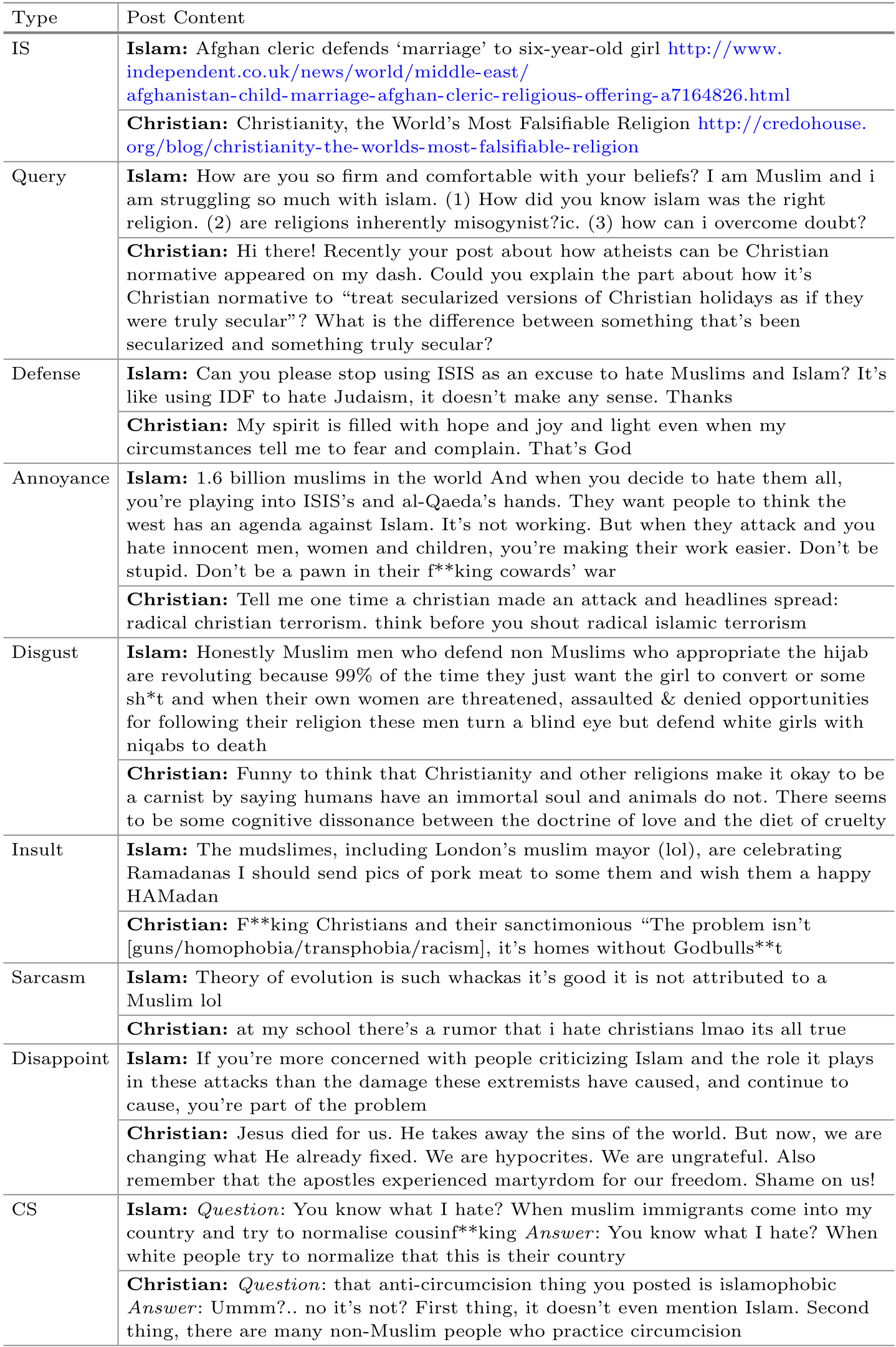
1. The Multi-Dimensional Framework
The core of the study lies in categorizing posts into 9 distinct conflict-related sentiments. This granularity is essential because a "Sarcastic" post requires a different intervention than an "Insult" or a "Defensive" justification.
2. Feature Engineering Pipeline
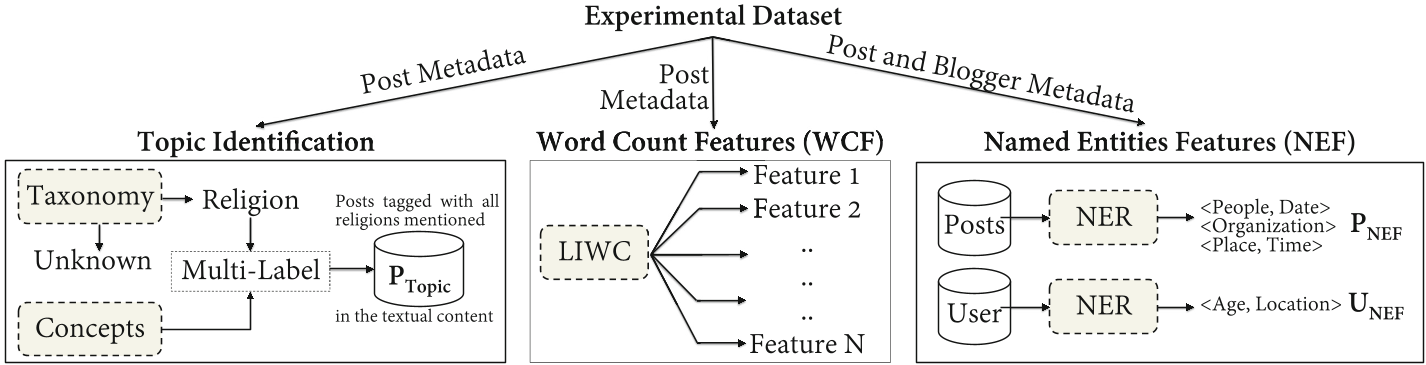
To process the data, the researchers utilized a three-pronged approach:
- Topic Modeling: Using taxonomy analysis to ensure a post tagged #religion is actually about religion (filtering out irrelevant buzzwords).
- LIWC (Linguistic Inquiry and Word Count): This is the "secret sauce" that quantifies the psychological state of the writer—measuring variables like Anxiety, Anger, and Certainty.
- NER (Named Entity Recognition): Identifying people and locations to correlate social media "flare-ups" with real-world incidents (e.g., attacks or political shifts).
Critical Findings & SOTA Comparisons
The study’s empirical analysis yields several "Aha!" moments regarding digital behavior:
- Short-Text Ambiguity: In posts with 1-20 words, only 33% could be accurately classified, highlighting a major limitation in current NLP for extreme micro-content.
- The Gender Variable: Interestingly, gender-specific terms (female mentions) appeared in ~10% of all conflict posts, suggesting that religious friction on social media is often intertwined with debates over women's roles and rights.
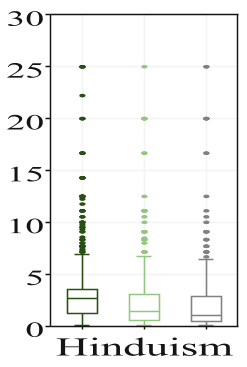
- Religion-Specific Signatures: The data showed that different religious communities display different "emotional fingerprints" in conflict. For instance, Hinduism-related posts in the dataset exhibited higher median anger scores compared to the higher "sadness" outliers found in Islam and Judaism related discussions.
Critical Analysis & Future Outlook
The paper successfully validates that linguistic features are discriminatory—meaning they can statistically separate a "Defensive" post from a "Disgust" post. However, the authors honestly note a remaining hurdle: Disambiguation. When a post uses sarcasm to deliver an insult, or discusses two religions simultaneously, current models still struggle to assign the correct "belief" to the correct entity.
Takeaway for the Industry: Law enforcement and social researchers should move away from simple keyword blacklists. The real insight lies in the correlation between emotional range (LIWC) and topical entities. Future SOTA models will likely need to incorporate Multimodal Fusion (analyzing the image/GIF alongside the text) to fully crack the code of online religious conflict.
Conclusion
This paper serves as a foundational dataset and methodology for the next generation of "Conflict Informatics." By making their 107k post dataset public, Agarwal and Sureka have opened the door for more sophisticated deep-learning models to tackle the collision of beliefs in our increasingly digital society.