
KDA: Bridging Structural Kernels and Deep Learning for Enhanced Linguistic Inference
On the Impact of Linguistic Information in Kernel-Based Deep Architectures
The paper investigates the Kernel-based Deep Architecture (KDA), a framework that integrates structured kernel methods with Deep Learning using the Nyström approximation. By evaluating various kernels on a Question Classification task, the study demonstrates that increasing the linguistic expressiveness of the kernel (from Bag-of-Words to Compositionally Smoothed Tree Kernels) leads to state-of-the-art accuracy while maintaining high computational efficiency.
Executive Summary
TL;DR: This paper explores the Kernel-based Deep Architecture (KDA), a hybrid approach that marries the structural richness of Kernel Methods with the non-linear power of Deep Learning. By using the Nyström method to linearize complex Tree Kernels into dense embeddings, the authors demonstrate that more "linguistically expressive" kernels—those that understand both syntax and semantic composition—consistently drive higher neural network accuracy.
Background Positioning: The work occupies a unique niche between traditional Statistical Learning Theory (SVMs/Kernels) and modern Deep Learning. It validates that we don't always need exotic neural architectures if we have a mathematically principled way to inject structural inductive biases (like parse trees) into a standard Multi-Layer Perceptron (MLP).
The Problem: The Structure vs. Scalability Trade-off
In NLP, meaning is often hidden in structure (syntax trees, dependency graphs). Historically, researchers faced two suboptimal choices:
- Kernel Methods (e.g., SVMs): Excellent at handling discrete structures via Tree Kernels but notoriously slow. Classifying a single sentence might require thousands of expensive kernel comparisons against "support vectors."
- Deep Learning (e.g., CNNs/RNNs): Highly scalable but often requires "ad-hoc" designs to handle trees, or relies on massive data to learn structures that kernels capture explicitly via the Kernel Trick.
The authors ask: Can we have both the structural intelligence of kernels and the speed/non-linearity of deep networks?
Methodology: The KDA Framework
The KDA solves this by adding a Nyström Layer to a neural network.
1. From Trees to Vectors (Nyström Approximation)
The Nyström method takes a high-dimensional (potentially infinite) kernel space and finds a low-dimensional projection. It selects a small subset of training examples called landmarks (). Any new tree is then represented as a vector of its similarities to these landmarks.
2. The Hierarchy of Expressiveness
The authors tested four kernels, each adding a layer of linguistic "intelligence":
- BOWK: Basic word overlap (Bag-of-Words).
- PTK (Partial Tree Kernel): Matches exact syntactic tree fragments.
- SPTK (Smoothed PTK): Allows matches between different but semantically similar words (using Word2Vec).
- CSPTK (Compositional SPTK): Captures how word meanings change when combined (e.g., "Hendrix" + "play").
 Fig 1: A Compositional Grammatical Relation Centered Tree (CGRCT) used by the CSPTK to capture semantic nuances.
Experiments and Results
The researchers tested their hypothesis on Question Classification. The results were clear: The smarter the kernel, the better the network.
Performance Highlights:
- Accuracy: The KDA using the CSPTK reached 94.3%, surpassing the state-of-the-art CNN (93.6%).
- Efficiency: While a traditional SVM requires ~3,800 kernel operations per classification, the KDA achieved similar results with just 100 to 400 landmarks, representing a 90%+ reduction in computation.
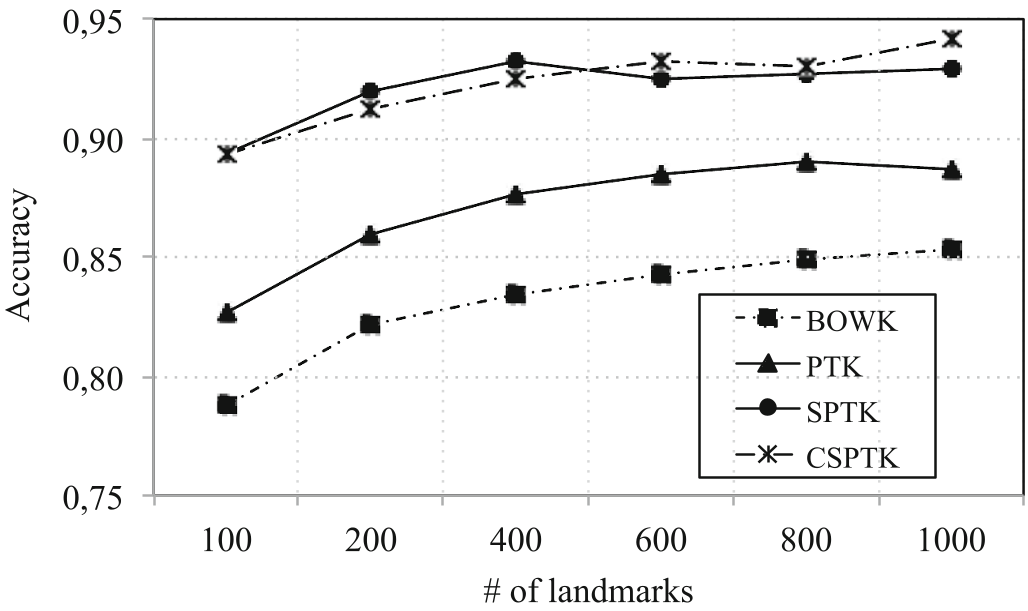 Fig 2: Impact of kernel type and number of landmarks on classification accuracy. Note how CSPTK/SPTK significantly outperform simpler kernels.
The "Smarter Representation" Win:
As seen in the results, even with very few landmarks (100), the semantic kernels (SPTK/CSPTK) provided enough information for the MLP to hit 90% accuracy, whereas the Bag-of-Words kernel (BOWK) struggled even with 1,000 landmarks.
Critical Analysis & Conclusion
Main Takeaway: This paper proves that the "Nyström reconstruction" successfully captures the semantics of input linguistic data. The effectiveness of a neural network is not just about its depth or hidden units, but about the expressiveness of the input manifold. By projecting trees into a kernel-defined space, we give the network a "head start" in understanding language.
Limitations:
- The landmark selection was done via uniform sampling. While effective, more sophisticated active learning or clustering techniques for landmark selection might further reduce the number of landmarks needed.
- The study is limited to Question Classification; how this scales to much larger tasks like Machine Translation remains an open question.
Future Outlook: The KDA framework offers a promising path for Neuro-Symbolic AI. By injecting domain knowledge (via kernels) into neural learning, we can build models that are more data-efficient and potentially more interpretable than pure black-box architectures.