
Hybrid Intelligence in Legal Tech: Combining SVMs and NLP for Juridical Information Extraction
Using Linguistic Information and Machine Learning Techniques to Identify Entities from Juridical Documents
2010-01-01
Summary
Problem
Method
Results
Takeaways
Abstract
The paper presents a hybrid methodology for information extraction from legal documents, combining SVM-based text classification with NLP-driven Named Entity Recognition (NER). It achieves a high classification precision of over 95% across four languages and successfully identifies complex entities like legal references and dates to populate legal ontologies.
## TL;DR
Researchers Paulo Quaresma and Teresa Gonçalves present a robust framework for processing European Union legal documents (EUR-Lex). By combining **Support Vector Machines (SVM)** for high-level classification and **Syntactic/Semantic Parsers** for Named Entity Recognition (NER), the study achieves near-perfect classification precision (>95%) while identifying the inherent difficulties in mapping complex legal "citation chains."
## Problem & Motivation
The legal domain is a "gold mine" of structured information buried in unstructured text. Traditional keyword searches are insufficient for modern legal research, which requires understanding **legal concepts** (e.g., "Fisheries," "Environment") and **entity relationships** (e.g., how one document cites another). The authors argue that a purely statistical approach misses the "physics" of language, while a purely linguistic approach lacks the robustness to handle thousands of documents.
## Methodology: The Hybrid Core
The authors proposed a two-pronged strategy:
### 1. Document Classification via SVM
To categorize documents into the "Directory Code" (legal topics), the system uses a **Bag-of-Words (BoW)** representation with **tf-idf weighting**.
* **Why SVM?** As the authors note, SVMs are computationally efficient and robust for high-dimensional text data, effectively finding the "maximum margin" to separate complex legal topics.
* **Multilingual Evaluation**: The system was tested on English, German, Italian, and Portuguese, exploring how linguistic variance affects machine learning performance.
### 2. NER via Semantic Parsing
Instead of using standard HMMs or CRF models (common at the time), the authors utilized the **PALAVRAS parser**. This tool generates a detailed parse tree for each sentence, assigning semantic tags like `<Lcountry>` for countries or `<HHorg>` for organizations.
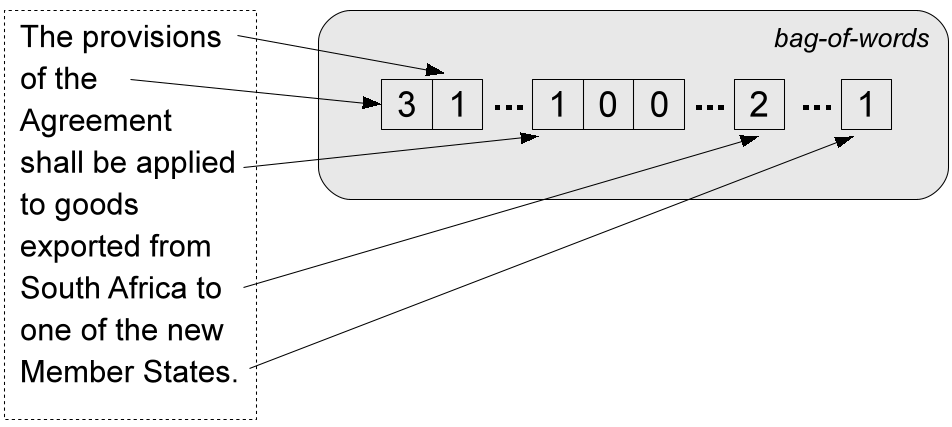
*Fig 1: Conceptual mapping of data into a high-dimensional feature space where linear separation becomes possible.*
## Experiments & Results
The methodology was applied to a corpus of 2,714 agreements from the EUR-Lex site.
### Key Performance Metrics:
* **Precision Powerhouse**: Classification precision was consistently above **0.95** (Micro-average) across all languages.
* **Language Sensitivity**: Performance was slightly lower for Romance languages (Portuguese/Italian) compared to Anglo-Saxon languages (English/German). The authors attribute this to the richer morphology and more complex syntactic structures in Romance legal writing.
* **NER Successes & Failures**:
* **Dates**: 0.1% error rate. Legal documents use highly standardized date formats.
* **Organizations/References**: ~65-67% error rate. This "failure" is actually a key insight—legal citations and organization names are often so syntactically complex that standard parsers classify any unknown entity as an "organization."
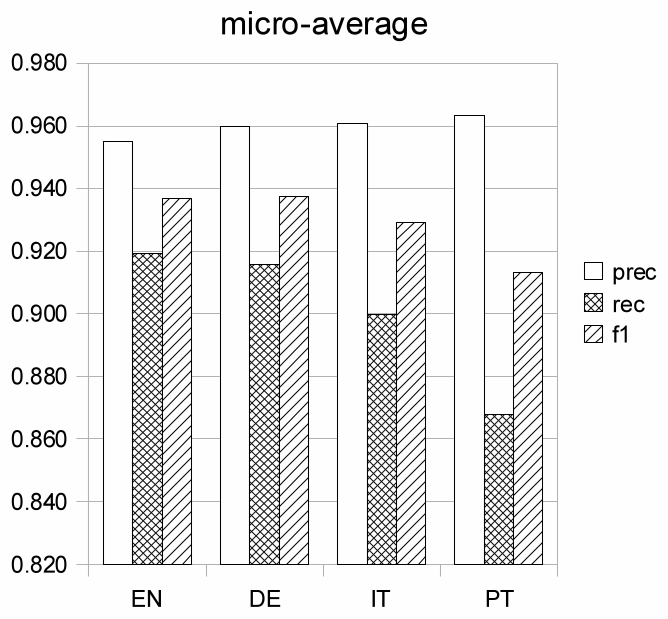
*Fig 2: Comparison of Micro and Macro-average values for Precision, Recall, and F1 across languages.*
## Depth Insight: The "Reference Chain" Challenge
The most significant takeaway is the difficulty of identifying **document references**. In EU law, a single sentence might cite three different articles across two previous treaties. The authors found that a 35% precision for references is a call for "deeper analysis of parse trees." This work highlights that while ML is great for "what" a document is about, we still need advanced NLP to understand "how" documents are legally connected.
## Conclusion & Future Work
The paper successfully demonstrates that top-level legal concepts can be identified with high reliability. However, the future of Legal AI lies in solving the **NER Bottleneck**. The authors suggest that integrating external geographical databases and developing specialized SVM classifiers for organizations will be the next step in creating truly high-level legal information retrieval systems.
***
**Keywords**: *SVM, Named Entity Recognition, legal-nlp, EUR-Lex, Information Extraction*