
SSP Mining: Unmasking the Rhetorical Engine of Polished Microblog Discourse
Linguistic Pattern Mining for Data Analysis in Microblog Texts using Word Embeddings
The paper introduces Short Semantic Pattern (SSP) mining, a technique for extracting recurrent discourse fragments from microblog texts using Word2Vec embeddings. By moving beyond literal lexical matching, the method identifies semantically similar word sequences that articulate frequent opinions or thoughts in social media.
TL;DR
Researchers have developed a method called Short Semantic Pattern (SSP) mining that uses word embeddings to find "recurrent thoughts" in tweets. Unlike traditional keyword searches, this method identifies fragments like "unqualified to be president" and "lacks decision-making ability" as part of the same linguistic pattern because they share a semantic space. In a case study of Donald Trump’s 2016 election tweets, the algorithm successfully mapped the systematic defamation of media and political rivals.
The Challenge: When Keywords Aren't Enough
Social media discourse is a "two-edged sword." While it fosters integration, it is also a breeding ground for disinformation and opinion manipulation. Analyzing this discourse is historically difficult because:
- Informal Language: Slang, typos, and regionalisms break standard NLP parsers.
- Lexical Diversity: Two different sentences can mean the exact same thing without sharing a single non-trivial word.
- Brevity: Microblogs lack the deep context found in traditional literature.
The authors argue that to fight disinformation, we must go beyond what words are used and find how specific meanings are frequently packaged and repeated.
Methodology: The Dynamic Context Window
The heart of this research is the Short Semantic Pattern. The authors represent every word as a vector (Word2Vec). The innovation lies in the mining algorithm:
- Keyword Anchoring: The process starts by identifying a central keyword (e.g., "Hillary" or "Media").
- Dynamic Expansion: A context window centered on the keyword expands to the left and right.
- Similarity Testing: As the window grows, the algorithm compares the resulting "linguistic component" to components in other documents using cosine similarity.
- Maximal Convergence: The window stops expanding when adding a new word drops the semantic similarity below a defined threshold (e.g., 80%).
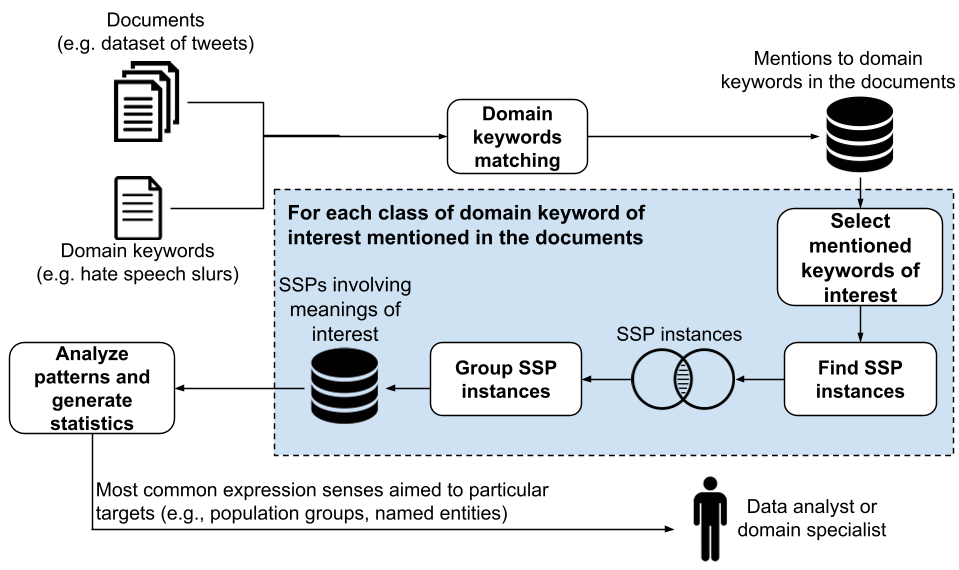
This allows the system to recognize that "Crooked Hillary is not qualified" and "Hillary is unfit... has bad judgment" are instances of the same semantic pattern.
Experimental Case Study: The 2016 Election
The authors analyzed 3,219 tweets from Donald Trump. By setting the similarity threshold at , they uncovered the structural anatomy of his digital campaign rhetoric.
Key Findings in Media & Opponent Analysis:
- Media Patterns: Three dominant "senses" emerged: information distortion, protection of opponents, and refusal to publish positive news.
- Opponent Patterns: A systematic "Atmosphere of Mistrust" was built using demeaning adjectives (e.g., "disgusting," "corrupt," "failing") that frequently appeared in clusters.
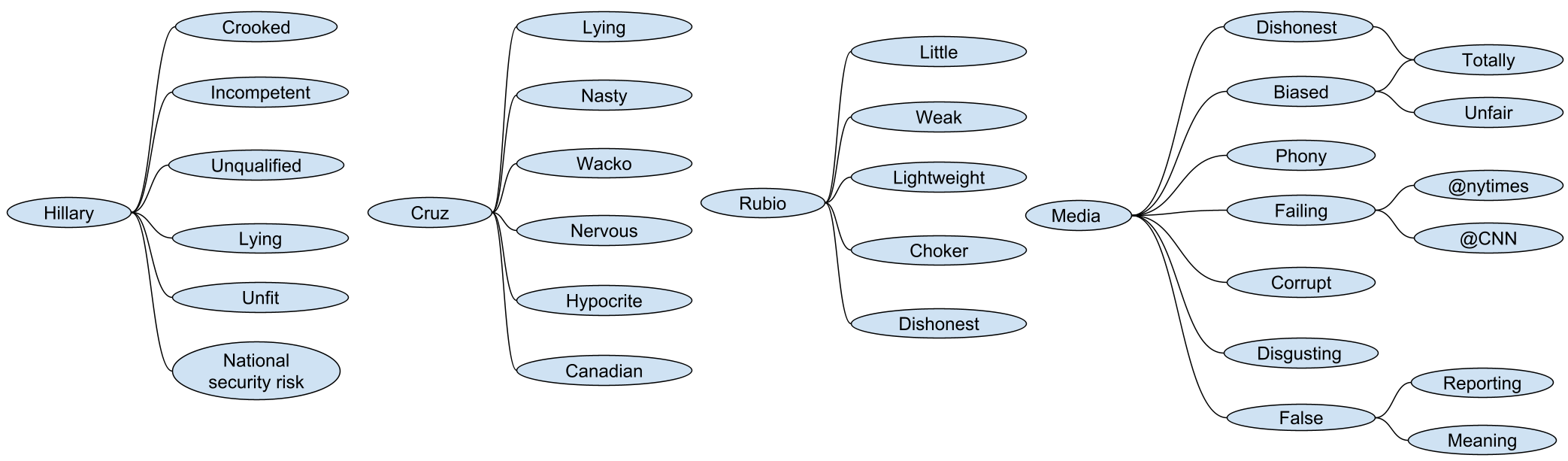
The results illustrate that Trump’s discourse was not just random outbursts but a collection of high-frequency semantic patterns designed to reduce complex political figures to a single, negative trait (e.g., "Lying Ted" or "Little Marco").
Critical Insight & Conclusion
This work represents a significant step from Syntactic Analysis (how sentences are built) toward Rhetorical Analysis (how meaning is weaponized).
Value-First Perspective: The real value of SSP mining is its ability to perform "unsupervised discourse discovery." We no longer need to know what a politician is saying to find the patterns; we only need to provide a subject (keyword), and the algorithm reveals the prevailing narrative structure.
Limitations:
- The method still relies on predefined keywords for anchoring.
- It requires substantial compute for large-scale embedding comparisons across high-volume streams.
Future Outlook: The authors suggest applying this to medical domains (matching symptoms to diseases) or automated Word Sense Disambiguation. In the era of LLMs, the SSP approach provides a lighter, more interpretable way to track the shift in public opinion compared to "black box" neural generators.