
CRPNs: Merging Cloud Model Theory with Petri Nets for Resilient Knowledge Reasoning
Linguistic Petri Nets Based on Cloud Model Theory for Knowledge Representation and Reasoning
This paper introduces Cloud Reasoning Petri Nets (CRPNs), a novel extension of Fuzzy Petri Nets (FPNs) that integrates Interval Cloud Model theory and the Interval Cloud Hybrid Averaging (ICHA) operator. It establishes a robust framework for uncertain knowledge representation and reasoning, specifically achieving superior reliability in power system fault diagnosis.
TL;DR
Knowledge-based systems often fail because they treat expert uncertainty as a single dimension. This paper proposes Cloud Reasoning Petri Nets (CRPNs), which utilize Interval Cloud Models to capture both the fuzziness and randomness of human judgment. By applying a new Hybrid Averaging Operator (ICHA), the model achieves more nuanced and reliable fault diagnosis in complex energy grids than traditional Fuzzy Petri Nets (FPNs).
Problem & Motivation: The "Blind Spot" of Fuzzy Logic
While Fuzzy Petri Nets (FPNs) are excellent at modeling "if-then" logic with non-binary values, they possess a critical flaw: they equate fuzziness (the boundary is unclear) with randomness (the occurrence is uncertain). In a power system fault, an expert might say "the voltage is very high." This statement isn't just a fuzzy membership value; it carries a degree of randomness based on the sensor's reliability.
Furthermore, existing reasoning algorithms usually focus on Local Weights (how important is this specific sensor?) but ignore Ordered Weights (how much should we trust the most extreme alarm versus the average one?). Without balancing these, the inference engine remains fragile to outliers.
Methodology: The CRPN Framework
The core innovation lies in replacing simple fuzzy numbers with Interval Clouds. A cloud is defined by three parameters:
- Expectation (Ex): The central value of the concept.
- Entropy (En): The "blurriness" or fuzziness of the concept.
- Hyper-entropy (He): The "uncertainty of the uncertainty"—essentially the randomness of the entropy itself.
1. Model Architecture
Knowledge is mapped via Cloud Reasoning Production Rules (CRPRs). Unlike standard rules, these include temporal constraints () and certainty factors represented as clouds.
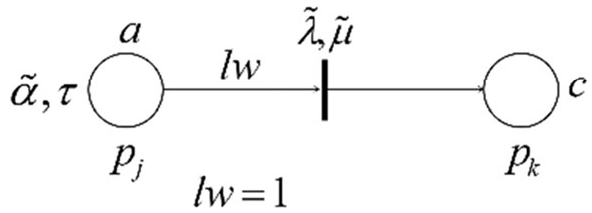 Fig 1: The mapping of linguistic variables to the CRPN structure, where transitions act as cloud-based inference gates.
2. The ICHA Operator
To solve the weighting bias, the authors propose the Interval Cloud Hybrid Averaging (ICHA) operator. It acts as a mathematical filter that:
- Assesses the importance of each input proposition (Local Preference).
- Re-ranks propositions based on their truth degrees to apply positional weights (Ordered Preference).
- Synthesizes these into a final "Truth Cloud" for the output place.
Experiments: Real-World Power Grid Diagnosis
The authors tested CRPNs on an IEEE 14-bus power system. In this scenario, protective relays and breakers generate a flood of alarms ( to ) when a fault occurs.
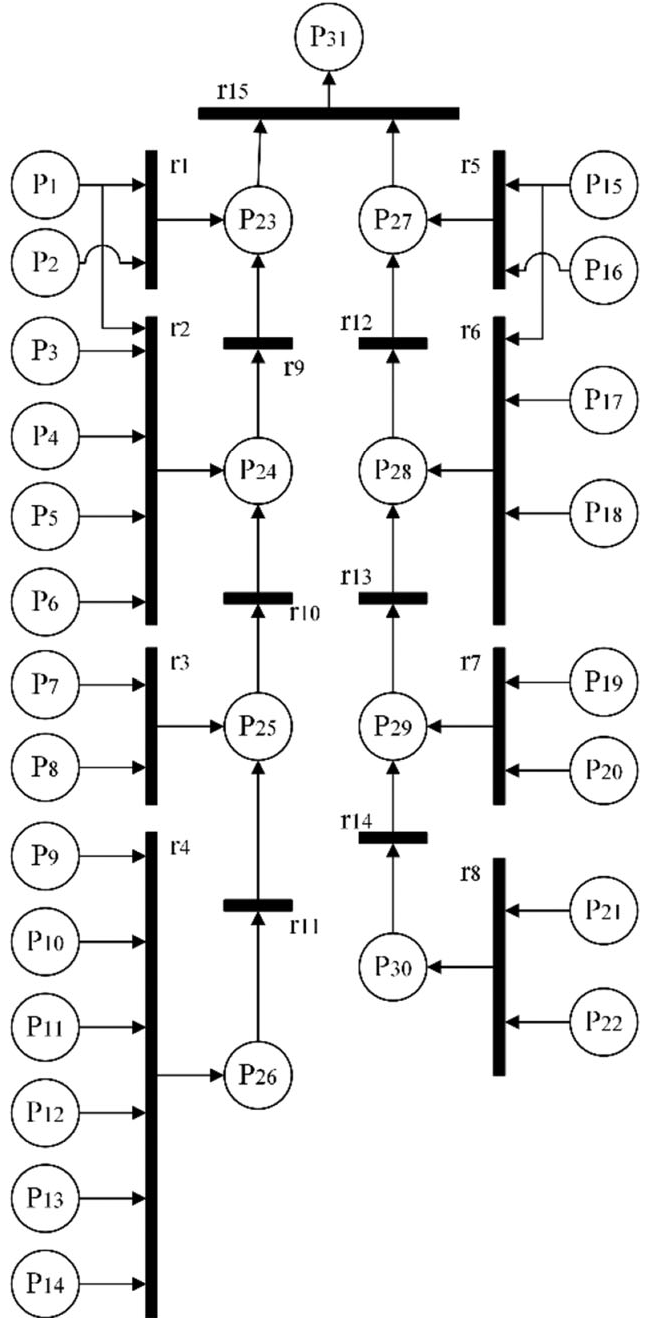 Fig 2: The graphical representation of the L0910 transmission line fault logic, showing the multi-layered reasoning from alarm events to the goal fault hypothesis ().
Comparative Performance
When compared to TRFPNs (Temporal Reasoning), LRPNs (Linguistic Reasoning), and IFPNs (Intuitionistic Fuzzy), the CRPN model provided more granular results. While other models gave a point estimate (e.g., 0.672), CRPNs produced a Probability Distribution Cloud.
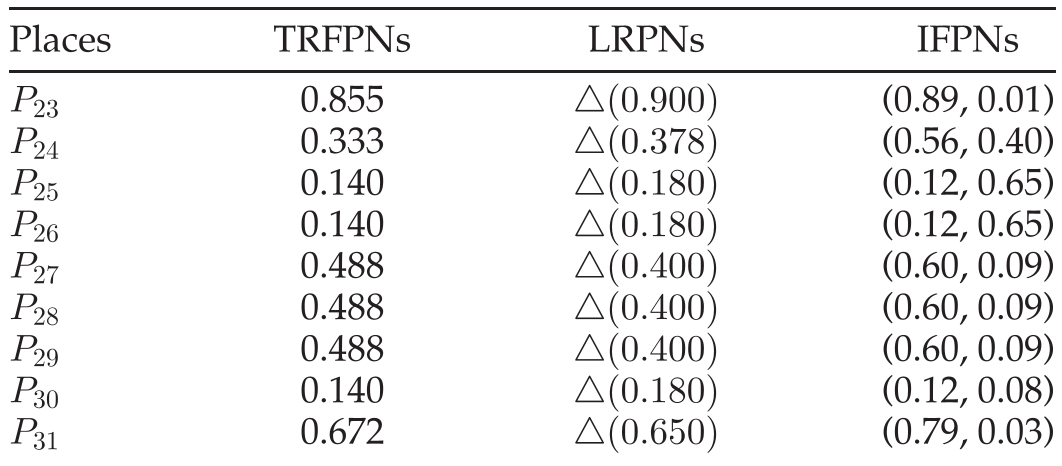 Table 1: CRPN results vs. traditional methods. The CRPN Truth Degree [0.554, 0.763] encompasses the point estimates of previous SOTA, but adds the critical dimension of hyper-entropy (), indicating the reliability of the result itself.
Critical Insight: Why This Matters
The breakthrough here isn't just a higher accuracy score; it's Reasoning Transparency. By utilizing Hyper-entropy, the system can essentially tell the operator: "I think there is a fault on Line 9, but my confidence in this judgment is low because the alarm timestamps are contradictory."
Conclusion & Future Outlook
CRPNs represent a significant step toward "Cognitive AI" in industrial automation. By treating uncertainty as a multi-layered physical property rather than a single error term, we can build expert systems that better mimic human expertise. Future research could look into Dynamic Weight Adjustment, where the CRPN learns to change its local weights in real-time as the grid topology evolves.
Takeaway: If your system operates in a high-noise environment where qualitative expert advice is the primary input, switching from Fuzzy Logic to Cloud Model Theory is no longer optional—it's a necessity for safety.