
Linguistic Agility: How the Surprise Language Exercise Cracked the Data Bottleneck
Linguistic Resource Creation for Research and Technology Development: A Recent Experiment
The paper details the "Surprise Language Exercise" conducted by the Linguistic Data Consortium (LDC) to rapidly create linguistic resources for Natural Language Processing (NLP) in under-studied languages. Using Hindi and Cebuano as case studies, the authors demonstrate how a combination of web-mining, manual annotation, and collaborative infrastructure can build functional data environments for SOTA technologies like Machine Translation and Information Extraction within a one-month timeframe.
TL;DR
The Linguistic Data Consortium (LDC) explores a radical experiment: can we build the entire data infrastructure for a "surprise" language—including lexicons, tagged corpora, and translation models—in just 30 days? By analyzing exercises on Hindi and Cebuano, this paper demonstrates that rapid data curation is possible through collaborative web-mining and standardized annotation pipelines, providing a blueprint for making NLP truly global.
The Motivation: The "Long Tail" of Language
While statistical machine learning has revolutionized NLP, it remains parasitic on massive datasets. For "high-resource" languages like English or Mandarin, data is abundant. However, for the roughly 300 languages spoken by over a million people, the lack of training data—a "data desert"—prevents the deployment of critical technologies like Machine Translation (MT) or Information Extraction (IE).
The authors argue that we shouldn't wait years for academic curation. Instead, they propose a "Surprise Language" model: a high-intensity, month-long sprint to discover, clean, and annotate core resources for any target language as the need arises.
Methodology: The Rapid Resource Pipeline
The experiment moved through three distinct phases of discovery and creation:
1. The Search: Iterative Web Mining
Before a native speaker is even hired, the methodology relies on "seed-word" discovery. By taking common function words (like "this" or "that") and feeding them back into search engines, the team could uncover "hidden" clusters of web text.
- For Cebuano: This technique expanded a measly 10,000-word archive into a 250,000-word corpus in just eight hours.
- The Encoding Nightmare: The Hindi exercise revealed that the biggest obstacle wasn't finding text, but decoding it. Unlike the Latin-based Cebuano (ASCII), Hindi utilized dozens of proprietary 8-bit fonts, requiring the rapid development of custom Unicode converters.
2. The Infrastructure: AGTK and Stand-off Markup
To allow dozens of researchers to work simultaneously, the team utilized the Annotation Graph Toolkit (AGTK).
- Design: The tools were platform-independent and used "stand-off" markup (storing annotations separately from the raw text).
- Insight: This allowed them to distribute tasks globally—where one team could handle sentence alignment while another tackled Named Entity Recognition (NER)—without file-locking conflicts.
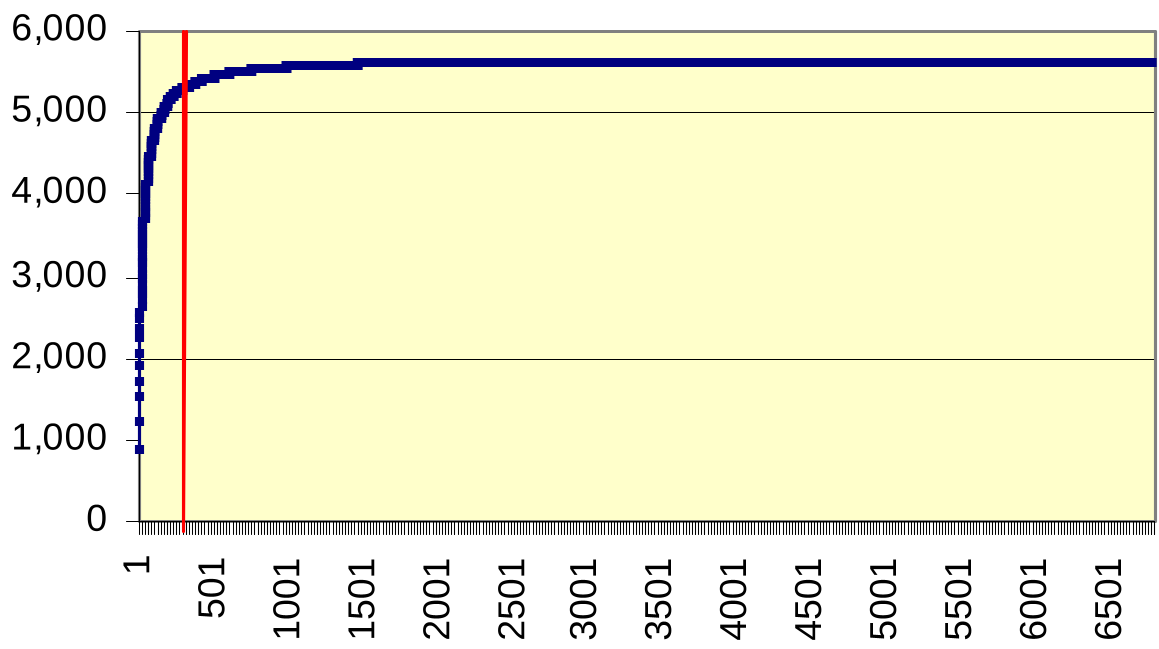 Figure 1: The cumulative distribution of the world's inhabitants by language, justifying the focus on the top 320 "critical" languages.
Results: Hindi vs. Cebuano
The paper highlights a fascinating contrast between two types of "low-resource" challenges:
| Resource | Cebuano (Low Web Vol) | Hindi (High Complexity) |
|---|---|---|
| Monolingual Text | 250K words | >100M words |
| Bilingual Text | 130K words | >5M words |
| Named Entity Data | 10K words | 430K words |
| Morphology | Simple (transducer built in hrs) | Complex (existing tools used) |
Key Achievements:
- Morphological Coverage: For Cebuano, a simple rule-based transducer achieved a 90% parse rate on news text.
- NER Scalability: Even with the encoding hurdles, the Hindi team tagged 430,000 words for Organizations, Persons, and Locations in under a month.
 Figure 2: Summary of resources gathered during the 30-day window.
Critical Analysis & Takeaways
The authors honestly reflect on the "Speed-Quality Trade-off." To hit the 30-day deadline, regular quality assurance—such as double-passing (having two annotators check the same text) and discrepancy resolution—had to be sacrificed. This introduces "noise" into the training data.
Conclusion: A Call for Global Coordination
The LDC concludes that while "rapid porting" works, it shouldn't be the default. They advocate for a Global Linguistic Resource Initiative based on four principles:
- Open shared surveys of current resources.
- Proactive negotiation of IP rights for data distribution.
- Standardization of annotation toolsets.
- Archival indexing to prevent redundant work.
This paper is a seminal reminder that in the world of AI, data is sovereign. By treating linguistic resource creation as an agile engineering problem rather than a slow-motion academic pursuit, we can finally begin to bridge the digital divide for the world's "lesser-studied" languages.