
LEILA: Bridging the Gap Between Linguistics and Statistics in Relation Extraction
Combining linguistic and statistical analysis to extract relations from web documents
The paper introduces LEILA (Learning to Extract Information by Linguistic Analysis), a system designed to extract binary semantic relations from unstructured web documents by combining deep linguistic parsing (Link Grammar) with statistical machine learning (kNN and SVM). LEILA identifies high-quality text patterns by analyzing syntactic structures rather than mere surface text, achieving superior results in extracting relations like birthdate, synonymy, and instanceOf.
TL;DR
Extracting structured knowledge from the chaotic natural language of the web has traditionally been a choice between fragile surface patterns or labor-intensive manual rules. LEILA (Learning to Extract Information by Linguistic Analysis) breaks this dichotomy by utilizing deep syntactic structures (Link Grammars) to train robust statistical classifiers. It outperforms traditional SOTA systems like Snowball and Text2Onto by significant margins, proving that "understanding" the sentence structure is key to reliable information extraction.
Problem & Motivation: The Fragility of Surface Patterns
Most early 2000s relation extraction systems viewed text as a sequence of tokens. They relied on "surface patterns"—fixed strings of words occurring between entities. For example, to find a birthdate, a system might look for [Person] "was born on" [Date].
The issue? Natural language is infinitely flexible. A simple passive voice shift, an intervening adjective, or an appositive phrase would break these patterns. Researchers realized that while the surface words changed, the underlying grammatical relationship remained stable. LEILA was born from the insight that we should match patterns in the syntactic space, not the string space.
Methodology: The Power of Link Grammars
LEILA's core innovation is the use of Link Grammar. Unlike standard constituency trees, Link Grammar provides a graph (a linkage) where words are connected by labeled links signifying their grammatical roles (e.g., subject, object, modifier).
1. The Pattern Bridge
Instead of a string, LEILA defines a "bridge"—the shortest path of links between two entities in a linkage. This bridge captures the semantic essence of the relation regardless of word distance.
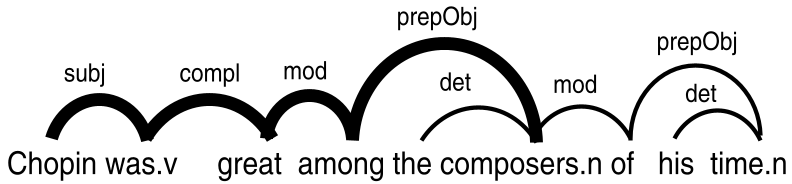 Figure 1: A linkage produced by the Link Parser and a resulting pattern bridge where 'X' and 'Y' are placeholders.
2. The Learning Workflow
LEILA operates in three distinct phases:
- Discovery: It finds sentences containing known examples (e.g., "Chopin" and "1810") and extracts the syntactic bridges as "positive patterns." Pairs that definitely don't fit (counterexamples) form "negative patterns."
- Training: It uses these bridges as features for a classifier. The authors tested both a specialized k-Nearest-Neighbor (kNN) and a Support Vector Machine (SVM).
- Testing: It scans new documents, extracts linkages for all noun pairs, and asks the classifier: "Does this bridge look like a birthdate relation?"
Experiments & Results: Crushing the Baselines
The researchers evaluated LEILA across various corpora, from curated Wikipedia articles to messy Google search results.
Quantifiable Superiority
In the head-to-head comparison with Snowball (a then-leading system), LEILA's precision was nearly triple (90% vs 34%). When tested against Text2Onto for ontology-based relations like instanceOf, LEILA found significantly more correct pairs, leading to an F1 score that was an order of magnitude higher.
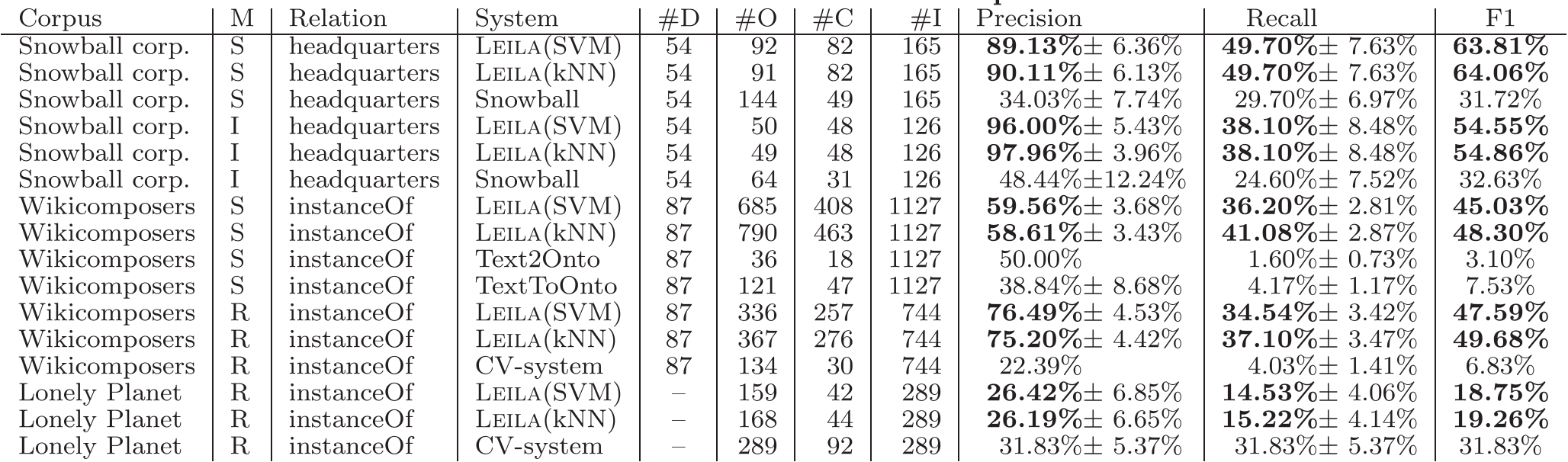 Table 1: Performance comparison showing LEILA's dominance in various contexts.
Critical Analysis & Conclusion
LEILA proved that Deep NLP is not just an academic luxury—it is a functional necessity for high-precision extraction. By mapping syntactic linkages to a vector space for SVMs, the authors successfully married linguistic theory with statistical robustness.
Limitations
- Parsing Overhead: Deep parsing is computationally expensive compared to regex-based surface matching.
- Parser Sensitivity: If the Link Grammar Parser fails to produce a valid linkage for a complex or ungrammatical "web" sentence, LEILA cannot extract the relation.
Takeaway
LEILA remains a landmark study in the transition from pattern-based IE to structure-aware IE. Its success highlights a timeless truth in NLP: understanding the "how" of a sentence (its structure) is often the most reliable path to extracting the "what" (its facts).