
Summarizing the Semantic Web: Leveraging Ontologies for Human-Readable Graph Insights
Linguistic summaries of graph datasets using ontologies: An application to Semantic Web
The paper introduces a novel framework for performing linguistic summarization on graph datasets—specifically the Semantic Web—by leveraging ontological hierarchies. By integrating class taxonomies into the summarization process, the authors enable the generation of human-readable patterns from complex graph data, achieving more generalized insights than traditional relational database methods.
TL;DR
Linguistic summarization turns massive datasets into simple sentences like "Most profitable customers are middle-aged." While well-established for Excel-like tables, this paper finally brings this power to Graph Databases (like the Semantic Web). By using the "family tree" of concepts (Ontologies), the authors' method can automatically "zoom out" from specific data points to find broad, human-understandable trends.
The Problem: Graphs are Richer than Tables
Most data mining tools treat categories as flat lists. In a relational database, if you search for "Artists," you might miss "Painters" or "Sculptors" unless they are explicitly tagged. In the world of the Semantic Web (RDF), data is a web of connections where relationships are transitive: a Poet is a Writer, and a Writer is an Artist.
Existing linguistic summarization fails here because it doesn't understand this hierarchy. It lacks a mechanism to:
- Collect all relevant subjects (all types of Artists).
- Generalize findings (moving from "born in Paris" to "born in Europe").
Methodology: Mining the Taxonomy
The authors propose three fundamental shifts to adapt summarization for graphs:
1. Subject Expansion ()
Instead of just looking at individuals explicitly labeled as the subject class , the algorithm traverses down the ontology tree. If you want to summarize "Artists," the system automatically includes instances of every subclass (e.g., Comedians, Musical Artists, Writers).
2. Summarizer Generalization ()
This is the "Zoom Out" feature. If the data contains many specific attributes (like "Guitarist," "Violinist"), the system looks at their common superclasses in the ontology. It can then generate a summary about "Musicians," a category that might not have been directly mentioned but provides a better "big picture" view.
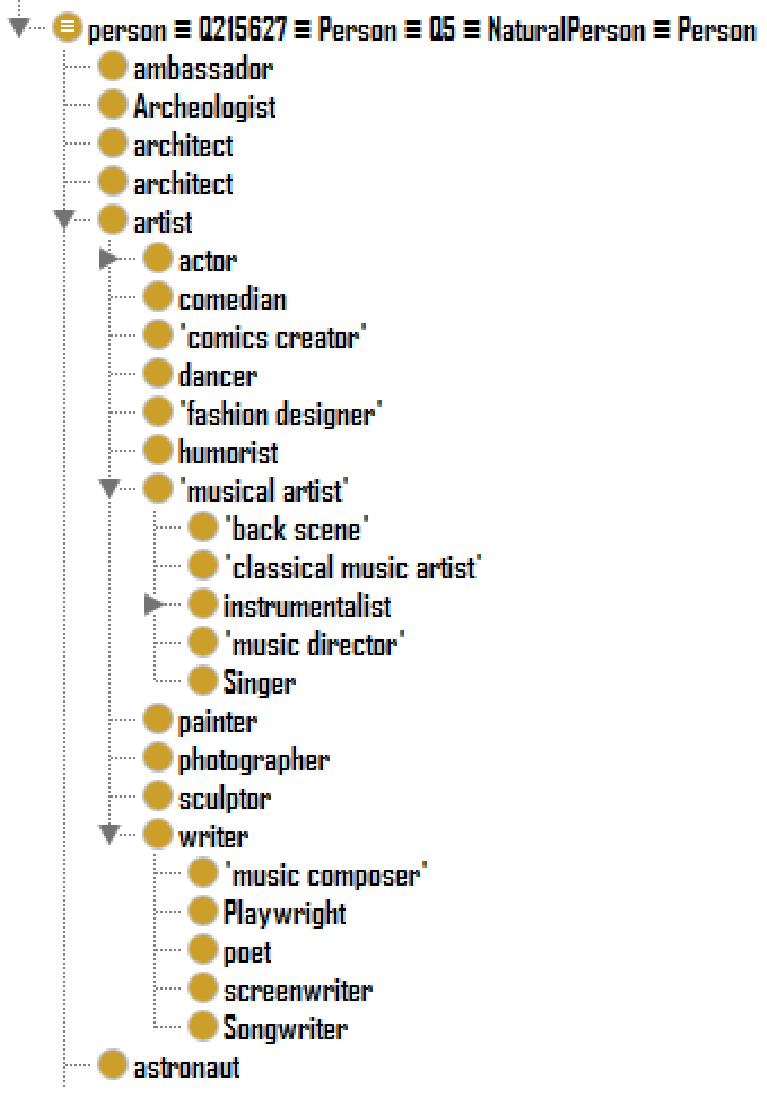 Figure 1: The hierarchical structure of the DBpedia ontology used to expand subjects and summarizers.
3. Ontological Quality Measures
The authors redefined two classic fuzzy logic measures:
- (Truth Degree): Now calculates truth by checking if an object belongs to a class or any of its subclasses.
- (Ontological Imprecision): A new formula that measures how "vague" a summary is based on its position in the tree. Summarizing "People" is more imprecise than summarizing "Abstract Painters."
Experiments: Real-World Knowledge Mining
The researchers tested their approach on DBPedia, the structured version of Wikipedia. They analyzed nearly 100,000 artists.
Key Findings from the experiment:
- Discovery of General Patterns: The system found that "Small number of artists are born in Europe." Interestingly, the value for this was very low (0.11), mathematically confirming that "Europe" is a very broad (imprecise) geographic summarizer.
- High-Accuracy Specifics: It successfully identified that "Almost all artists born in Russia are actors" with a truth value of 1.0.
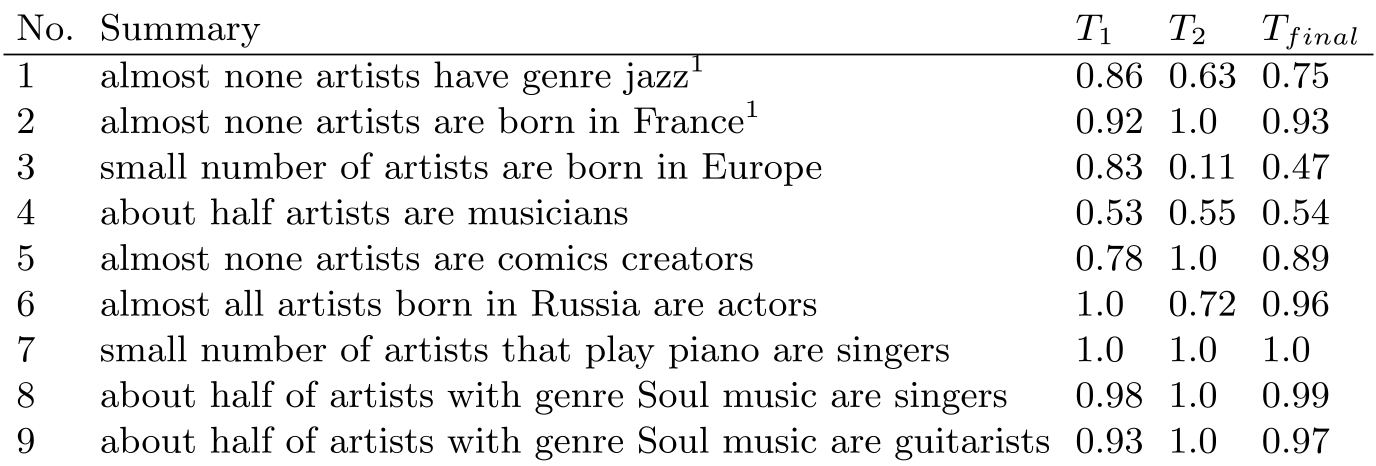 Table 1: Examples of linguistic summaries generated from DBPedia, showing the balance between Truth () and Imprecision ().
Critical Analysis & Conclusion
The value of this research lies in its Inductive Bias—by forcing the summarization algorithm to respect ontological structures, the results become significantly more "human." It moves data mining away from "counting labels" toward "understanding concepts."
Limitations:
- Computational Complexity: Traversing deep ontologies across millions of RDF triples is expensive.
- Compound Summarizers: The current experiment didn't handle complex summaries (e.g., "Artists who are both painters AND born in Europe") due to the sheer number of possible attribute combinations.
Future Outlook: As the "Global Graph" grows, we need ways to talk about data in natural language. This methodology provides the bridge between the rigid logic of ontologies and the flexible nature of human speech. Future iterations could likely incorporate State-of-the-Art (SOTA) Large Language Models (LLMs) to refine the phrasing of these summaries even further.