
Beyond Numbers: Harvesting Human-Centric Knowledge with Type-2 Fuzzy IF-THEN Rules
Linguistic Summarization Using IF–THEN Rules and Interval Type-2 Fuzzy Sets
This paper proposes a linguistic summarization (LS) framework to extract IF–THEN rules from causal databases using both Type-1 and Interval Type-2 Fuzzy Sets (IT2 FSs). It introduces five specific quality measures—truth, sufficient coverage, reliability, outlier, and simplicity—to evaluate and rank discovered rules.
TL;DR
Modern databases are often "data rich but information poor." This paper introduces a framework to transform raw data into human-readable IF-THEN rules (e.g., "If horsepower is large, then MPG is very low"). By employing Interval Type-2 Fuzzy Sets (IT2 FSs), the system accounts for the inherent vagueness in human language, providing a more reliable way to summarize data for decision-making than traditional statistical means.
The "Linguistic" Gap in Data Mining
Standard data mining gives us averages and variances. While mathematically precise, they lack the qualitative "feel" required for expert communication. Earlier attempts at Linguistic Summarization (LS) used Type-1 Fuzzy Sets, but these are limited: they assume a word like "Small" has a single, fixed mathematical definition.
The authors argue that words mean different things to different people (interpersonal uncertainty). To solve this, they move to Interval Type-2 Fuzzy Sets, which represent a word not as a single curve, but as a "Footprint of Uncertainty" (FOU)—effectively a cloud of possible definitions that captures human disagreement.
Methodology: The Five Pillars of Rule Quality
To ensure the generated rules are actually useful, the authors define five Quality Measures (QM). This is a critical departure from prior work that focused almost exclusively on the "Degree of Truth."
- Truth (T): Does the data support the rule?
- Sufficient Coverage (C): Is there enough data to make the rule significant?
- Reliability (R): The intersection of T and C. This is the "Gold Standard" for a good rule.
- Outlier (O): Identifies rules that are technically "true" but only describe a tiny, isolated cluster of data.
- Simplicity (S): Favors rules with fewer antecedents (e.g., "If X, then Z" is better than "If X and Y and W, then Z").
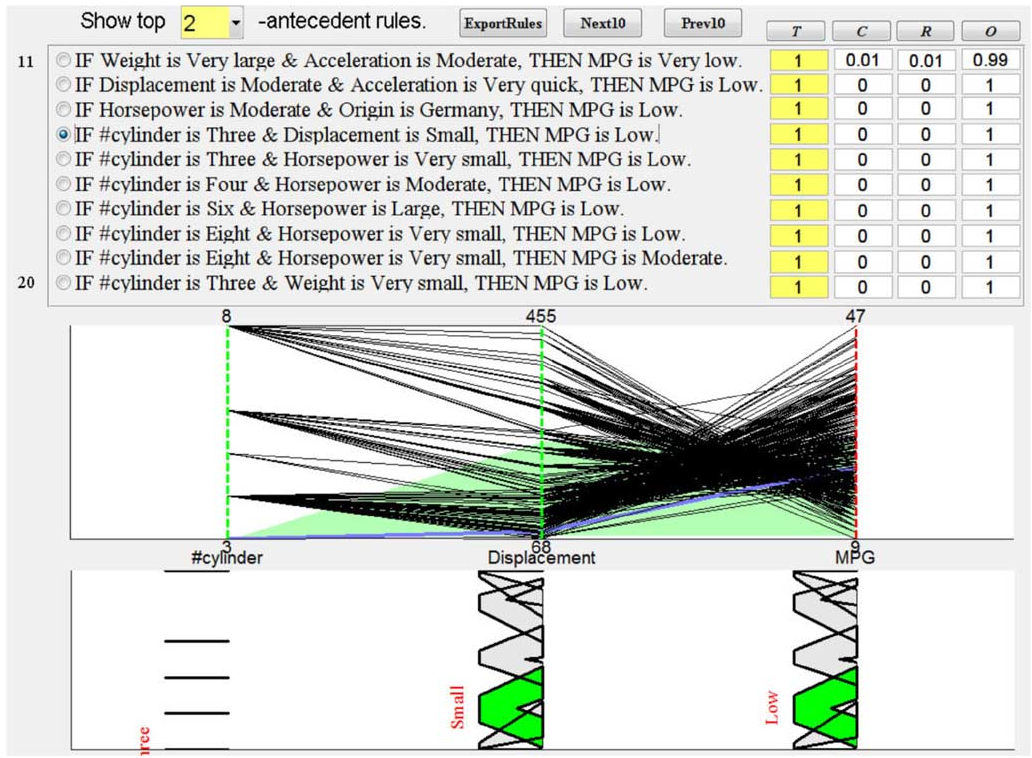 Figure: The framework uses Parallel Coordinates to visualize how data points (curves) flow through linguistic categories, highlighting supports (blue) and violations (red).
Experimental Insight: Reliability vs. Truth
A standout finding in their experiments on the Auto MPG dataset was the danger of relying solely on "Truth." They discovered rules with (perfect truth) that only described a single car (an outlier). By using their new Reliability (R) measure, the system could automatically ignore these "flukes" and focus on rules that represent broad mechanical trends.
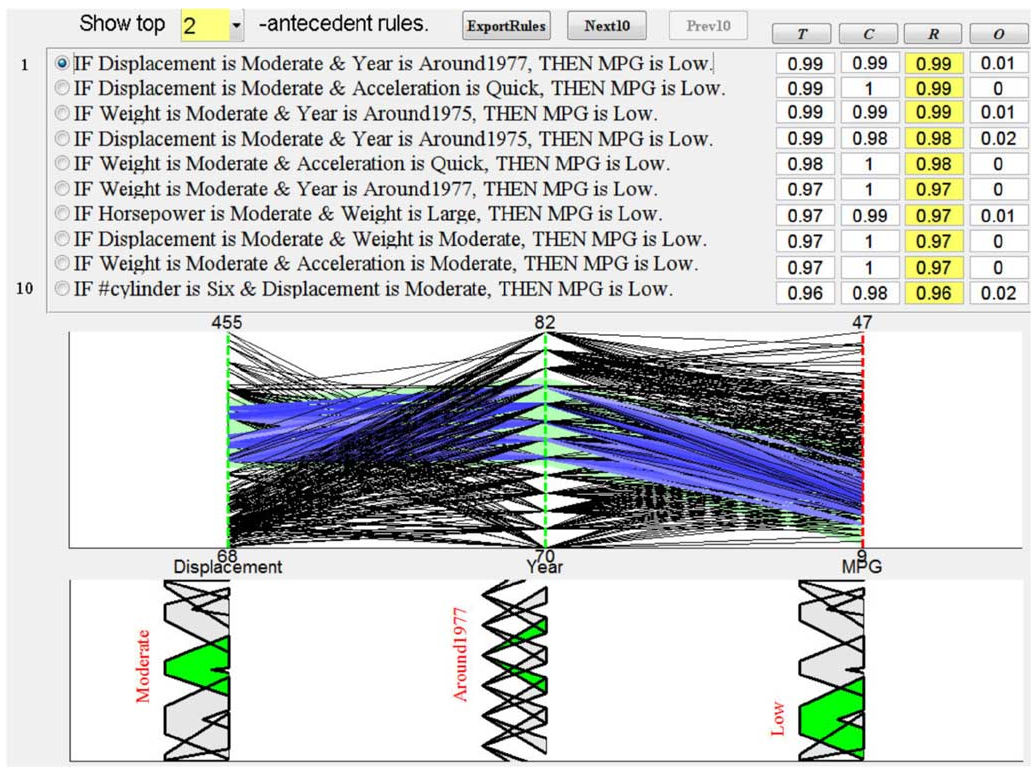 Figure: Global top rules ranked by Reliability (R) consistently show high truth and high coverage, representing the most "trustworthy" knowledge in the dataset.
Why This Matters: From Description to Decision
Most summarization tools are descriptive—they tell you what happened. This framework is prescriptive. Because it outputs IF-THEN rules, the results can be directly plugged into a Perceptual Reasoning engine to make autonomous decisions.
Limitations and Future Work
The current approach uses an exhaustive search, which is computationally expensive for massive datasets with hundreds of variables. The authors suggest that moving toward heuristic search or incremental updates (updating rules as new data arrives) will be the next frontier for scalable human-centric AI.
Takeaway
By modeling the "blurriness" of human language using Type-2 Fuzzy Logic, we can bridge the gap between "Black Box" data mining and transparent, rule-based expert systems. This paper provides the mathematical "eyes" to see patterns in data exactly the way a human expert would describe them.