
Fact or Friend? Decoding Intent in How-To Communities with Semi-Supervised Learning
Leveraging linguistic traits and semi-supervised learning to single out informational content across how-to community question-answering archives
The paper introduces a semi-supervised learning framework to distinguish between informational and non-informational content in how-to Community Question-Answering (cQA) archives. Utilizing linguistic traits such as sentiment and dependency parsing, the authors achieve State-of-the-Art performance in small-label scenarios, significantly improving "best answer" retrieval precision.
TL;DR
Not every "How-to" question on the web is looking for a manual. This paper presents a robust semi-supervised approach to filter informational needles from social haystacks in cQA archives. By combining deep linguistic traits with a Small-Label/Big-Data learning strategy, the authors boost classification accuracy to 84% and significantly enhance the retrieval of "Best Answers."
The "Social vs. Task" Tension in cQA
When a user asks "How do I know I found my soul mate?", they aren't looking for a technical procedure. Conversely, "How to make homemade mayonnaise?" requires a precise, informational response.
The core challenge identified in this research is the confluence of social networking and information seeking. Many current systems treat all procedural questions the same, leading to a "lag" in user satisfaction and poor retrieval of past answers. Existing SOTA methods generally rely on titles alone or require massive labeled datasets, which are expensive and time-consuming to create.
Methodology: The Power of Linguistic Intuition
The authors argue that the intent of a question or answer is encoded in its linguistic DNA. Instead of just looking at keywords (Bag-of-Words), they extract four dimensions of features:
- Sentiment Polarity: Non-informational questions often carry higher subjective or emotional weight.
- Dependency Parsing (DP): The structural depth and complexity of a sentence can signal whether it is providing a detailed instruction or a brief social comment.
- Morphological Traits: The use of coordinating conjunctions or specific verb tenses (3rd person singular) often distinguishes seeking advice from seeking facts.
- Named Entity Recognition (NER): Informational content tends to cite specific locations, dates, or organizations.
Architecture: Semi-Supervised Generalization
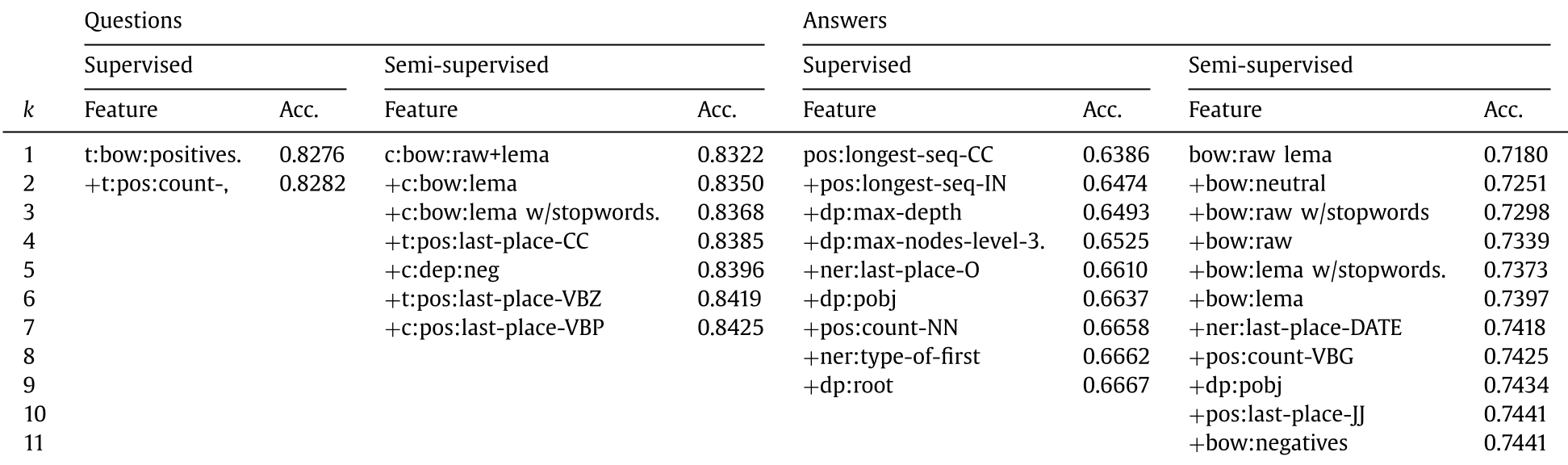
To handle the lack of labeled data, the paper utilizes Deterministic Annealing SVM (SVMLin) and Naive Bayes-EM. These models take a handful of labeled seeds and "propagate" that knowledge across hundreds of thousands of unlabeled documents by looking for similar linguistic clusters.
Experimental Breakthroughs
The results confirm that "more data" isn't just about labels—it's about the unlabeled structure.
- Question Classification: The semi-supervised SVM reached 84.25% accuracy.
- Answer Classification: Achieving 74.41% accuracy, a massive jump compared to traditional supervised methods which struggled with the high variance of answer formats (see ROC curves below).
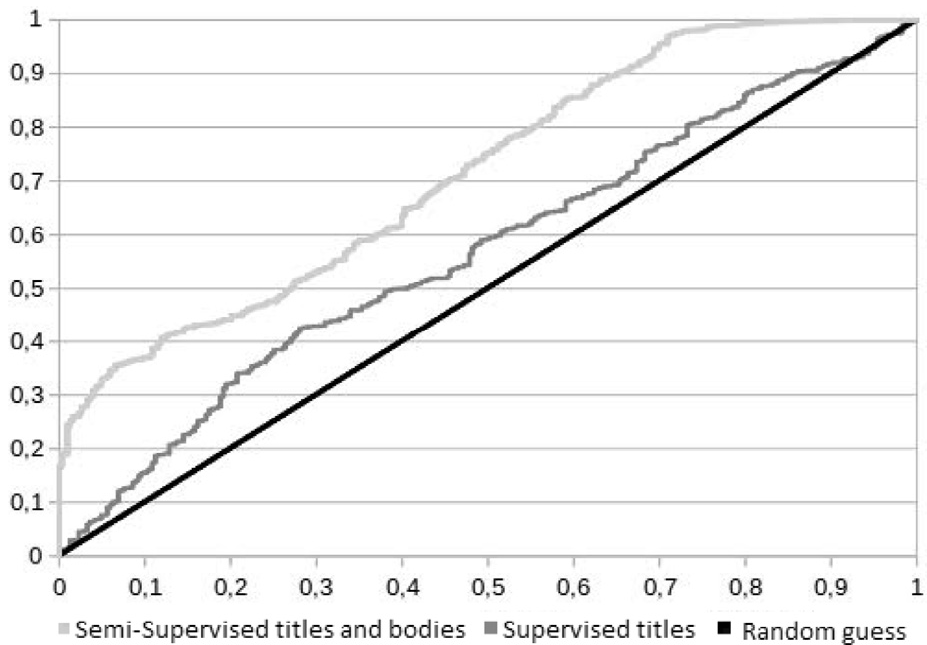 Fig 1 & 2: The Semi-supervised approach (Top curves) consistently dominates supervised baselines across all thresholds.
Improving Retrieval
The real-world value of this classification is seen in Answer Re-ranking. By matching the "Intent" of the new question with the "Intent" of the archived answer:
- Precision@1 increased by 4.12%.
- Irrelevant social chatter was successfully pushed to the bottom of search results, ensuring informational users get "textbook" answers first.
Critical Insight: Why Morphology Matters
The most fascinating takeaway is the role of Sequential Forward Selection (SFS). The analysis showed that in the absence of big data, "Grammar Inferences" (like dependency tree depth) became the critical bridge for the model. For answers, the count of gerunds or present participles was a "smoking gun" for informational content, as these words typically describe the action-oriented steps of a procedure.
Conclusion & Future Look
Palomera and Figueroa prove that even in the age of massive data, linguistic nuance still matters. By using semi-supervised learning, we can build efficient, high-performing systems that respect user intent without the "labeling tax."
Future Directions: The authors suggest that category-specific adaptations (e.g., different rules for "Health" vs. "Consumer Electronics") could further refine these models, especially as NLP moves toward more nuanced human-centric AI.