
The Architecture of Affinity: How Geography and Interests Intertwine in aNobii
Link Creation and Profile Alignment in the aNobii Social Network
This paper investigates the structural and dynamical properties of aNobii, a niche social bookmarking site for book lovers. By analyzing the interplay between network topology and user profiles (libraries, wishlists, and geography), the authors identify a bidirectional causal relationship between user similarity and social link formation.
Executive Summary
TL;DR: Does similarity breed social links, or do social links make us more similar? Analyzing the digital bibliographies of aNobii users, this paper demonstrates that both are true. By mining 697,910 social ties, the authors reveal that geography still anchors our digital "neighborhoods" and that the formation of a social link triggers a measurable, ongoing alignment of personal interests.
Positioning: This work bridges the gap between static graph theory and dynamic social psychology, providing empirical proof of the "feedback loop" between user profiles and network evolution in a specialized niche community.
Problem & Motivation: Beyond the Graph
Most OSN research treats nodes as anonymous points. However, in a platform like aNobii, nodes represent complex readers with libraries (), wishlists (), and physical locations.
The authors identified two distinct types of links in aNobii:
- Friendship: Intended for real-life acquaintances.
- Neighborhood: Intended for "interest" follows based on attractive libraries.
The core mystery: How do these non-reciprocal, directed links emerge? Is it just the "rich get richer" (Preferential Attachment), or is there a deeper "gravity" based on what people read and where they live?
Methodology: Measuring Similarity
The study utilizes Cosine Similarity to quantify how similar two users' libraries are:
This allows the researchers to look past the size of a library and focus on the overlap of tastes.
The Geographic Anchor
Despite being a global platform, the "Social Graph" is actually a collection of national clusters. As seen in the architecture below, the network is fragmented by language and distance.
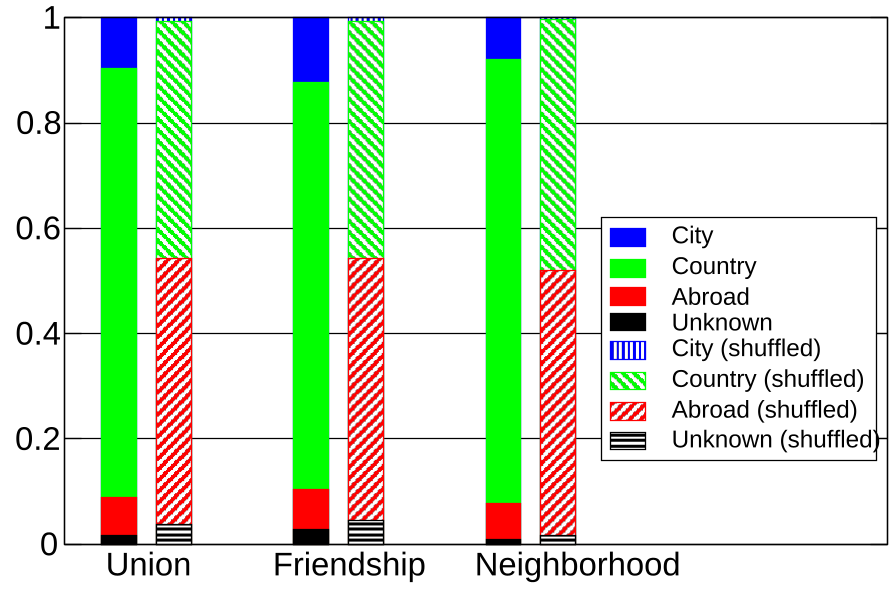 Figure: The aNobii network is split into distinct geographic "islands," primarily Italian and Far-Eastern clusters.
Experiments & Results: The 2-Way Causal Loop
The longitudinal analysis (tracking the network over 2.5 months) yielded two major insights:
1. Similarity Drives Links
When new links are formed between existing users, they aren't random. The users were often "neighbors of neighbors" (Distance d=2) and already possessed higher library similarity than average. This confirms Homophily.
2. Links Drive Similarity
Perhaps the most striking finding is the change in similarity after a link is formed.
 Figure: After link creation, the similarity between users' libraries continues to climb, suggesting users "infect" each other with reading interests.
Key Stats:
- 90% of links are intra-country.
- Friendship links have high reciprocation (0.71), while Neighborhood links are more "one-way" (0.45).
- Triadic Closure (connecting to a friend of a friend) is the dominant engine of growth.
Critical Analysis & Conclusion
Takeaway
The study proves that Online Social Networks are not "flat." Even on a site dedicated to abstract interests (books), our physical location is a massive predictor of whom we connect with. Furthermore, social networks act as alignment engines—once we follow someone, we start becoming like them.
Limitations
- Tagging Data: The authors couldn't analyze tag alignment because aNobii users rarely used the tagging feature.
- Short Window: The 2.5-month monitoring period is a relatively short "snapshot" of a user's entire reading life.
Future Outlook
The findings here are gold for Link Prediction algorithms. Instead of just looking at "who you know," systems should look at "where you are" and "what you've recently read" to predict your next social interaction. This loop of alignment is the fundamental mechanic behind the social internet's power to shape culture.