
LDPA: Stabilizing Community Detection via Link-Density Preference
A Link-Density-Based Algorithm for Finding Communities in Social Networks
The paper introduces Link-Density-based Preferential Attachment (LDPA), a deterministic enhancement of the Label Propagation Algorithm (LPA) for community detection. By utilizing local link density to inform label selection and introducing a fuzzy membership function, the method achieves stable and accurate cluster identification in social networks.
TL;DR
The Label Propagation Algorithm (LPA) is prized for its efficiency but plagued by randomness and instability. This paper introduces LDPA (Link-Density-based Preferential Attachment), which replaces random choices with a "preference" score based on how tightly a neighbor’s own neighborhood is connected. The authors also extend this into a Fuzzy LDPA to detect the overlapping communities typical of real-world human social circles.
The "Random" Crisis in Label Propagation
In the world of graph mining, the Label Propagation Algorithm (LPA) is the equivalent of a rumor spreading through a crowd: every person adopts the opinion held by the majority of their friends. It's fast and intuitive. However, the tragedy of LPA lies in ties. If three friends say "A" and three friends say "B," the algorithm flips a coin.
Across multiple runs, this randomness causes the community boundaries to dance around unpredictably. For researchers, this means the results aren't reproducible. For businesses, it means your "customer segments" might change every time you run the script.
Improving Intuition: The Attraction of Dense Neighborhoods
The authors' core insight is that connectivity is not created equal. A node should be more attracted to a neighbor that belongs to a dense, well-organized group than a neighbor that is loosely connected.
The Methodology
They define the "strength" of a link between node and () as: Where represents the number of internal edges among 's neighbors. This is then normalized to create a preference probability.

By using these weights during the label update phase, the algorithm becomes deterministic. There are no more coins to flip; the math dictates the direction of the "rumor" spread.
From Partitions to Overlaps: Fuzzy Propagation
Social networks are messy. You belong to a "family" community and a "work" community simultaneously. Standard LPA forces a choice; Fuzzy LDPA records a membership degree ().
They use a growth factor to calculate how much a node belongs to a cluster based on the比例 of its neighbors in that cluster:
This allows the algorithm to identify:
- Central Nodes: High membership in one cluster (>0.9).
- Mediator Nodes (Super Nodes): Low membership across multiple clusters, acting as bridges between worlds.
Experimental Validation
The authors tested LDPA across varied datasets, from the small Zachary Karate Club to the massive Facebook anonymized network.
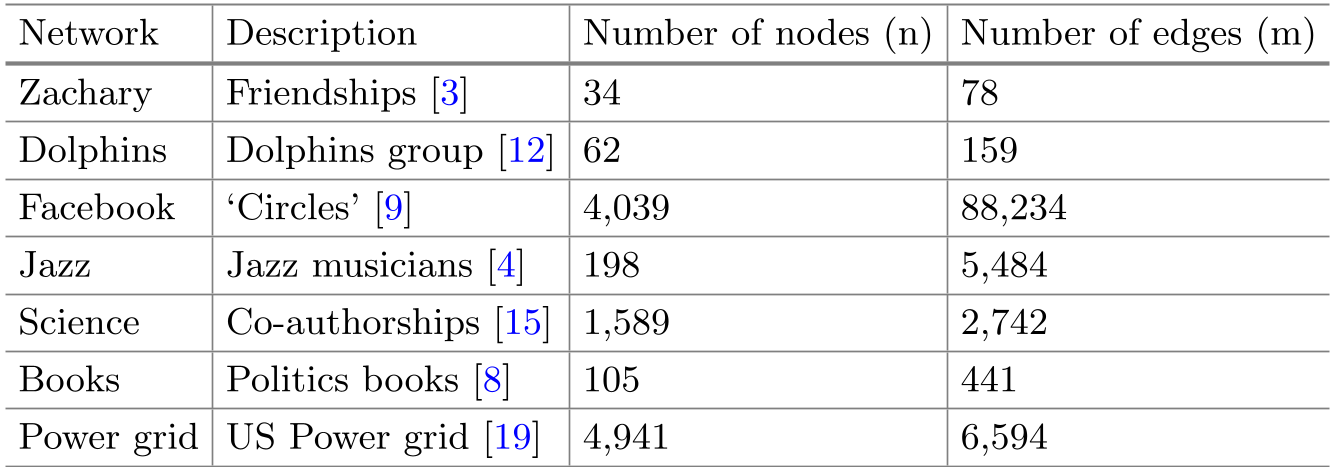
The results revealed a massive breakthrough in stability. In the Zachary dataset, two communities were detected in 94% of all runs. In standard LPA, this number fluctuates wildly.
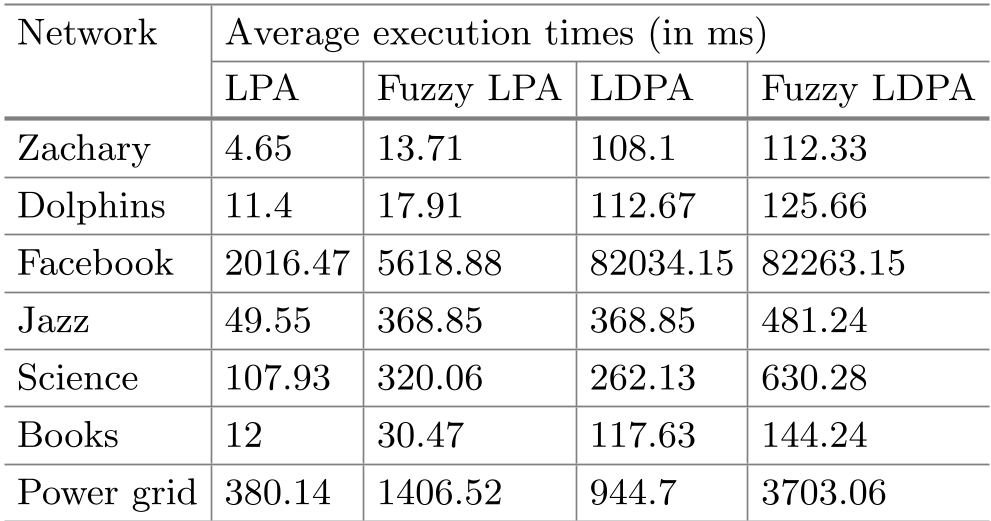
While the execution time is higher than the basic LPA (due to the preprocessing step), it is a small price to pay for a result that doesn't change every time you hit "Run." Furthermore, the authors note that these link-density calculations are highly parallelizable, suggesting even better performance on modern GPU/distributed architectures.
Critical Insight & Conclusion
LDPA successfully addresses the "instability" bottleneck of label propagation without resorting to complex linear algebra or heavy spectral methods.
- The Strength: It is a "parameter-free" logic (for the non-fuzzy version) that relies entirely on the graph's topology.
- The Limitation: In extremely dense graphs where every neighborhood looks similar, the "preference" signal may wash out, leading to trivial solutions.
For practitioners, LDPA offers a robust middle ground: the speed of propagation with the reliability of density-based clustering. It turns simple graph traversals into a sophisticated tool for organizational and social analysis.