
CSLP: Deciphering "Friend or Foe" in Directed Social Networks via Random Walks
Link Mining in Online Social Networks with Directed Negative Relationships
This paper introduces CSLP, a link mining framework specifically designed for directed signed social networks. It leverages an extended Laplacian matrix and random walk theory to predict both the sign (positive/negative) and the direction of unknown relationships, achieving SOTA performance on real-world datasets like Slashdot and Epinions.
TL;DR
Predicting relationships in modern social media is no longer just about "who knows whom." It is about understanding the nuance of trust and distrust. This paper introduces the CSLP method, which masterfully combines Random Walk theory with Collaborative Filtering to predict not just if a link will form, but whether it will be positive or negative, and in which direction it will point.
Background: Beyond Simple Connections
In platforms like Slashdot or Epinions, users can explicitly mark others as "foes." Traditional link prediction (like Jaccard Similarity) treats all links as positive, which is a massive oversimplification. When you factor in direction (I might trust you, but you might not trust me), the mathematical complexity increases because the standard Graph Laplacian—the "skeleton" of most graph algorithms—becomes asymmetric and difficult to process.
The Core Innovation: Solving the Negative Probability Paradox
One of the biggest hurdles in using Random Walks on signed graphs is that the transition probability can be negative if the edge is negative. To solve this, the authors provide a rigorous proof treating these as "intermediary probabilities" where:
- One negative link = Distrust (Negative).
- Two negative links (foe of a foe) = Trust (Positive).
1. The Extended Laplacian Matrix
To handle the directed nature of the networks, the authors define a symmetric, positive semi-definite matrix: By proving this matrix is a legal kernel (satisfying Mercer’s Theorem), they ensure that the resulting commute distances are mathematically valid for measuring node similarity.
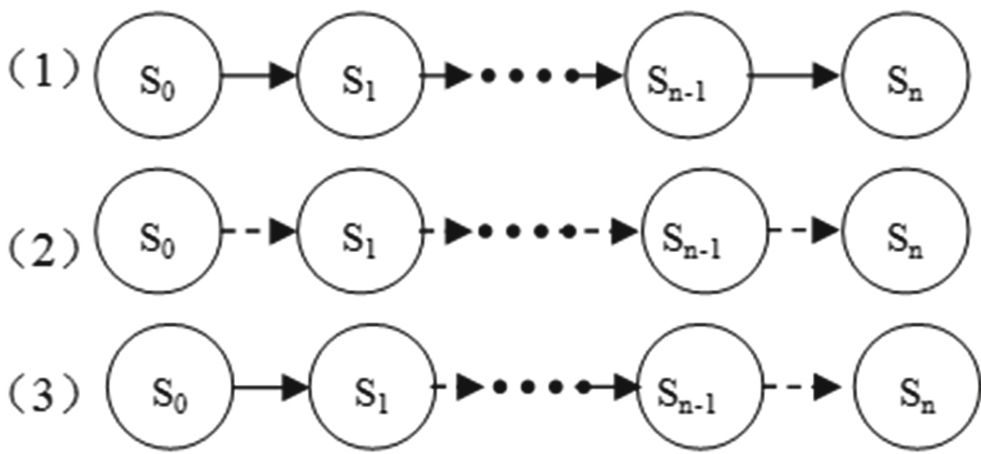 Figure 1: Transition situations in signed networks, illustrating how structural balance theory is encoded into the Markov Chain.
2. Collaborative Recommendation
Instead of a simple threshold, the authors use a collaborative filtering logic. To predict a link from node to , they look at the top- nodes most similar to (based on commute distance) and aggregate their existing attitudes toward .
Experimental Validation
The authors tested CSLP against competitive baselines like LR-ALS (Matrix Factorization) and FriendTNS+.
- Sign Accuracy: CSLP consistently stayed at the top of the curve.
- AUC Performance: In the "Area Under Curve" metric, which measures the ability to rank real missing links above random noise, CSLP showed a clear advantage as the training data increased.
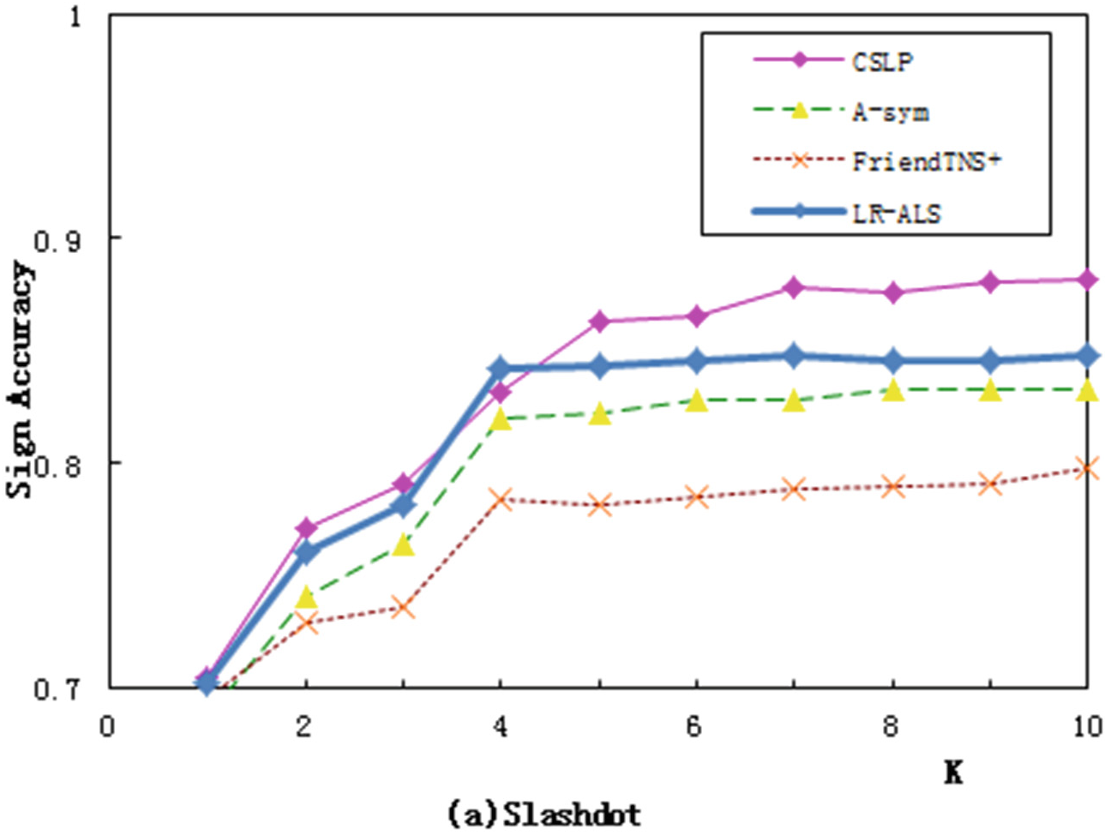 Figure 2: Sign prediction accuracy vs. k-value. CSLP sustains higher performance even as the neighborhood size increases.
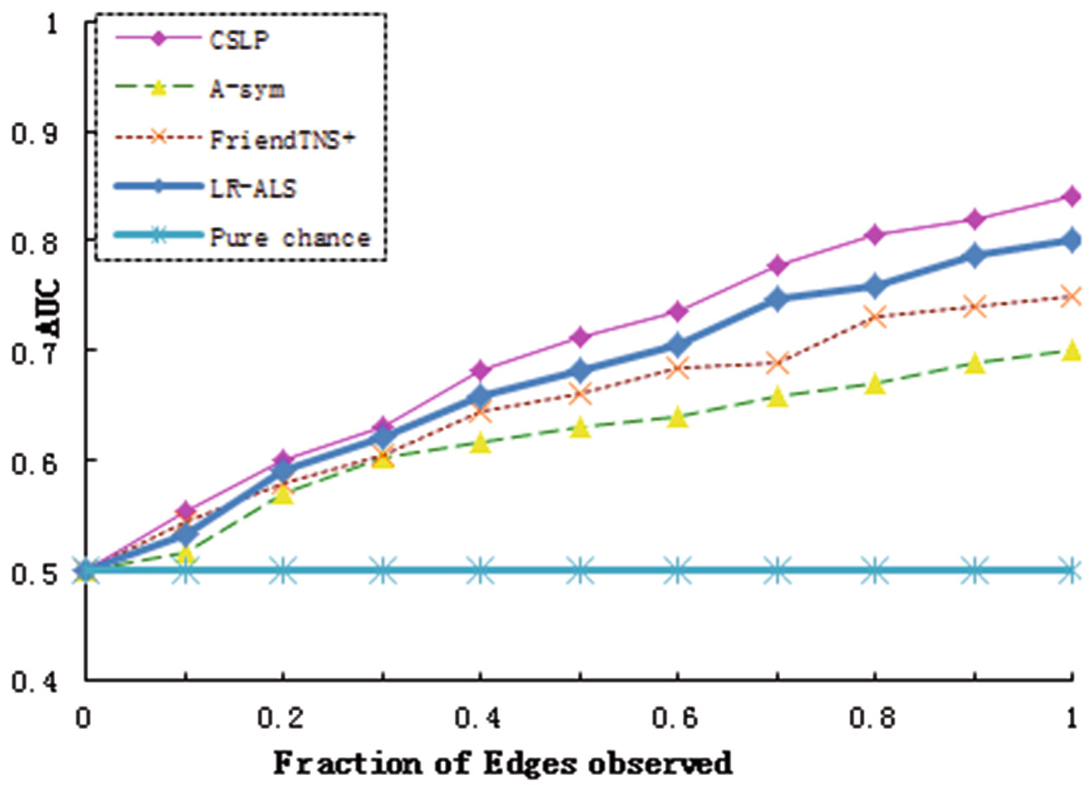 Figure 3: AUC comparison showing CSLP's robust predictive power over pure chance and traditional algorithms.
Critical Insight: Why Does This Work?
The brilliance of this work lies in its Inductive Bias. By using the Laplacian-based commute distance, the model implicitly respects the Social Balance Theory. It doesn't just look at immediate neighbors; it captures the global structural "vibe" of the network. The fact that it maintains high precision (~80%) even when tasked with predicting both direction and sign simultaneously is a testament to the power of the Extended Laplacian.
Conclusion and Future Outlook
CSLP provides a robust mathematical bridge between classical graph theory and modern signed social networks. While the complexity of matrix inversion is a bottleneck for billion-user networks, the authors suggest using SVD (Singular Value Decomposition) to scale.
Future research directions are clear: how do we adapt this for dynamic networks where "friends" become "foes" overnight? For now, CSLP stands as a definitive guide for link mining in the complex world of online social friction.