
Beyond Similarity: Leveraging Structural Holes for Bipartite Link Prediction
Link Prediction for Bipartite Social Networks: The Role of Structural Holes
This paper introduces a novel approach to link prediction in bipartite social networks by leveraging the sociological concept of "Structural Holes." The researchers propose two specific metrics—Absent Links (AL) and Minimum Description Length (MDL)—and demonstrate that these methods significantly outperform traditional neighborhood-based baselines, achieving performance comparable to computationally expensive global methods like the Katz index.
TL;DR
Most link prediction algorithms assume that "friends of friends become friends." This paper challenges that status quo by applying Structural Hole Theory to bipartite networks (like Directors and Actors). Instead of looking for overlap, it looks for non-redundancy. Using two new metrics—Absent Links and MDL—the authors achieved a massive 56% improvement over traditional local methods, matching the accuracy of complex global algorithms with a fraction of the cost.
Problem & Motivation: The "Closure" Trap
In social network analysis, we often obsess over cliques and triadic closure. If Director A works with Actor B and Actor C, we assume B and C are likely to work together. However, sociologists Mark Granovetter and Ronald Burt argued the opposite: the most valuable new links are "Weak Ties" that bridge "Structural Holes."
In a bipartite network (where links only exist between two different sets, like Directors and Actors), traditional neighborhood methods (Jaccard, Adamic/Adar) struggle because they are designed for unipartite graphs. More importantly, they ignore the incentive for a link. If two people already share all the same contacts, a new link between them provides redundant information. The real "social capital" lies in connecting to a community you haven't reached yet.
Methodology: Quantifying the "Hole"
The paper introduces two main ways to measure these structural gaps in a bipartite context:
1. Absent Links (AL)
This metric counts the "missing" links between the neighborhoods of two candidate nodes.
- C-type (Common): Links that could have existed between the shared contacts of a director and actor but don't.
- S-type (Separate): Links between contacts that are unique to each person. The formula, , emphasizes that a lack of connection actually increases the probability of a future link because it represents a "Structural Hole" waiting to be filled.
2. Minimum Description Length (MDL)
If you think of a neighborhood as an adjacency matrix, a highly "redundant" neighborhood is easy to compress (low entropy). A "diverse" neighborhood—one full of structural holes—is more complex and harder to compress. By calculating the bits required to describe the connection matrix, the authors create a parameter-free measure of structural diversity.
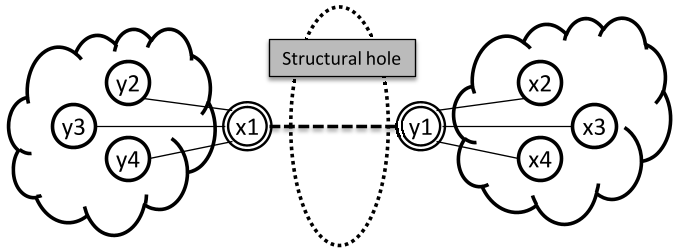 Figure 1: Visualizing the Structural Hole. The gap between neighborhoods Γ(x) and Γ(y) represents potential for information flow.
Experiments & Results: The IMDb Showdown
The authors tested their theory on a real-world dataset from the Internet Movie Database (IMDb), specifically focusing on the Director-Actor bipartite graph.
Key Findings:
- AL Wins Big: The Absent Links method (with a small ) achieved an IAR (Improvement over Random) of 24.505, vastly outperforming the Jaccard Coefficient (6.333).
- Efficiency: While the Katz Index (a global method that looks at every possible path in the network) achieved a similar score of 24.561, it is computationally expensive. The structural hole methods are local, meaning they only look at immediate neighbors, making them much faster for large-scale systems.
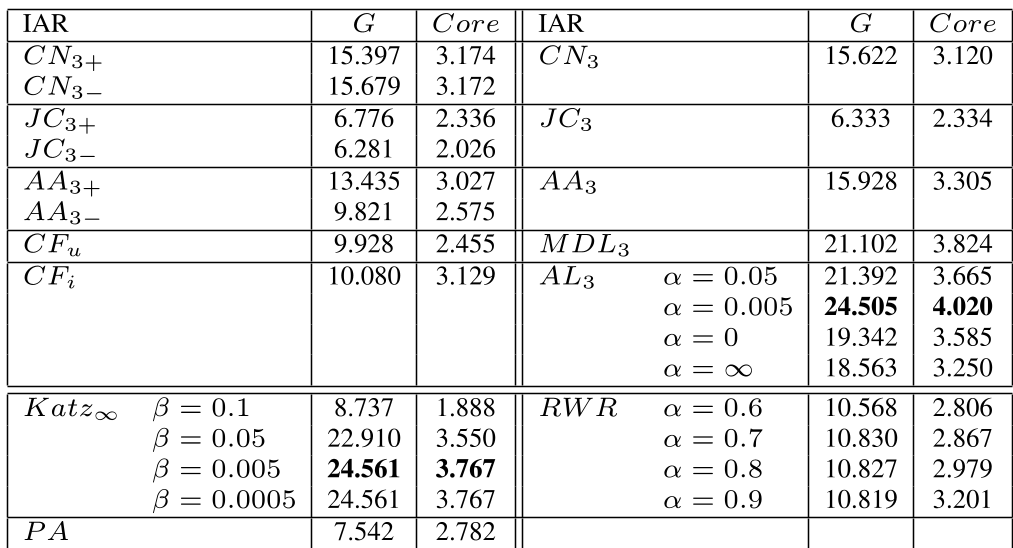 Table 1: Comparing IAR across different methods. Note how AL3 and MDL3 significantly eclipse the standard CN and JC baselines.
Critical Analysis & Conclusion
This work demonstrates that for specific types of social networks—particularly collaborative bipartite ones—the richness of the gap is more important than the density of the connection.
Takeaways for Practitioners:
- Stop only recommending "similar" items: In professional networks, people seek the "Structural Hole" to expand their influence.
- Complexity vs. Performance: You don't always need a global Random Walk or Katz index. Understanding the sociological intuition (like Structural Holes) can help you design local filters that are just as accurate but significantly cheaper to run.
Limitations: The study is currently limited to undirected bipartite graphs. Future research needs to address how "intent" or "weight" (e.g., a director working with an actor 10 times) influences the value of a structural hole.
Future Outlook: As we move toward more complex GNNs (Graph Neural Networks), integrating these "diversity-aware" topological indices could be the key to solving the "filter bubble" problem in recommendation engines.