
Bridging the Gap: How Structural Holes Revolutionize Link Prediction in Bipartite Networks
Link Prediction for Bipartite Social Networks: The Role of Structural Holes
This paper introduces a novel approach to link prediction in bipartite social networks by leveraging the sociological concept of "Structural Holes." It proposes two new mathematical measures—Absent Links (AL) and Minimum Description Length (MDL)—specifically tailored for bipartite structures, achieving state-of-the-art performance on the IMDb director-actor dataset.
TL;DR
In the world of social network analysis, we often assume that "friends of friends" are the most likely to connect. However, this paper argues that the most valuable new links are those that fill Structural Holes—empty spaces between unconnected groups. By introducing two local measures, Absent Links and MDL, the authors significantly outperform traditional Jaccard and Common Neighbor methods, matching the accuracy of expensive global algorithms with much simpler local computations.
Problem & Motivation: The Weakness of Strong Ties
Most traditional link prediction algorithms (Common Neighbors, Adamic/Adar) are built on the principle of homophily: if node and share many neighbors, they are likely to link.
While intuitive, this contradicts the "Weak Ties" theory from sociology. If two people already share the same community, they already have access to the same information. A new link between them adds little value. The authors argue that in collaborative bipartite networks (like Directors and Actors), people seek non-redundancy. The real "social capital" is found in bridging Structural Holes—connecting two disparate clusters that were previously isolated from each other.
Methodology: Quantifying the "Hole"
The paper extends neighborhood-based methods to the bipartite context and introduces two primary structural hole metrics:
1. Absent Links (AL3)
Instead of counting shared connections, AL3 counts the missing connections. It looks at the potential edges that could exist between the neighborhood of a director and an actor but don't.
- c-type absent links: Missing links between nodes on the shortest paths.
- s-type absent links: Missing links between more distant neighbors. The intuition is that a high number of absent links indicates a significant "hole" that a new relationship could profitably fill.
2. Minimum Description Length (MDL3)
This is an information-theoretic approach. It treats the connection matrix between two neighborhoods as data to be compressed.
- If the neighborhoods are highly redundant, the matrix is easy to compress (low entropy).
- If the neighborhoods are diverse and non-redundant, the matrix is harder to compress (high entropy). High MDL scores indicate a structural hole with high diversity, signaling a high probability for a future link.
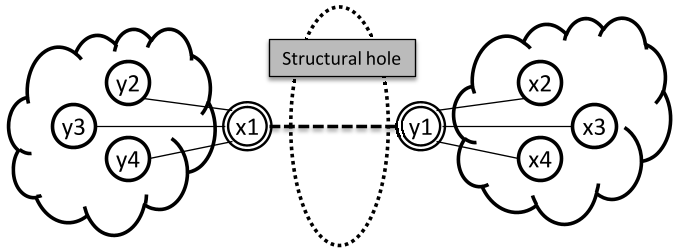 Fig 1: The concept of a structural hole where and bridge non-redundant communities.
Experiments & results
The authors tested their methods on the IMDb Director-Actor network, comparing local neighborhood extensions, collaborative filtering, and global indices (Katz, RWR).
Key Findings:
- Superior Accuracy: The Absent Link method at achieved an IAR of 24.505, outclassing the best neighborhood-based baseline (CN3-) which scored 15.679.
- Efficiency: Despite being local measures, AL3 and MDL3 performed on par with Katz index (), which requires global knowledge of the entire network.
- Bipartite Nuance: The paper proves that simply extending Jaccard Coefficient to bipartite graphs () performs poorly, as it rewards redundancy rather than structural gaps.
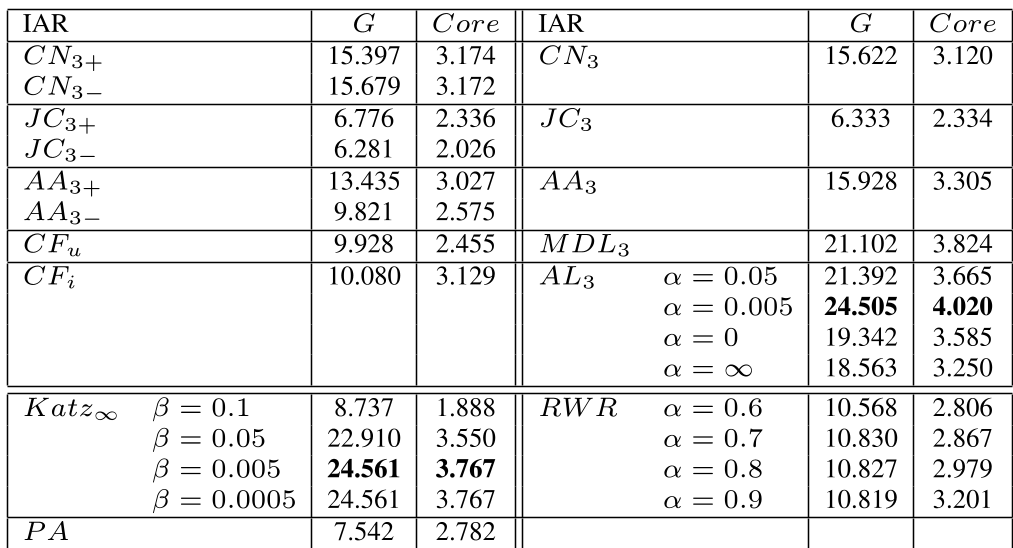 Table 1: Experimental results showing Structural Hole methods (AL3, MDL3) significantly outperforming local baselines.
Critical Analysis & Conclusion
Takeaway
The core contribution of this work is shifting the focus of link prediction from similarity to complementarity. By mathematically defining structural holes through AL and MDL, the authors provide a lightweight yet powerful tool for recommendation engines.
Limitations & Future Work
- Parameter Sensitivity: The AL3 method relies on a parameter to balance different types of absent links. While the paper suggests a low is better, this might vary across datasets.
- Scope: The study is currently limited to undirected bipartite graphs. Real-world applications often involve weights (frequency of collaboration) and directionality, which remain open for future research.
In conclusion, filling a "hole" in the network is often more predictive of future behavior than reinforcing an existing cluster, especially in professional collaborative environments.