
SEAL: Revolutionizing Link Prediction by Learning Heuristics with Graph Neural Networks
Link Prediction Based on Graph Neural Networks
The paper introduces SEAL (Subgraphs, Embeddings, and Attributes for Link prediction), a novel GNN-based framework for link prediction. It achieves state-of-the-art results (SOTA) across multiple datasets, outperforming traditional heuristics and latent feature methods by learning "heuristics" directly from local subgraphs.
TL;DR
Link prediction—predicting missing connections in networks—has long relied on manual "heuristics." This paper introduces SEAL, a framework that replaces these manual rules with a Graph Neural Network (GNN). By proving that local subgraphs contain almost all the information needed even for global heuristics, the authors provide a rigorous foundation for a method that beats traditional heuristics, node embeddings, and matrix factorization by significant margins.
Background & Motivation: Why Manual Rules Fail
In network science, we often assume "friends of friends become friends" (Common Neighbors). But in protein networks, shared neighbors might actually suggest a lower chance of interaction. Traditional heuristics like Katz Index or PageRank are more robust because they look at longer paths (high-order), but calculating them for the whole graph is slow.
The core question the authors ask is: Can we learn a custom heuristic for any specific network automatically without requiring the entire graph?
The "Gamma-Decaying" Theory: The Math Behind the Magic
The paper's breakthrough is the -decaying heuristic theory. Many complex metrics (Katz, SimRank, PageRank) follow a pattern where the influence of a node decays exponentially as the distance increases.
The authors prove that for any such metric, the error of using only an h-hop enclosing subgraph (the local neighborhood around two nodes) instead of the whole graph decreases exponentially with . This justifies why SEAL only needs to look at a small "local" picture to understand "global" relationships.
Methodology: How SEAL Works
The SEAL pipeline consists of three elegant steps:
- Subgraphs Extraction: For any two nodes , it extracts an -hop enclosing subgraph.
- Double-Radius Node Labeling (DRNL): This is crucial. Since GNNs are permutation invariant, they don't naturally know which nodes are the "target" pair. DRNL assigns labels based on a node's distance to both targets, marking their structural roles uniquely.
- GNN Learning (DGCNN): It feeds the labeled subgraph into a Deep Graph Convolutional Neural Network. Unlike previous methods (like WLNM), SEAL can also incorporate latent features (like node2vec) and explicit attributes (like user profiles) directly into the node information matrix.
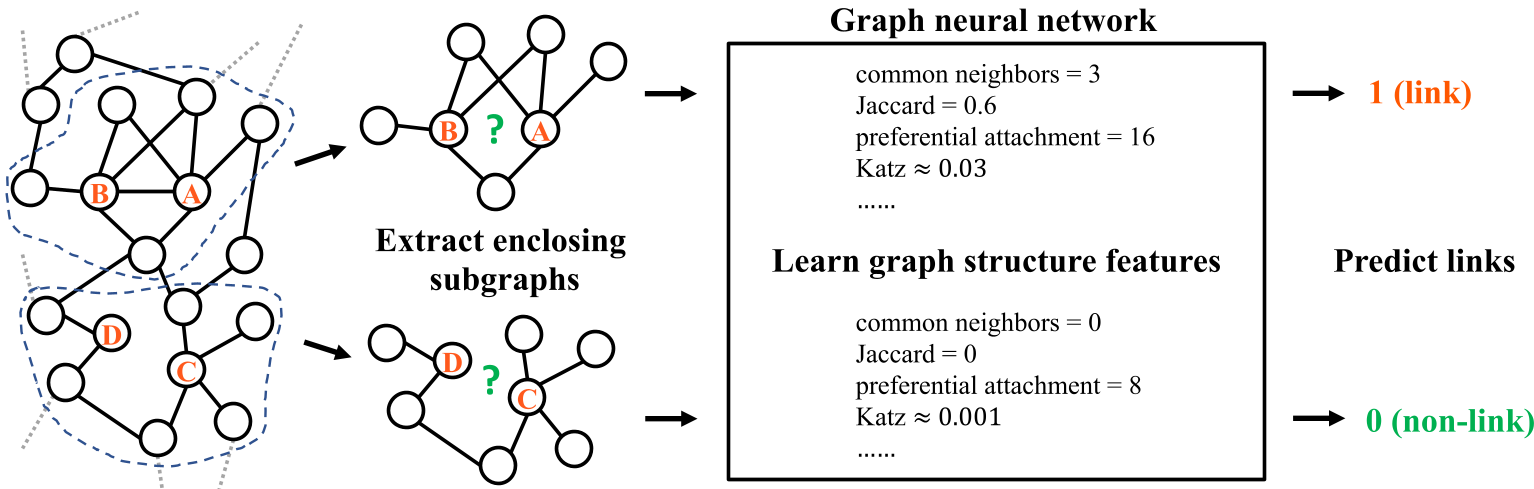 Figure 1: The SEAL architecture extracts local subgraphs and uses GNNs to learn optimal link features.
Experimental Performance
The results are striking. SEAL was tested against 8 heuristics and 6 latent feature methods (including VGAE and node2vec):
- Consistency: On "Power Grid" and "Router" datasets where traditional heuristics perform no better than a coin flip (~50-60% AUC), SEAL hits 87-96% AUC.
- Synergy: By combining graph structure with node embeddings, SEAL often outperforms pure embedding methods by huge margins, proving that local topology is a "missing link" in modern embedding-based prediction.
 Table 1: SEAL outperforms traditional heuristics and previous learning-based models (WLNM, WLK) across almost all datasets.
Deep Insight: Beyond "What" to "Why"
Why does SEAL work better than Node2Vec or Matrix Factorization?
- Inductive vs. Transductive: Latent factors are often "tied" to specific nodes. If the graph changes, you must retrain. SEAL learns structural patterns (e.g., "if two nodes share a triangle with specific properties..."), which are transferable and more robust to sparse data.
- Explicit Distance Awareness: The DRNL labeling provides the GNN with a coordinate system relative to the target link, allowing the neural kernels to act as "learned similarity functions."
Conclusion & Future Outlook
SEAL marks a shift from prescribing how nodes should link to learning how they link. Its ability to scale (predicting millions of links in under an hour) and its theoretical grounding in the -decaying theory make it a gold standard for link prediction. Future work could likely see this applied to Knowledge Graphs or Recommender Systems, where the "local subgraph" intuition is equally powerful.
Limitations: While is often enough, in very dense "hub" networks, even a 2-hop subgraph can grow too large, suggesting a need for intelligent neighbor sampling in future iterations.