
Better Link Prediction in Heterogeneous Networks: A Multi-Task Metric Learning Approach
Link prediction in heterogeneous social networks
The paper introduces a novel framework for link prediction in heterogeneous social networks by reformulating it as a Multi-Task Metric Learning (MTML) problem. The proposed method learns coupled distance measures for multiple relationship types simultaneously, achieving SOTA performance on Flickr and DBLP datasets.
TL;DR
Predicting links in social networks isn't just about who knows whom; it's about understanding the diverse types of interactions (e.g., following a user vs. joining a group). This paper proposes a unified framework that treats link prediction as a Multi-Task Metric Learning (MTML) problem. By learning task-specific distance measures and their correlations while filtering out "noise" features, the authors achieve nearly a 10% improvement over previous state-of-the-art methods like MRIP.
The Problem: The Complexity of Heterogeneity
Most real-world social networks are heterogeneous—they contain different types of nodes (users, groups, images) and edges (friendship, membership, tagging).
Existing approaches often fall into two traps:
- Oversimplification: Treating all links the same (ignoring heterogeneity).
- Isolation: Modeling different link types separately, which ignores the fact that joining a specific photo group might be a strong indicator of a future "friend" link.
Furthermore, social networks are messy. They contain non-informative features (noisy metadata) and non-stationary degree distributions (some nodes are "super-connectors" while others are niche), both of which break standard metric learning models.
Methodology: The "Combined Approach"
The authors build upon Structure Preserving Metric Learning (SPML), which learns a Mahalanobis distance metric such that the network's actual links are preserved in the feature space.
1. Robustness via Mixed-Norms
To handle noisy features, they introduce an mixed-norm penalty. This encourages "row-sparsity" in the learned metric matrix, effectively zeroing out the influence of dimensions that don't contribute to predicting links.
2. Learning the Task Covariance
Instead of assuming all tasks (link types) are equally related, the model learns a Task Covariance Matrix (). This allows the model to discover that, for instance, "user-user" links and "user-group" links might share similar underlying feature triggers, while "group-image" links may be distinct.
3. Degree Distribution Awareness
The model incorporates a degree preference function. This accounts for the physical reality that some entities (like a "Nature Photography" group) naturally have thousands of links, whereas individual users have far fewer.
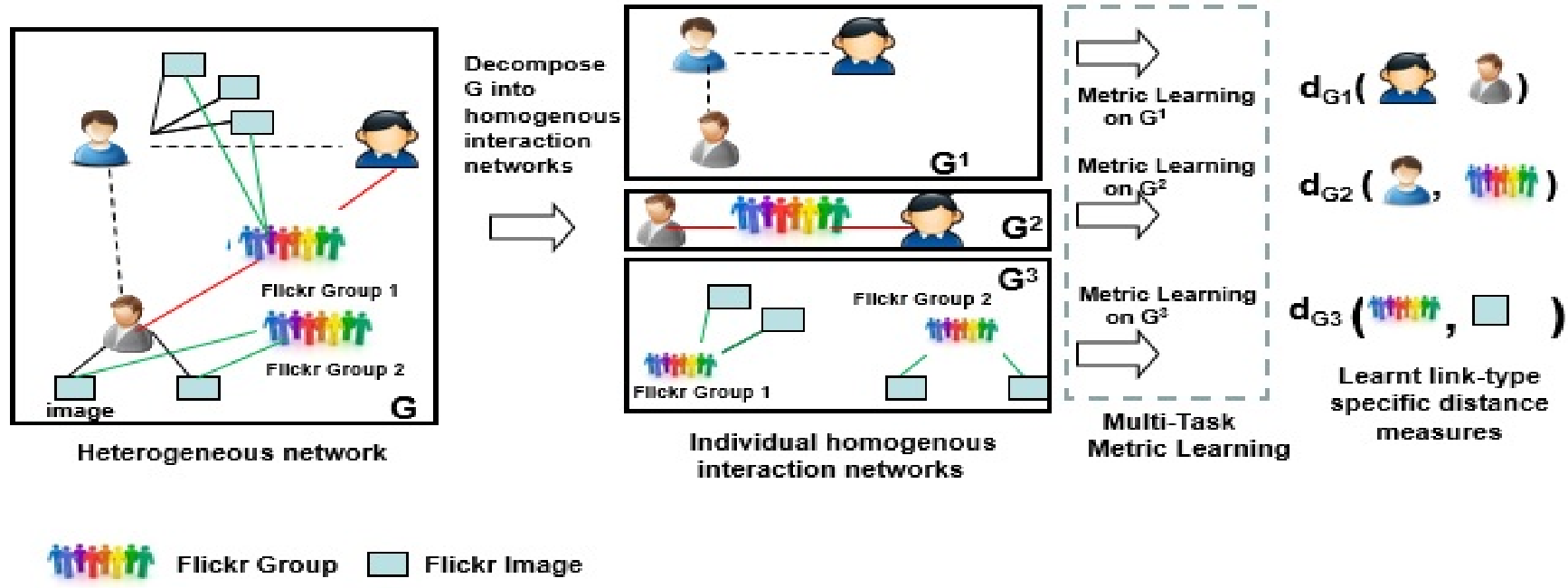 Figure 1: The workflow—Decomposing the heterogeneous network into single-type interaction networks and jointly learning metrics.
Experiments & Results
The authors tested their framework on two massive, real-world datasets: Flickr and DBLP.
SOTA Comparison
In every category, the "Combined Approach" outperformed baseline methods like MT-SVM and MRIP.
- Flickr Gain: +10.3% average AUC improvement.
- DBLP Gain: +9% average AUC improvement.
 Table 1: AUROC results on Flickr dataset showing the "Combined Approach" leading across all link types.
Ablation Insights
The research found that Robust-MT-SPML was particularly effective on Flickr, where tags are notoriously noisy. On the other hand, the Covariance modeling was more beneficial for DBLP, suggesting that academic citation and collaboration patterns have more structured correlations than social media tagging.
Critical Analysis & Conclusion
Takeaway
The core philosophy of this work is that link prediction is a structural ranking problem. By optimizing the distance metrics directly to satisfy neighborhood constraints across multiple tasks, the model captures the "latent physics" of the network more accurately than a simple classifier.
Limitations & Future Work
While powerful, the current ADMM optimization can be computationally intensive for networks with millions of link types. The authors suggest that moving to a Map-Reduce (distributed) implementation is the next logical step for production-scale deployment.
This paper provides a robust blueprint for any researcher working on recommendation systems or knowledge graph completion where multiple interaction types are at play.