
MINTP: Bridging the Gap Between Disparate Social Networks via Structural Signatures
Link Prediction Across Multiple Social Networks
This paper introduces the Inter-Network Link Prediction (INLP) problem, focusing on predicting ties in one social network using structural and attribute data from another. The authors propose the MINTP algorithm, which leverages the Multi-Theoretical Multi-Level (MTML) framework to achieve superior prediction accuracy across diverse MMORPG networks.
TL;DR
Predicting who will connect with whom is a staple of network science, but what if you have to predict links in a network where you have no prior edge data? This paper defines Inter-Network Link Prediction (INLP) and introduces MINTP, an algorithm that uses social science theories (MTML) to "translate" interactions from one social context (e.g., a housing trust network) to another (e.g., a professional mentoring network).
The "Silo" Problem in Link Prediction
Most link prediction research operates under a localized assumption: to predict future links in Network A, you analyze the past state of Network A. In reality, human sociality is multi-layered. We might trade with people we met through a hobby or mentor people within our guild.
The challenge is that these networks often have low adjacency correlation. Even if the same people (nodes) exist in two networks, the way they form ties is drastically different. The authors found that while there is high node overlap between trade and mentoring networks in the game EverQuest II, the actual link correlation is nearly zero. Traditional topological metrics fail here because they expect similar connectivity patterns across domains.
Methodology: The MTML Power-Up
The core insight of this paper is that while raw topology changes, the underlying social drivers remain predictable. The authors utilize the Multi-Theoretical Multi-Level (MTML) Framework, which categorizes social behavior into archetypes like:
- Bonding: Driven by Homophily and Balance (forming triangles).
- Exploiting: Driven by Exchange and Self-interest.
- Swarming: Driven by Proximity and Cognition.
Each of these theories predicts specific "Structural Signatures" (subgraphs). The MINTP (MTML Inter NeTwork Predictor) algorithm works by:
- Identifying existing signatures in the "Source" network.
- Applying conditional probabilities based on social theories to predict if those nodes will form a specific type of link in the "Target" network.
- Iteratively "rewiring" the predicted graph until it aligns with theoretically expected distributions.
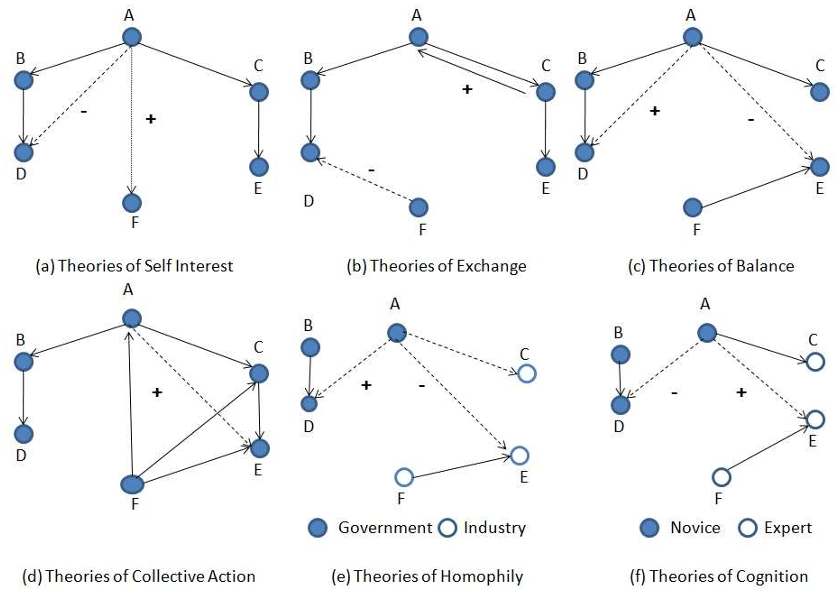 Figure 1: Archetypal subgraphs (signatures) predicted by various social theories.
Experiments: Virtual Worlds, Real Results
The authors tested their approach using millions of logs from the MMORPG EverQuest II, focusing on three distinct networks: Housing-Trust, Mentoring, and Trade.
Quantitative Edge
The performance gains were most notable in sparse/difficult prediction tasks. For example, when predicting the Housing network from the Mentoring network:
- MINTP F-Score: 0.472
- Baseline (KNN) F-Score: 0.144
- Baseline (J48) F-Score: 0.404
The only case where standard ML models stayed competitive was the Trade Network, simply because it was so dense (1.7M+ edges) that standard proximity features became highly informative regardless of theoretical grounding.
 Table 1: The vast difference in density between Mentoring (M), Housing (H), and Trade (T) networks.
Critical Insight: Why Theoretical Signatures Matter
Traditional link prediction (like Jaccard or Adamic-Adar) is essentially "blind" curve fitting. It assumes the geometry of the graph is all that matters. MINTP introduces Social Semantics. If Theory A (Exchange) explains the Trade network, and Theory B (Balance) explains the Housing network, MINTP uses the transformation between these theories to predict edges. It bridges the gap between what the graph looks like and why the links are forming.
Conclusion & Future Directions
This work highlights that link prediction isn't just a math problem—it's a sociological one. By treating disparate networks as shadows of the same underlying human behavior, we can predict relationships across the digital divide.
Future Outlook: The next step for this research involves integrating these MTML signatures into Graph Embedding techniques (like Node2Vec or GraphSAGE), potentially allowing deep learning models to learn these "social rules" automatically from multi-layer network data.