
Beyond Simple Hubs: Leveraging Multi-Group Memberships for Superior Link Prediction
Link Prediction in Online Social Networks Using Group Information
The paper introduces three novel link prediction measures—WOCG, CNG, and TPOG—that leverage multi-group membership information in online social networks (OSNs). By accounting for users belonging to multiple communities simultaneously, the authors achieve superior performance over state-of-the-art local structural measures in both unsupervised and supervised learning contexts.
TL;DR
This research tackles the link prediction problem—predicting future friendships in social networks—by looking at the groups users join. Unlike previous models that assume you only belong to one "tribe," this work introduces three new metrics (WOCG, CNG, TPOG) that embrace the reality of overlapping community memberships. Testing on millions of nodes from Orkut and Flickr, the authors prove that knowing which diverse circles you share with a friend is a better predictor of a "link" than just counting mutual friends.
Problem & Motivation: The "Single-Community" Fallacy
Most link prediction algorithms rely on local topology (e.g., "If Alice and Bob share many friends, they might become friends"). While hybrid methods have tried to incorporate community structure, they often fall into the trap of hard clustering: assuming a user belongs to exactly one group.
In reality, a user on Flickr might belong to a "Black and White Photography" group, a "Street Art" group, and a "Travelers in Brazil" group simultaneously. If two users share friends across several of these distinct niches, the probability of them connecting is significantly higher. The authors argue that the multi-group intersection is a goldmine of latent social signals that current state-of-the-art (SOTA) methods like Adamic-Adar (AA) miss.
Methodology: The Logic of Group Overlapping
The authors propose three specific measures based on Bayesian Likelihood Ratios:
- WOCG (Common Neighbors Within and Outside of Common Groups): It calculates the ratio of mutual friends who are in the same groups as the target pair versus those who are not.
- CNG (Common Neighbors of Groups): It expands the definition of "neighborhood" to include nodes that belong to at least one group shared by the target pair.
- TPOG (Total and Partial Overlapping of Groups): Perhaps the most sophisticated, it distinguishes between "Total Overlapping" (neighbors in groups shared by both users) and "Partial Overlapping" (neighbors in groups shared by only one) to refine the connection probability.
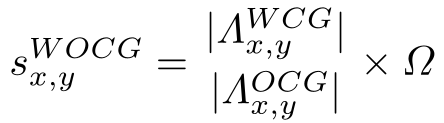 The WOCG score calculation: A Bayesian approach to weighting common neighbors based on group context.
Experiments & Results: Dominating the AUC Rankings
The researchers tested their measures on four massive datasets: Flickr, LiveJournal, Orkut, and Youtube.
Unsupervised Performance
Using the AUC (Area Under the ROC Curve) metric, the new measures (TPOG and CNG) consistently outperformed traditional metrics like Jaccard Coefficient and Preferential Attachment.
 Table showing that TPOG (rank 2.5) and CNG (rank 3.0) are the top performers across varied social networks.
Supervised Learning Integration
The authors didn't stop at scores; they used these measures as features for machine learning classifiers (J48, Naive Bayes, SMO). The results showed that VTotal (a feature set combining local structural measures and the new group-based measures) provided the best overall Accuracy and F-Measure. This proves that group-based info isn't just a replacement for local data—it's a powerful complement.
Academic Insight: Why did Youtube behave differently?
One fascinating result was that the performance of group-based measures dipped on Youtube. The authors observed that Youtube has a negative assortativity coefficient and low group clustering. In simpler terms: Youtube "groups" are weak and users often connect with people who share very few interests/neighbors. This highlights a critical boundary condition: Group-based prediction works best in "pure" social networks (like Orkut) where groups are dense and meaningful, but less so in "interest-brokering" platforms.
Summary & Critical Analysis
Takeaway
The core contribution is the shift from "who you know" to "where you hang out together." By utilizing natural group information (i.e., groups users voluntarily join), we can bypass the high computational cost of running community detection algorithms on billions of links.
Limitations
- Cold Start: These measures still rely on nodes having existing group memberships. They wouldn't help for a brand-new user who hasn't joined any circles yet.
- Group Quality: As seen in the Youtube case, the utility of this method is heavily dependent on how the platform defines and manages "groups."
Future Outlook
Future research could look into Temporal Group Dynamics—predicting links based on when a user joins a group—providing a more "real-time" recommendation experience.