
USMDM: Reimagining Social Link Prediction as a Matrix Denoising Problem
Link Prediction in Online Social Networks Based on the Unsupervised Marginalized Denoising Model
This paper introduces the Unsupervised Marginalized Denoising Model (USMDM) for link prediction in online social networks. By treating link prediction as a matrix denoising problem, USMDM maps an incomplete observed network matrix to an ideal "all links" target matrix using local and global topological features.
TL;DR
Predicting who will connect next in a massive social network is traditionally a game of calculating similarities. This paper proposes a paradigm shift: USMDM (Unsupervised Marginalized Denoising Model). By treating an existing social network as a "corrupted" version of a perfect, fully-connected network, the author uses matrix denoising and low-rank approximations to reconstruct missing links with unprecedented accuracy (AUC > 0.98).
Background: The Limits of Traditional Similarity
Most social network algorithms rely on Homophily (people with similar interests connect) or Stochastic Equivalence (people with similar structural roles connect). However, existing tools like Common Neighbors (CN) or Adamic-Adar (AA) are often "short-sighted"—they see the immediate neighbors but miss the global architectural patterns of the network. Furthermore, user-provided data is often noisy or incomplete.
The Core Insight: The Denoising Intuition
The author views the current state of Facebook or Twitter not as a final product, but as a "noisy" or "incomplete" dataset.
- The "Corruption" Logic: If we randomly hide some existing links (corrupting the data) and then train a model to "recover" those hidden links, the resulting mapping function should theoretically be able to "recover" links that haven't even been formed yet.
- The Mapping Function: The model learns a function that projects the observed sparse matrix onto an ideal matrix .
Methodology: Local Affinity meets Global Topology
The secret sauce of USMDM lies in how it reconstructs the matrix using two distinct lenses:
- Local Affinity (Matrix W): Captures the "friend of a friend" logic.
- Global Affinity (Matrix C): Captures complex, non-linear relationships and block patterns across the entire network.
To prevent the model from exploding in computational complexity (), the author employs Low-Rank Approximation. Instead of learning massive matrices, the model learns smaller latent vectors.
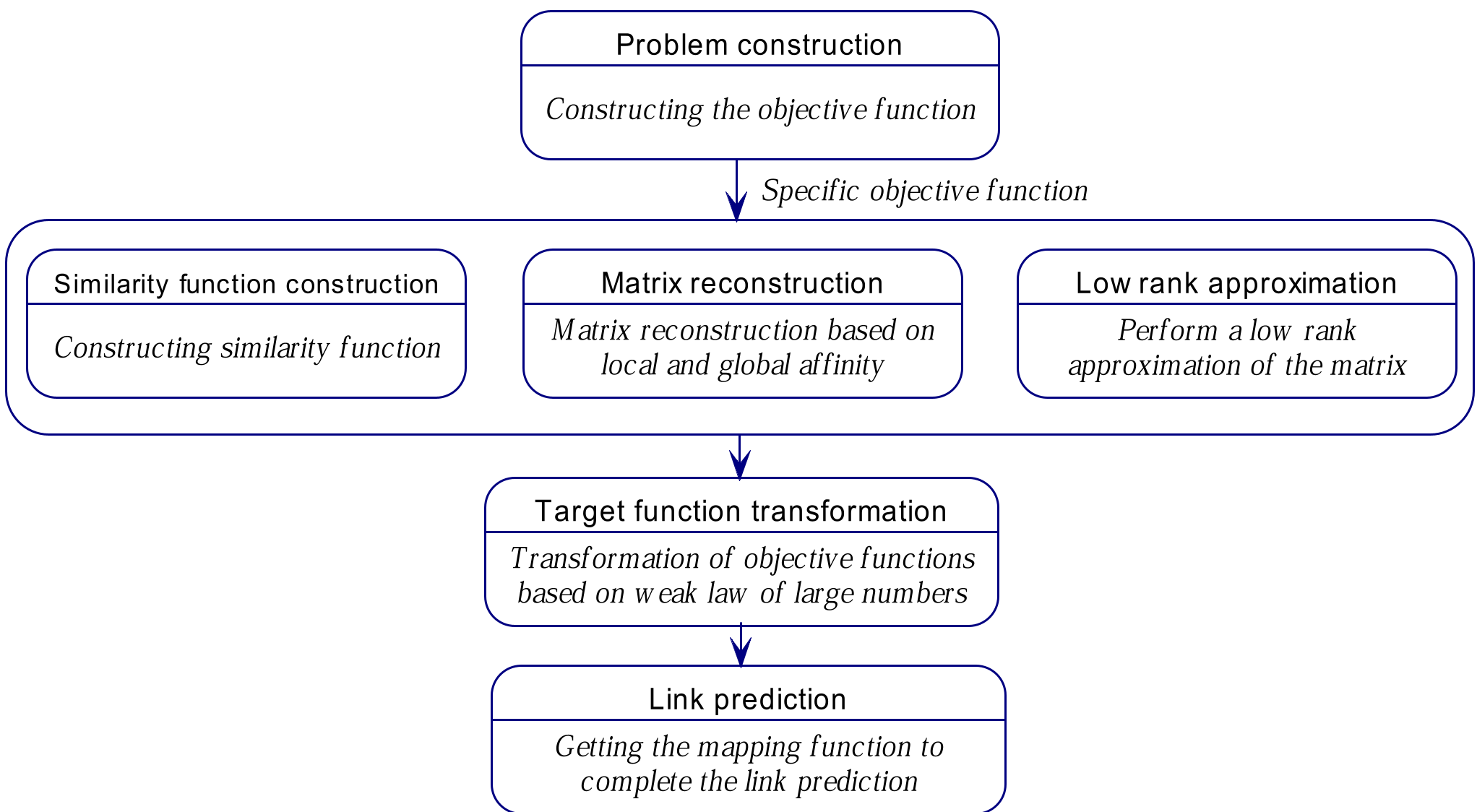 Figure 1: The USMDM Workflow - from corruption to mapping function optimization.
Experiments & Results: Efficiency at Scale
The model was tested against SOTA baselines like mDA and Hypergraph models.
- Accuracy: USMDM consistently outperformed all competitors across Facebook, Twitter, and Pokec datasets.
- The Power of Low-Rank: On the largest dataset (Pokec), the low-rank version was over 200 times faster than the full-matrix version, while actually yielding a higher AUC due to reduced overfitting.
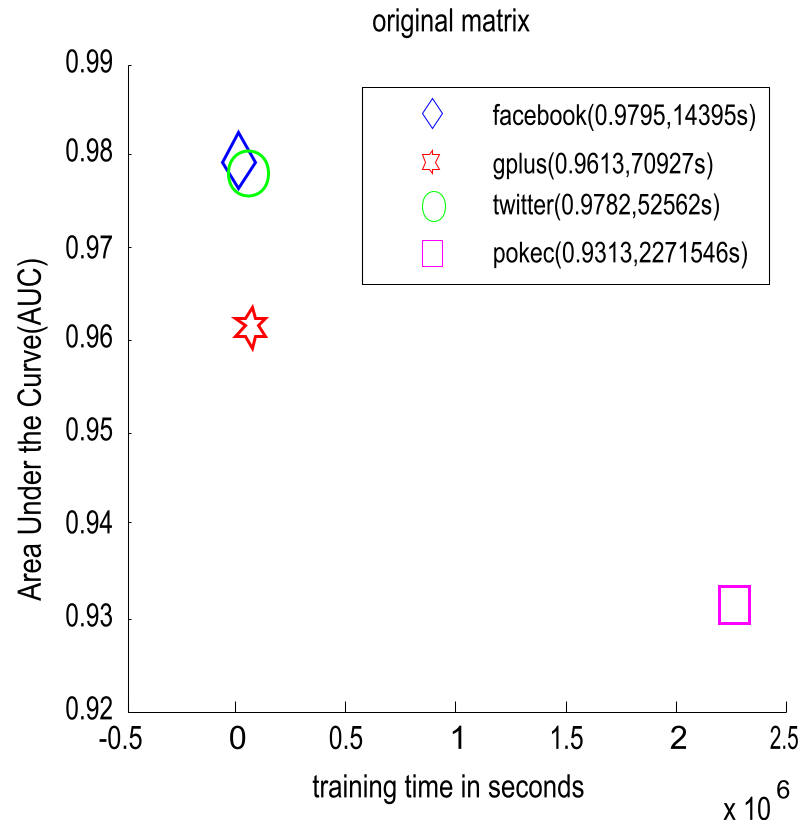 Figure 2: Comparison of AUC scores and learning times between Original and Low-Rank matrices.
Critical Analysis & Conclusion
Why it works
By incorporating the Weak Law of Large Numbers, USMDM doesn't need to generate thousands of corrupted samples explicitly. It calculates the expected error analytically, making the training process elegant and mathematically grounded. It successfully bridges the gap between "feature-based" and "latent-variable" models.
Limitations
Despite the efficiency gains from low-rank approximation, the global topology search still carries a significant computational weight compared to simple heuristic methods. It remains a "heavyweight" contender suitable for offline recommendations rather than real-time edge triggers.
The Future
The author hints at a fascinating next step: Image Analysis. In a world where we share more via photos than text, integrating visual features into the "denoising" pipeline could be the next frontier for friend recommendation engines.
Takeaway: Link prediction is no longer just about counting common friends; it’s about reconstructing the underlying manifold of human connection from the noisy data we leave behind.