
Deciphering Social Dynamics: Link Prediction in Large-Scale Open Networks
Link prediction applied to an open large-scale online social network
This paper investigates link prediction in open, large-scale social networks like LiveJournal using topological metrics. The authors propose a new metric based on local clustering coefficients and utilize a Naïve Bayes classifier to achieve optimal prediction results shortly after users join the network.
TL;DR
Predicting who you will follow next is a core feature of modern social media. This paper shifts the focus from static citation networks to the "chaotic" and "open" environment of LiveJournal. By tracking new users for 10 months, authors Corlette and Shipman prove that link prediction is most effective shortly after a user joins and introduce a novel clustering metric that significantly boosts recommendation recall.
Context: Why Static Models Fail in Open Networks
In the academic world of link prediction, many "SOTA" models were historically built on DBLP or citation data. However, citation networks are slow-moving and "closed." Real-world social networks like Facebook or Twitter (X) are open systems: users join and leave daily, and the rate of interaction is measured in hours, not years.
The authors argue that the "openness" of a network—specifically the constant influx of new nodes—creates a unique dynamic that prior work ignored. They ask: Does the length of time a user has been in the system affect how predictable their behavior is?
Methodology: Beyond Simple Common Neighbors
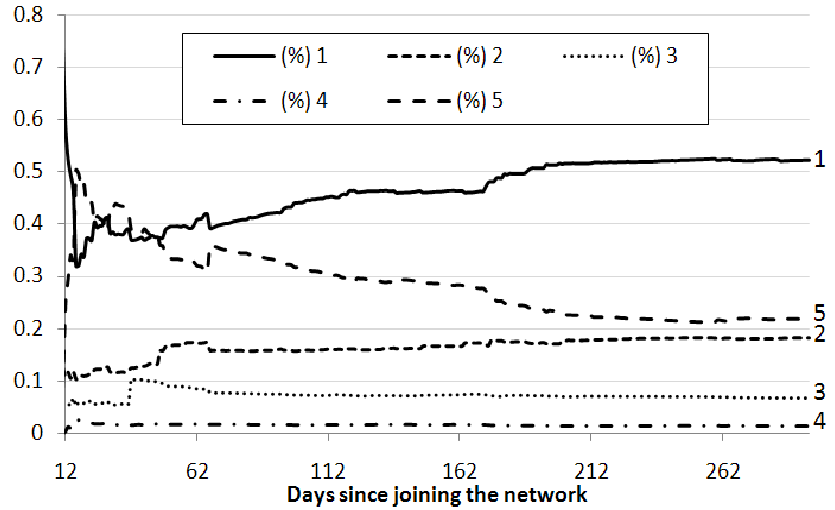
To capture data without hitting API limits, the authors used Event-Driven Sampling (EDS), monitoring the LiveJournal Atom feed to sample active users. They focused on the 2-hop neighborhood (friends of friends), as their analysis showed this region accounts for over 50% of new links formed after the initial "honeymoon" period.
The Metrics
- Adamic/Adar (Metric 1): A classic metric that weighs common neighbors higher if those neighbors themselves have fewer total friends (less "social noise").
- Restricted Clustering Coefficient (Metric 2): The authors' original contribution. It measures the ratio of existing edges to possible edges within a potential friend's local neighborhood, specifically excluding the source user's immediate circle.

The logic is intuitive: if a potential friend is in a "tight-knit" local cluster, the structural pressure for you to join that cluster is higher.
The "10-Day Chaos" and Experimental Results
One of the paper's most fascinating insights is the lifecycle of a new user:
- Day 0-10 (The Chaotic Phase): New users form links erratically. 89% of their first friends are "strangers" (6+ hops away). Prediction here is nearly impossible.
- Day 11-30 (The Settling Phase): Users begin exploring their friends' social circles. The 2-hop neighborhood becomes the dominant source of growth.
- The Maturity Decline: As users stay longer, precision drops. This is likely because the "obvious" friends are already added, leaving only harder-to-predict, niche connections.
Performance Gains
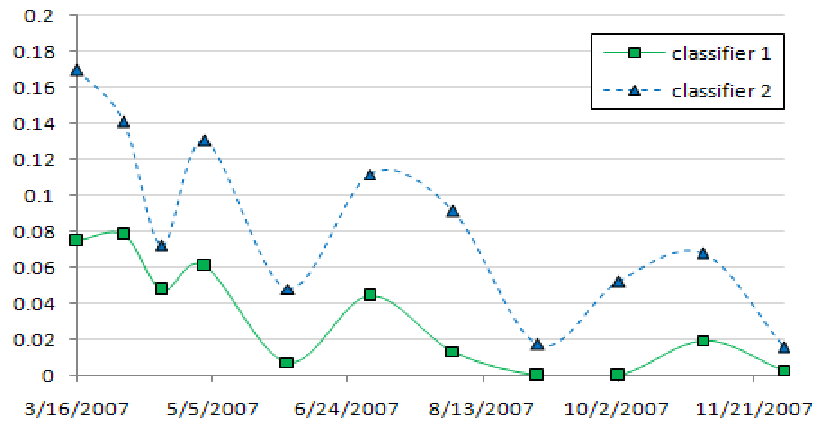
The authors used a Naïve Bayes classifier to combine metrics. While Adamic/Adar alone provided decent precision initially, the inclusion of Metric 2 (Clustering Coefficient) provided a massive boost in Recall (the ability to find all future friends, not just the easy ones).
Deep Insight: The Value of Precision Timing
The study demonstrates that link prediction isn't a "one-size-fits-all" algorithm for all users. The window of opportunity for high-precision recommendation is narrow—typically within the first 30 to 60 days of a user joining.
Limitations:
- The precision scores (peaking at 0.16) may seem low compared to modern deep learning models, but for 2010 topological-only methods, this represented a significant benchmark.
- The rely strictly on topology; they do not account for content (what people post), which we now know is a critical signal in modern RecSys.
Summary
This work serves as a foundational reminder that time is a first-class citizen in social network analysis. By isolating the "chaotic" entry phase and the subsequent "settling" phase, the authors provided a roadmap for how social platforms can better onboard users by hitting them with the right recommendations at the right time in their social lifecycle.