
SLP: Harnessing Learning Automata for Uncertainty-Aware Link Prediction
Link prediction in stochastic social networks: Learning automata approach
The paper introduces a novel method called SLP (Stochastic Link Prediction) for link prediction in stochastic social networks where link weights are random variables. It utilizes Learning Automata (LA) to estimate similarity metric distributions, achieving superior performance over classical static methods on synthetic stochastic graphs.
TL;DR
Predicting future connections in social networks has traditionally been a "static" affair, treating snapshots of data as absolute truth. This paper challenges that paradigm by introducing SLP (Stochastic Link Prediction). By modeling links as random variables and using Learning Automata (LA) to intelligently sample the network, the authors achieve higher accuracy (AUC ~0.92) while cutting computational overhead in half compared to exhaustive sampling.
Problem & Motivation: The Fallacy of the Static Graph
Most link prediction algorithms ask: "Given this fixed snapshot, who will connect next?" But social networks are not static. User interactions are characterized by uncertainty and temporality. A single snapshot ignores the fact that link strengths fluctuate and some connections are noisier than others.
The authors identify two core gaps:
- Deterministic Limitations: Fixed-weight models cannot represent the inherent "randomness" of human behavior.
- Computational Inefficiency: In a stochastic world, repeatedly sampling every link to find a distribution is prohibitively expensive.
Methodology: Adaptive Sampling via Learning Automata
The core "magic" of this paper lies in integrating Learning Automata (LA)—adaptive decision-making units—into the sampling process. The architecture consists of a dual-layered approach:
- Redefining Similarity: Classic metrics (Jaccard, Adamic-Adar, Katz) are mathematically reformulated to handle weights as random variables. For instance, Stochastic Common Neighbors (SCN) becomes the sum of shared stochastic weights.
- LALinks (The Explorers): These automata decide whether to "take a sample" of a specific link or reuse the previous value. They learn to focus on "promising regions"—parts of the graph where weights change frequently or impact the global structure significantly.
- LATests (The Evaluators): These automata decide if a test link's similarity distribution actually needs an update, preventing redundant calculations.
 Figure: The interaction between Learning Automata and the Stochastic Environment.
The Feedback Loop
The model uses Skew Divergence to measure the distance between the current similarity distribution and the previous one. If the distribution hasn't changed much, the LA is "penalized" for updating, teaching it to save compute in the next iteration.
Experiments & Results: Efficiency meets Accuracy
The authors tested SLP against classic heuristics and supervised methods (like MI-LP and CMA-ES) across three synthetic network types: Barabasi-Albert (Scale-free), Watts-Strogatz (Small-world), and Erdos-Renyi (Random).
Key Performance Highlights:
- Predictive Power: SLP reached an AUC of 0.9351 on BA-Graphs, outperforming the Katz index (0.8344) and MI-LP (0.8975).
- Efficiency: As shown in the performance tables, SLP reached target accuracy levels with 50% fewer samples than the Standard Sampling Method (SSM).
- Adaptability: The "Changes Phase" allows the model to handle link additions/removals in online social networks without re-calculating the entire graph.
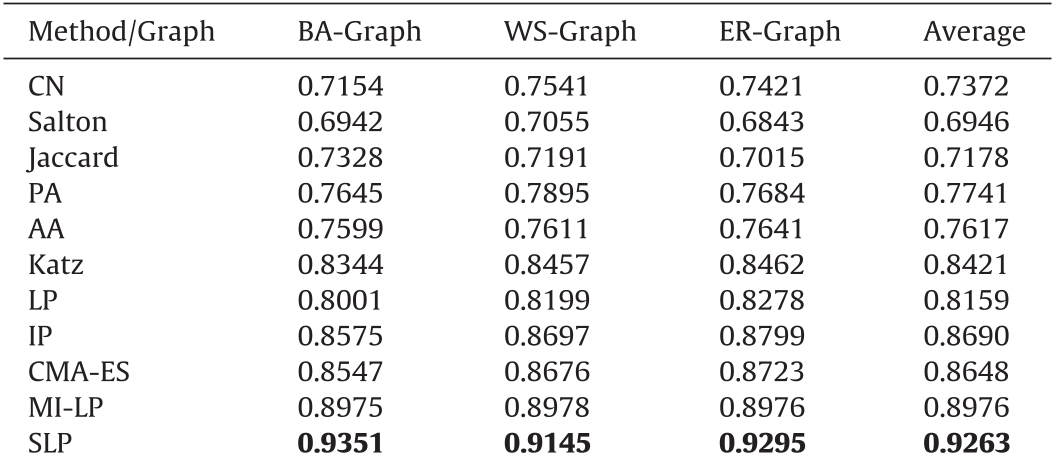 Table: AUC Comparison across different graph models.
Critical Analysis & Conclusion
The true value of this work is the probabilistic shift. By outputting a distribution of similarity rather than a single score, the model acknowledges uncertainty.
Limitations:
- Synthetic Reliance: While the synthetic tests (BA, WS, ER models) are mathematically sound, real-world social data often contains noise that synthetic models can't perfectly replicate (e.g., bot activity, platform-specific biases).
- Parameter Sensitivity: The learning rates () and penalty rates () for the automata are tuned empirically. In a massive, rapidly evolving network, finding the optimal and might require additional meta-learning.
Future Outlook
This methodology paves the way for integrating Reinforcement Learning into graph analysis. As we move toward larger "online" networks, the ability of Learning Automata to selectively sample data will be vital for maintaining real-time recommendation systems and friend-suggestion engines.