
Breaking the Echo Chamber: Link Recommendation for Maximum Information Diffusion
Link recommendation for promoting information diffusion in social networks
This paper introduces a novel link recommendation framework that optimizes for information diffusion rather than just social interaction. By proposing a "User Diffusion Degree" metric and a scalable reranking algorithm, the authors improve network-wide information spread under Independent Cascade and Linear Threshold models.
TL;DR
Existing social network algorithms are great at helping you find people you already know, but they are terrible at helping information travel across the network. This paper proposes a User Diffusion Degree algorithm that identifies "bridge" users to rerank recommendations. The result? A network structure that isn't just more connected, but significantly more "viral."
Problem & Motivation: The Local Proximity Trap
Most link recommendation systems (like "People You May Know") rely on Common Neighbors. If Alice and Bob share many friends, the system suggests they connect. While this strengthens local clusters (cliques), it often fails the network’s second vital function: Information Diffusion.
Prior work (like the RMPP model) tried to solve this but was either computationally too heavy for large datasets or relied on the oversimplified assumption that information only travels along a single "maximum probability" path. The authors argue that we need a scalable way to identify users who can act as hubs between different communities, breaking the information silos created by standard proximity-based algorithms.
Methodology: Beyond Centrality to Community Bridges
The core innovation is the User Diffusion Degree (UDD). Unlike standard "Betweenness Centrality"—which often rewards nodes simply for being in the middle of a single large group—UDD specifically targets nodes that connect disparate communities.
The UDD Logic:
- Community Detection: First, use an algorithm (like Girvan-Newman) to partition the network into groups.
- Structural Analysis: For a candidate node, count how many of its neighbors are not connected to each other.
- Cross-Group Weighting: If those neighbors belong to different groups, the node’s Diffusion Degree increases exponentially.
The final recommendation score is a product of traditional proximity and this new UDD:
 Figure: The framework focuses on reranking potential links to maximize the reach of information.
Experiments & Results: Real-World Impact
The researchers tested their approach on two massive real-world datasets: Enron-Email and Amazon. They used the "Lift" metric to measure how much extra information spread occurred after adding recommended links compared to the original graph.
Key Findings:
- Superior Scalability: Unlike previous greedy algorithms, this heuristic approach handled the Amazon dataset (330k+ nodes) with ease.
- Performance Gain: In both the Independent Cascade (IC) and Linear Threshold (LT) models, the UDD-based reranking significantly outperformed the "Common Neighbors" baseline.
- The "Betweenness" Flaw: The experiments proved that simple betweenness is a poor proxy for diffusion; UDD's awareness of group boundaries allowed it to facilitate much faster inter-group communication.
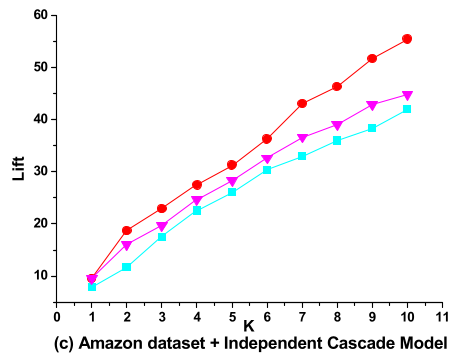 Figure: Lift performance on Email and Amazon datasets. Our method (black line) shows a steeper growth curve in diffusion efficiency as links (K) are added.
Critical Analysis & Conclusion
The value of this paper lies in its simplicity and modularity. It doesn't ask you to throw away your existing recommendation engine; it provides a "plugin" layer to rerank those results for better network health.
Limitations:
- The study assumes that users will actually accept a recommendation that might be slightly outside their immediate social circle (lower proximity).
- The community detection step (Girvan-Newman) can still be a bottleneck for truly billion-scale graphs, suggesting a need for even faster clustering methods.
Future Outlook: As we move toward a world where information silos and "filter bubbles" are major societal concerns, algorithms that prioritize Information Diffusion over simple Interaction Proximity will become essential for the next generation of social architecture.