
Beyond Friends and Foes: Improving Link Prediction via Bayesian Node Types
Link sign prediction and ranking in signed directed social networks
This paper introduces a novel "Node Type" framework for link sign prediction and ranking in signed directed social networks (like Wikipedia and Epinions). By categorizing nodes into 16 distinct types based on their local edge configurations, the authors propose a Bayesian model that effectively infers trust/distrust relationships even when nodes lack common neighbors.
TL;DR
Predicting whether a social link is positive (trust) or negative (distrust) is difficult when users haven't met through a mutual friend. This paper shifts the focus from neighborhood triads to intrinsic node types. By classifying nodes into 16 behavioral categories and applying a Bayesian framework, the authors achieve SOTA performance in predicting and ranking social relationships across Wikipedia, Slashdot, and Epinions.
The Sparsity Trap in Signed Networks
Traditional social network analysis relies heavily on two pillars:
- Structural Balance Theory: "The friend of my friend is my friend."
- Social Status Theory: Positive links point to higher status; negative links point to lower status.
Both theories suffer from a fatal flaw in the real world: Sparsity. In the Slashdot dataset, nearly 48% of edges share no common neighbors. If there is no "friend of a friend" (triad), these theories provide zero evidence for the link's sign.
Methodology: The 16-Dimensional Anatomy of a Node
The authors propose that every node in a directed signed network belongs to one of 16 types based on its edge configuration (Incoming/Outgoing vs. Positive/Negative/Mixed).
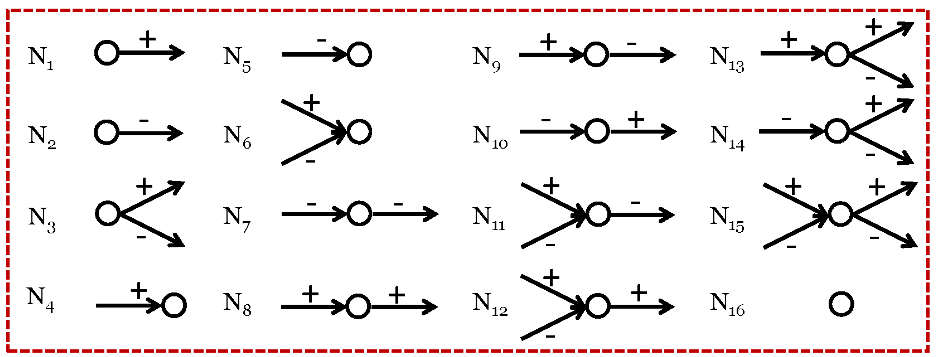 Fig 1: The 16 node types based on local structure.
From Static Types to Bayesian Inference
In a real scenario, we don't know all the signs (partially observed). The authors use Bayesian Node Features (BNF) to capture the probability distribution of a node's type.
- Node Properties: Ratios of positive/negative incoming and outgoing edges.
- Bayesian Node Types (BNT): Probability vectors representing the likelihood of a node being type given unobserved edges.
- Kronecker Interaction: Instead of just looking at node A and node B, the model calculates the Kronecker product of their type vectors () to capture the complex "logic" of how different types interact.
Better Ranking by Design
Most link prediction models optimize for global accuracy, but for a user, the ranking matters—trustworthy links should appear at the top. The authors developed a link ranking model that directly optimizes the AUC (Area Under the Curve) using a sigmoid-based log-likelihood surrogate. This ensures that the model specifically learns to push positive samples above negative ones.
Experimental Results
The model was tested on Wikipedia, Slashdot, and Epinions.
1. Superior Prediction Accuracy
The combination of Bayesian Node Types (BNTK) and Bayesian Node Properties (BNPC) consistently beat the baseline "Degree+Triad" features.
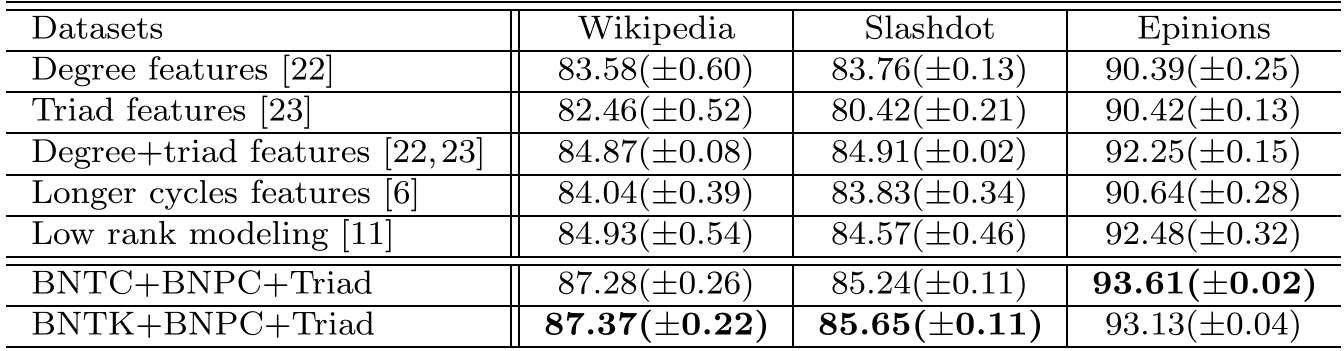 Fig 2: Link sign prediction performance across three datasets.
2. Solving the Sparsity Problem
As shown in the ablation studies, the advantage of this model is most pronounced when embeddedness is low. Even when two users have zero mutual contacts, their "node type" tells a story about their likely interaction.
3. Cross-Dataset Robustness
Intriguingly, the node-type logic transfers across different platforms. A model trained on Wikipedia could predict signs on Epinions with high accuracy, suggesting that the "social physics" of trust and distrust are universal across these node archetypes.
Critical Insight: Why This Matters
The fundamental shift here is moving from relational features (what connects us?) to positional features (what kind of role do I play in the network?). While a triad tells us about a specific context, a node type tells us about a user's disposition.
Limitations: The model currently treats the network as a snapshot. In the future, observing how node types evolve—for example, a user shifting from a "neutral voter" to a "distrustful critic"—could provide even deeper insights into social dynamics.
Conclusion
By formalizing node behavior into 16 categories, this paper provides a robust solution to the sparsity problem in signed networks. Whether you are building a recommendation engine for a niche forum or an anti-fraud system for a bank, understanding the "type" of node you are dealing with is just as important as knowing who their friends are.