
LinkBench: Decoding the DNA of Facebook's Social Graph Workload
Linkbench: A database benchmark based on the facebook social graph
LinkBench is an open-source synthetic database benchmark designed to replicate the "social graph" workload of Facebook's production environments. It focuses on persistent storage performance, modeling complex graph-structured data and a diverse mix of point lookups, range scans, and updates, achieving a realistic SOTA baseline for web-scale social service evaluations.
TL;DR
At the SIGMOD 2013 conference, researchers from Facebook and the University of Chicago unveiled LinkBench, a synthetic benchmark that finally brought "social network realism" to database testing. Unlike generic benchmarks, LinkBench is built from the ground up using production traces from Facebook's massive MySQL clusters, providing a rigorous testbed for the persistent storage layer of the social graph.
Problem & Motivation: Why TPC-C Isn't Enough
For years, the database community relied on TPC-C (for transactions) and TPC-H (for analytics). However, a social network's database layer lives in a unique "purgatory" called the post-cache workload.
At Facebook, layers like TAO and Memcached absorb the vast majority of read requests. What actually hits the database?
- Cache Misses: Reads for "cold" or very specific range data.
- All Writes: Every like, comment, and friend request must be persisted.
Existing benchmarks either emphasized complex multi-hop traversals (Graph benchmarks) or simple Key-Value lookups (YCSB). None captured the single-hop range scans (e.g., "get the last 100 comments on this post") that dominate social graph traffic.
Methodology: Engineering Realism
The core of LinkBench is its ability to generate 1TB+ of data that behaves like Facebook's real graph without compromising user privacy.
1. Data Schema: Nodes and Edges
The data model is deceptively simple but functionally rich:
- Objects (Nodes): People, posts, or albums (Mean payload: ~88 bytes).
- Associations (Edges): Friendships, likes (Mean payload: ~11 bytes).
2. The Secret Sauce: Correlated Access Distributions
The authors observed a crucial correlation: Hotness follows Degree. A popular post (high outdegree) is much more likely to be accessed than an obscure one. LinkBench uses a sophisticated distribution framework to ensure that the synthetic workload mimics this "Power Law" behavior.
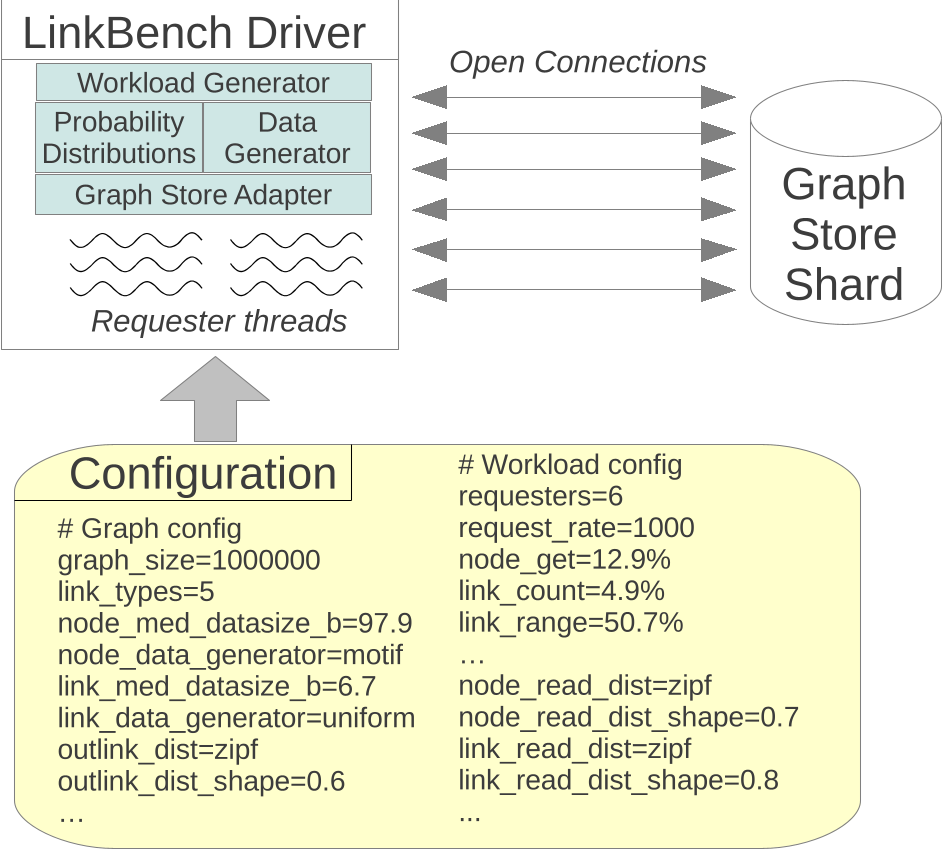 Figure 1: The LinkBench client-server architecture, featuring a Java-based driver that generates stateless requested based on predefined probability distributions.
3. Payload and Compressibility
Database performance is often tied to I/O, which is tied to storage efficiency. LinkBench uses a "motif" generator to create data with representative compression ratios (60% for objects, 30% for associations), ensuring SSD wear and cache hit rates are realistic.
Experiments: MySQL vs. HBase
The paper includes a provocative case study comparing MySQL (tuned with Facebook's patches) and HBase.
Despite the "NoSQL" hype of the early 2010s, the results were eye-opening:
- Efficiency: MySQL processed the same workload with 5% CPU utilization, while HBase required 20-35%.
- Latency: MySQL's 99th percentile latency for range scans was roughly half that of HBase (25.3ms vs 54.8ms).
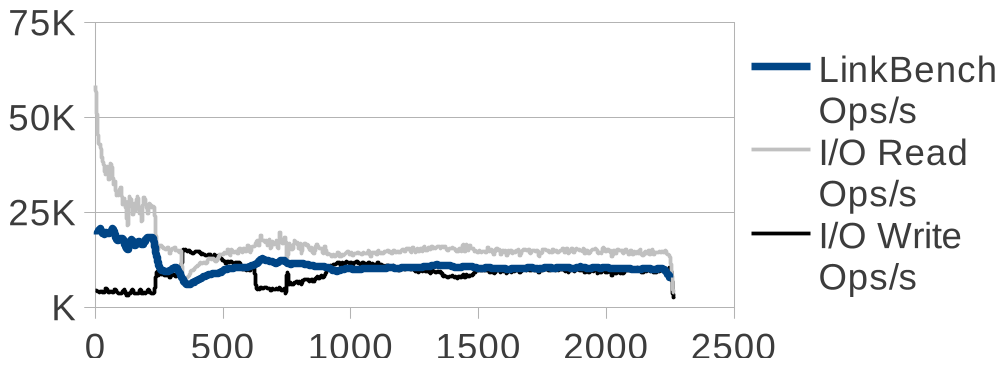 Figure 2: Steady-state performance on MySQL. Note the "warm-up" phase where the buffer pool is populated before hitting a stable 11k QPS.
Critical Analysis & Conclusion
LinkBench is more than just a tool; it's a characterization of the modern web. Its primary value lies in its stateless design. By generating IDs algorithmically rather than tracking them in memory, the benchmark can scale to billions of nodes without the client itself becoming the bottleneck.
Limitations: While LinkBench captures spatial locality (hot rows), it struggles with temporal locality. In the real world, a post becomes "viral" for a day and then dies. LinkBench's current model has a mostly static "hot" set.
Future Outlook: As we move toward NewSQL and serverless databases, LinkBench remains the "Gold Standard" for testing how a system handles the chaotic, read-write-balanced, and highly skewed nature of human interaction data. For any developer building a social-scale application, LinkBench is the first hurdle their database should clear.