
LinkedIn Pros: Balancing the Job Marketplace with GLMix and LiJAR
Personalized Job Recommendation System at LinkedIn: Practical Challenges and Lessons Learned
This paper presents the architecture and deployment of LinkedIn's personalized job recommendation system, highlighting the "GLMix" ranking model and the "LiJAR" redistribution framework. It establishes a marketplace-efficient approach that balances user engagement with job provider needs, achieving up to a 40% increase in job applications.
TL;DR
LinkedIn’s job recommendation system is not just a standard "recommender"; it is a complex marketplace balancing act. By implementing a high-efficiency multi-tier architecture, a massive-scale GLMix ranking model, and a unique redistribution system called LiJAR, LinkedIn has successfully boosted job applications by up to 40% while ensuring that job posters aren't overwhelmed and "underserved" jobs get the attention they need.
The "Unique" Challenge of Job Recommendations
Unlike Netflix or Amazon, where a million people can watch the same movie or buy the same book, a job posting is a finite resource. If a recommendation engine sends 10,000 qualified applicants to a single "Software Engineer" role at a startup:
- The Recruiter is overwhelmed: They cannot possibly interview 10,000 people.
- The Seekers are frustrated: The probability of any single individual getting the job drops to near zero.
- The Marketplace is inefficient: Other great jobs remain hidden and unapplied for.
Furthermore, the system must navigate billions of structured data points (skills, titles, locations) in real-time while maintaining strict millisecond latency.
Methodology: The Three Pillars of the LinkedIn Engine
The architecture transitions from simple retrieval to sophisticated scoring and finally to business-logic redistribution.
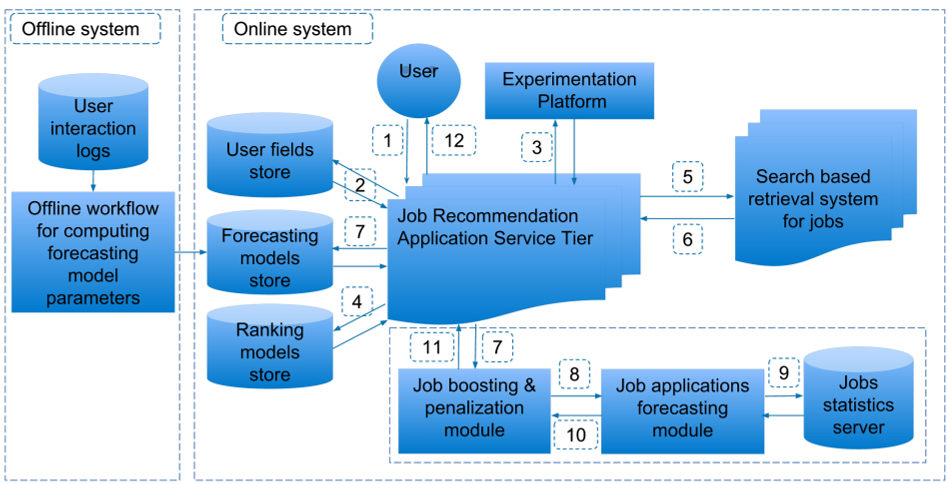
1. High-Efficiency Candidate Selection
To handle the scale, LinkedIn uses a Decision Tree-based Query Construction method. Instead of scoring every job in the database, the system converts branch paths of a decision tree into Weighted AND (WAND) clauses. This allows the search index to "early-terminate" and only retrieve the most promising candidates, reducing p99 latency by a staggering 56%.
2. Deep Personalization via GLMix
The core ranking is handled by Generalized Linear Mixed Models (GLMix). This model is powerful because it decomposes a member's interest into three parts:
- Global Prior: General trends (e.g., "People with Python skills like Data Science jobs").
- Per-Member Factors: Your specific history and clicks.
- Per-Job Factors: How attractive this specific job is to people like you.
This allows the model to capture the "long tail" of user behavior, resulting in highly tailored matches that feel personal, not just popular.
3. LiJAR: The Social Engineer of the Marketplace
LiJAR (LinkedIn Job Applications Redistribution) is the "invisible hand." It forecasts how many applications a job will receive by its expiration date.
- Under-served? If a job is falling behind, LiJAR gives it a "boost" in the rankings.
- Over-saturated? If a job has too many applicants, LiJAR applies a penalty to redirect users to other relevant opportunities.
Experimental Results & Business Impact
The impact of these systems on LinkedIn’s production environment was profound:
- Application Growth: The transition to GLMix drove a 20-40% increase in job applications per day.
- System Efficiency: The latency reductions allowed engineers to deploy even more complex ML models (like Deep & Wide networks) without breaking the user experience.
- Marketplace Health: LiJAR increased engagement with underserved jobs by 6.5%, improving the ROI for job posters who previously struggled to find candidates.
Critical Insight & Conclusion
This paper teaches us that in professional social networks, relevance is a multi-objective optimization problem. It is not enough to show a user a job they might like; you must show them a job they might like and have a realistic chance of getting, while ensuring the person hiring on the other side is equally satisfied.
Future Outlook: The lessons learned here—moving from content-based filtering to hierarchical interaction modeling and finally to redistribution—serve as a blueprint for any two-sided marketplace (Uber, Airbnb, Freelancer) where supply is restricted.