
LinkedIn Skills: Scaling Expertise through Folksonomy and Inference
LinkedIn skills: large-scale topic extraction and inference
The paper presents a large-scale system for professional skill extraction and inference at LinkedIn. By constructing a data-driven "folksonomy" from millions of profiles and deploying a Naive Bayes-based recommender system, the authors achieved a 49% conversion rate in member skill tagging.
TL;DR
LinkedIn's "Skills and Expertise" feature isn't just a list of tags; it's the result of a massive data-mining operation. This paper details how LinkedIn moved from a noisy collection of free-text phrases to a standardized 50,000-topic folksonomy. By shifting from a "search-to-add" model to an "inference-and-confirm" model using Naive Bayes, they boosted user engagement by over 1,200%.
Background: The Taxonomy Problem
In 2014, LinkedIn faced a scaling wall. Professional identities are multi-faceted, ranging from "Atmospheric Physics" to "Public Speaking." Standard taxonomies like O*NET were too rigid. To build a system that reflected the real world, LinkedIn looked at its own data—specifically, the "Specialties" section of millions of profiles.
Problem & Motivation: The Chaos of Free Text
Before standardization, skills were a mess of:
- Ambiguity: Does "Organ" mean a musical instrument or a body part?
- Redundancy: "Java programming," "Java development," and "Java" are the same thing.
- The Blank Page Problem: Users rarely know what to type in a search box, leading to low profile completeness.
Methodology: The Three Pillars of Folksonomy
1. Discovery (Entity Extraction)
The team extracted phrases from comma-separated lists in profile sections. They used a simple but effective threshold: This filtered out prose and captured high-density skill lists.
2. Disambiguation (SVD & Clustering)
To solve the "Organ" problem, they looked at co-occurrence. If "Organ" appears with "Surgery," it’s medical. If it appears with "Piano," it’s musical.
- Insight: They calculated Jaccard similarity between phrases and then applied Cosine similarity on the resulting vectors to create a sense-matrix.
- Action: K-Means clustering on the SVD-reduced matrix separated these distinct "senses" of a word.
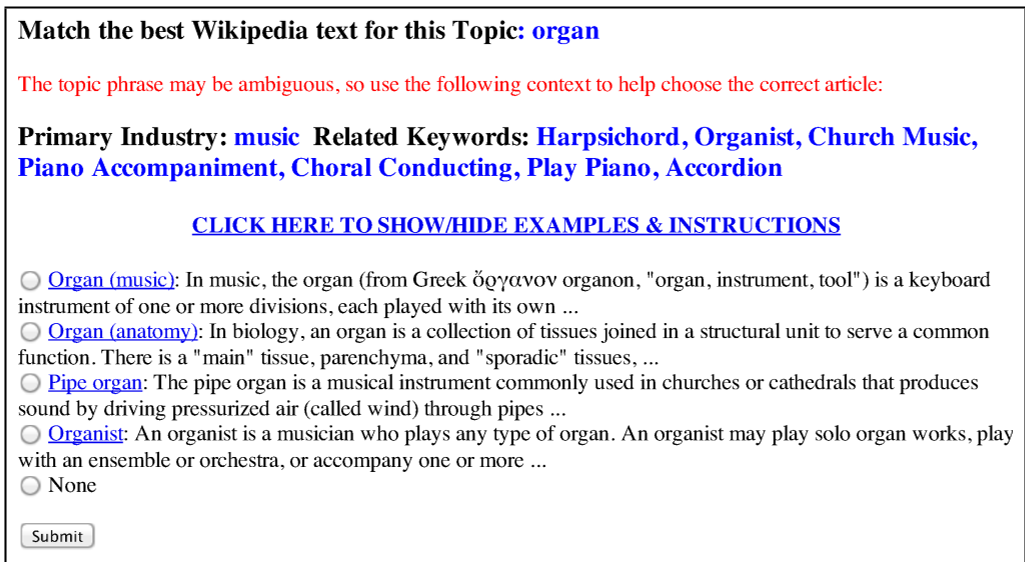 Figure: Crowdsourcing tasks provided context (Industry/Related phrases) to workers for Wikipedia mapping.
3. Deduplication (Wikipedia Grounding)
Instead of manual merging, LinkedIn used Wikipedia as a universal glue. If two phrases (e.g., "B2B" and "Business to Business") mapped to the same Wikipedia page via Amazon Mechanical Turk, they were merged into a single standardized skill topic.
The Inference Engine: Collaborative Filtering with Naive Bayes
Once the skills were standardized, LinkedIn needed to predict which skills a member should have. They used a Naive Bayes classifier where: Features () included Top Titles, Company, Industry, and Group Membership.
Performance & Feature Selection
They used Mutual Information to filter out low-value (feature, skill) pairs, reducing the dataset to the 25th percentile of utility without sacrificing accuracy.
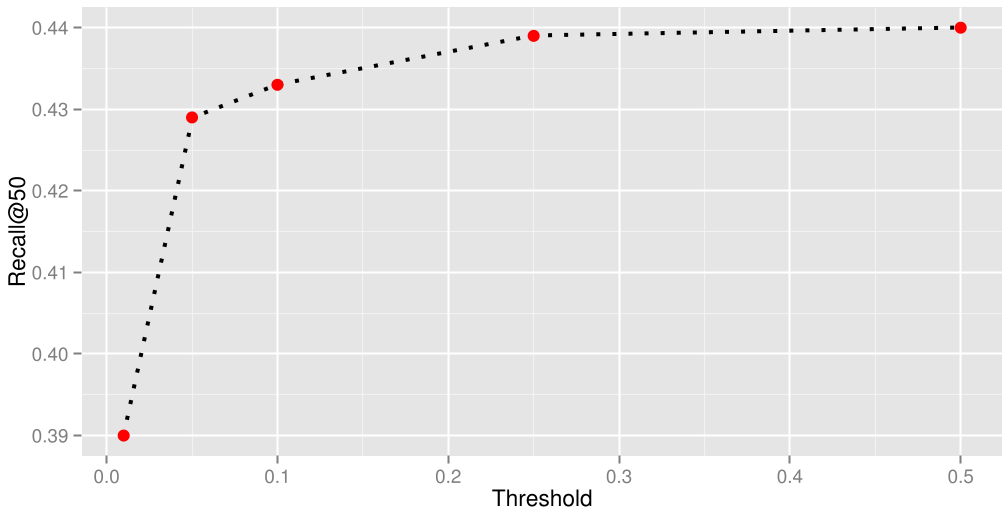 Figure: Impact of Mutual Information threshold on performance. Note that performance remains robust even after significant data pruning.
Experiments & Results: The Power of Recommendations
The most striking result was the change in user behavior:
- Type-ahead only: 4% conversion.
- Suggested Skills: 49% conversion.
This proves that Reciprocal Recognition (suggesting what we already think you know) is the strongest driver for profile completeness in social networks.
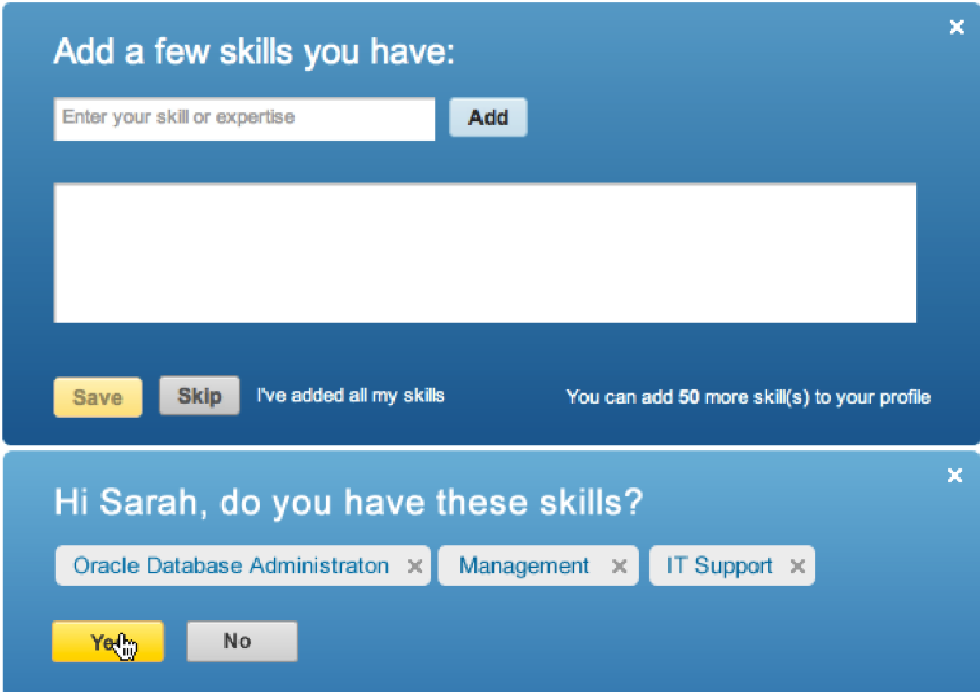 Figure: Comparison of the legacy UI (4% conversion) vs. the recommendation-driven UI (49% conversion).
Critical Analysis & Conclusion
The Takeaway: LinkedIn succeeded by treating users as "tag confirmers" rather than "tag creators." Leveraging Wikipedia for deduplication was a brilliant move to bypass the "cold start" of creating a taxonomy from scratch.
Limitations: The Naive Bayes approach assumes feature independence, which is rarely true (e.g., Company and Title are highly correlated). Furthermore, "soft skills" (e.g., "Ability to learn") performed poorly (AUC ~0.5) compared to technical skills like "Hadoop" (AUC ~0.9), highlighting the difficulty of quantifying interpersonal traits.
Future Work: This 2014 work laid the foundation for today's Graph Neural Networks (GNNs) and LLM-based entities at LinkedIn. It remains a masterclass in how to turn "messy" user data into a structured professional graph that powers everything from job search to social endorsements.