
LAIP: Mapping the Global DNA of Artificial Intelligence Ethics
Linking Artificial Intelligence Principles
The paper introduces LAIP (Linking Artificial Intelligence Principles), a semantic analysis framework and platform designed to connect 27 major AI ethical proposals from academia, government, and industry. It utilizes word2vec and RDF/OWL standards to map common ethical topics across diverse organizational manifestos.
TL;DR
As AI ethics frameworks proliferate worldwide, the Linking Artificial Intelligence Principles (LAIP) project provides the first semantic "Rosetta Stone" for global AI governance. By analyzing 27 major sets of principles from organizations like Google, IEEE, and various governments, the research reveals critical gaps—such as industry's avoidance of privacy issues and government's lack of focus on accountability—while advocating for a move toward Harmonious AI.
Problem: The Tower of Babel in AI Ethics
Every major tech player and nation now has an "AI Ethics" manifesto. However, these documents are often vague, legally non-binding, and highly divergent. Current approaches suffer from:
- Incompleteness: No single document captures the full spectrum of social and ethical risks.
- Organizational Bias: Firms focus on what benefits them (collaboration) while potentially ignoring what costs them (strict accountability).
- Semantic Fragmentation: Different groups use different words for the same concepts, making cross-comparison nearly impossible for policy-makers.
Methodology: Semantic Linking and Word Embeddings
The researchers didn't just read the papers; they built a quantitative mapping tool. They identified 10 General Topics (Humanity, Fairness, Transparency, etc.) and used word2vec (Google News-trained vectors) to expand these into semantic groups.
The Semantic Expansion Strategy
For a topic like Transparency, the algorithm looks for explainable, predictable, intelligible, audit, and trace. This ensures that a company calling for "auditability" is correctly linked to an academic paper calling for "explainability."
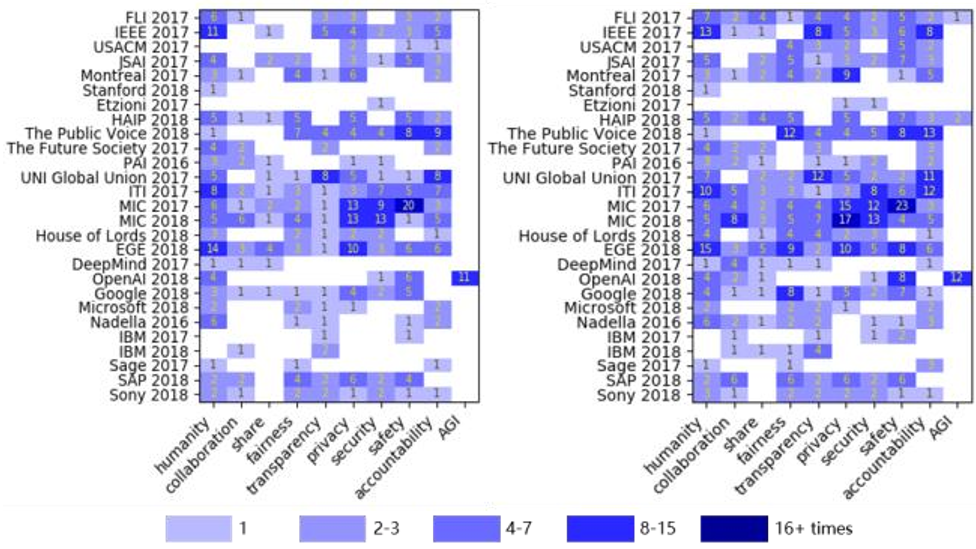 Figure 1: Comparison between manual keyword matching (A) and semantic expansion (B), proving that semantic linking captures a much higher "hidden" coverage of ethical principles.
Experiments: Who Cares About What?
The study categorized principles into three "Schools of Thought":
- Academia/NGOs: The most comprehensive and accountability-focused.
- Governments: Heavily focused on security and democratic prerequisites, but surprisingly silent on Accountability.
- Industry: High emphasis on Collaboration (beneficial for business ecosystems) but significantly lower frequency in Security and Privacy topics.
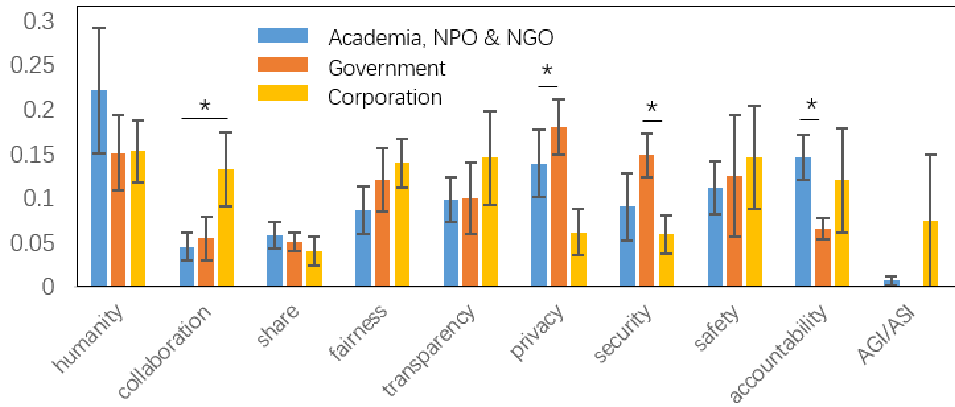 Figure 3: Statistically significant differences in topical focus between Academia, Government, and Industry.
The "Accountability" Gap
One of the most striking findings is the lack of "Accountability" mentions in governmental drafts compared to academic ones. This suggests a hesitancy in the public sector to define who is legally liable when AI systems fail.
Critical Analysis & Conclusion
The Shift to "Harmonious" AI
The paper’s most provocative insight is the critique of Human-Centered AI. The authors argue that as AI evolves toward AGI (Artificial General Intelligence) or ASI (Superintelligence), we must move beyond a purely anthropocentric view. They propose Harmonious Principle Design, which views humans and AI as part of a single, evolving cognitive ecosystem.
Limitations
- Word2Vec Constraints: Since the study used 2018-era word embeddings, it might miss the nuance of more modern "alignment" terminology (e.g., RLHF, Constitutional AI).
- Lip Service vs. Action: A high "coverage" score in a corporate manifesto doesn't necessarily translate to ethical engineering in practice.
Final Takeaway
The LAIP platform (www.linking-ai-principles.org) serves as a vital infrastructure for global AI treaty-making. It proves that we don't need new principles; we need to link the ones we have to ensure no critical dimension—especially safety and accountability—is left behind.