
SPAR: Solving the Scalability Crisis in Online Social Networks with Local Semantics
The Little Engine(s) That Could: Scaling Online Social Networks
SPAR (Social Partitioning and Replication) is a middleware designed to scale Online Social Networks (OSNs) by jointly optimizing data partitioning and replication. It achieves "local semantics," ensuring all one-hop neighbor data is co-located on the same server, and significantly outperforms standard DHT-based systems like Cassandra in throughput.
TL;DR
Scaling Online Social Networks (OSNs) like Twitter or Facebook is a nightmare because social data isn't "sharding-friendly." The authors propose SPAR, a middleware that uses a clever "Social Partitioning and Replication" strategy. By ensuring a user and all their friends live on the same machine (local semantics), SPAR boosts throughput by 300% and slashes network traffic by 8x compared to industry standards like Cassandra.
The Motivation: The "Multiget" Hole
When you open your Twitter feed, the system must fetch tweets from every person you follow. In a standard distributed database (using Random Partitioning), your friends' data is scattered across hundreds of servers. This creates two massive bottlenecks:
- Network I/O: A single request explodes into hundreds of internal network calls.
- The Long Tail: Your response time is dictated by the slowest of those hundreds of servers.
Vertical scaling (buying a bigger box) is too expensive, and traditional horizontal scaling (DHTs) ignores the underlying "social" structure of the data.
Methodology: Joint Partitioning and Replication
The core "aha!" moment of SPAR is that Partitioning and Replication should not be treated separately.
The system enforces Local Semantics: for every master copy of a user, either a master or a slave replica of all their neighbors must exist on the same server.
How the Little Engine Works:
SPAR uses a greedy, online algorithm that reacts to events in real-time:
- Edge Addition: When two users connect, SPAR decides whether to move a "Master" replica or simply create a "Slave" replica. It chooses the path that minimizes total replicas while keeping server loads balanced.
- Redundancy for Free: Most systems require replicas for fault tolerance. SPAR uses these existing replicas to satisfy locality requirements, achieving local semantics at almost no extra memory cost.
 Figure 1: The SPAR architecture acting as a transparent middleware between the application logic and the database.
Experimental Performance
The authors tested SPAR against Cassandra (the powerhouse behind Facebook's early growth) and MySQL.
1. Throughput & Latency
SPAR demonstrated a massive performance leap. While Cassandra's performance degraded due to inter-server "multiget" overhead, SPAR's local execution allowed it to handle 800 req/s with a 99th-percentile latency under 100ms.
2. Replication Overhead
The research proved that SPAR is more efficient than even high-end offline graph partitioning tools like METIS because it focuses specifically on the locality constraint rather than just "cutting edges."
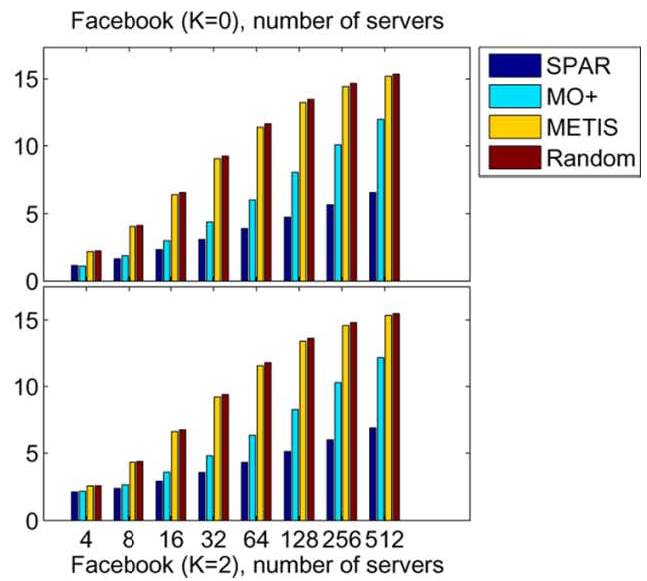 Figure 2: SPAR maintains significantly lower replication overhead compared to METIS and Random Partitioning across Twitter, Orkut, and Facebook datasets.
Critical Insights: Why This Works
The "magic" isn't just in avoiding the network. The authors discovered a hidden benefit: Improved Cache Locality. When a user’s data is read, their friends' data (which is co-located) is likely pulled into the OS file cache. Subsequent requests for those friends' profiles become "memory-hit" operations rather than "disk-seek" operations. Random partitioning destroys this natural correlation; SPAR exploits it.
Limitations & Future Work
While SPAR is revolutionary for OSNs, its complexity lies in the Partition Manager (PM). If the PM becomes out-of-sync, the locality guarantee breaks. Furthermore, while the paper handles "Super-users" (like celebrities with millions of followers) by replicating them widely, the "write-heavy" super-user still presents a challenge for consistency propagation.
Conclusion
SPAR proves that you don't need a supercomputer to run a global social network. By being "socially aware" at the middleware level, developers can use arrays of "Little Engines" (commodity servers) to achieve performance that eclipses specialized, expensive distributed databases.
Takeaway: Stop fighting the graph structure; start using it to decide where your data lives.