
SPAR: Breaking the "Hairball" Bottleneck in Social Network Scaling
The lile engine(s) that could: scaling online social networks
This paper introduces SPAR (Social Partitioning And Replication), a middleware designed to scale Online Social Networks (OSNs) by leveraging social graph structures. It achieves "local semantics" by ensuring a user and all their one-hop neighbors are co-located on the same server, significantly reducing inter-server communication.
TL;DR
Scaling Online Social Networks (OSNs) like Facebook or Twitter is notoriously difficult because social data is a "hairball" of interconnections. Traditional random partitioning (as seen in NoSQL/DHTs) forces servers to engage in massive cross-server communication for every simple query. SPAR (Social Partitioning And Replication) solves this by ensuring that a user’s data and all their friends' data live on the same physical server, reducing inter-server "read" traffic to zero and boosting throughput by 300%.
The Scaling Wall: Why Social Graphs Break Databases
In a standard web app, you can split users into buckets (sharding). But in a social network, a user’s "Home Feed" is a composite of all their friends' updates. If you use random sharding (the industry standard), a user with 500 friends might need their data pulled from 100 different servers for a single page load.
This leads to two disasters:
- The Multi-Get Hole: The system speed is limited by the slowest of the 100 servers (tail latency).
- Designer’s Dilemma: Developers must choose between adding features or spending months rewriting complex distributed logic.
The Core Insight: Local Semantics
The authors of SPAR argue that instead of trying to perfectly "cut" the graph (which is NP-Hard), we should jointly partition and replicate.
SPAR guarantees Local Semantics: for every "Master" copy of a user, the server hosting it must also host at least a "Slave" copy of every one of that user's neighbors.
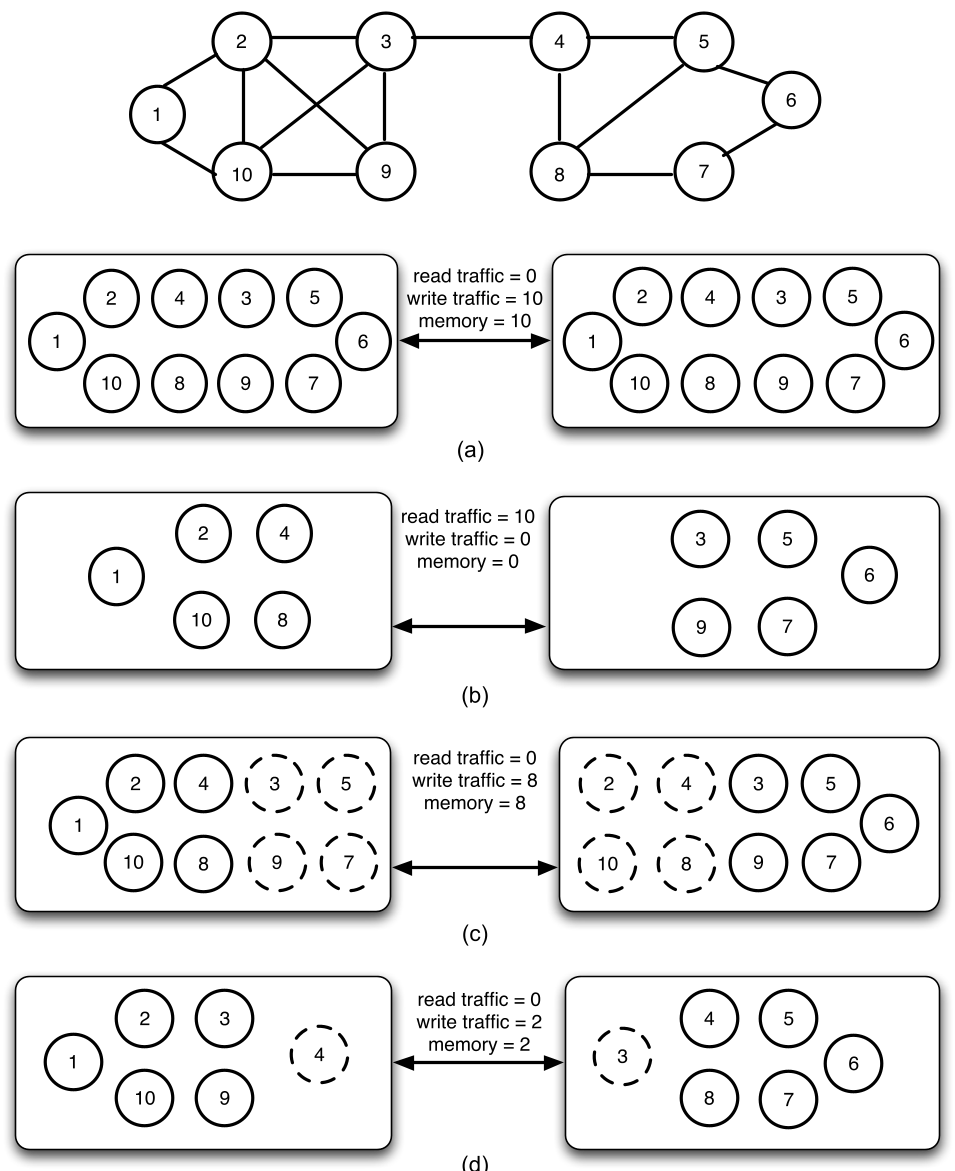 Fig 1: Comparing (a) Full Replication, (b) DHT/Random, (c) Neighbor Replication, and (d) SPAR's optimized social awareness.
How SPAR Works: Greedy Optimization on the Fly
SPAR isn't a static algorithm; it's a middleware that reacts to events in real-time.
- Edge Addition: When User A follows User B, SPAR does a cost-benefit analysis. It calculates:
- Should it move A's master record to B's server?
- Should it move B to A?
- Or just create a new replica?
- Greedy Decision: It chooses the path that minimizes total replicas while keeping the number of "Master" records balanced across all servers.
- K-Redundancy: It cleverly reuses the replicas needed for fault tolerance to also serve the purpose of data locality, effectively getting "locality for free."
Experimental Results: Scaling the "Little Engines"
The team tested SPAR on a cluster of 16 low-end "commodity" servers (the "Little Engines"). They replayed real traces from Twitter (2.4M users) and Facebook.
Performance vs. Industry Titans (Cassandra)
When layered on top of Cassandra, SPAR outperformed the vanilla, randomly-partitioned version significantly.
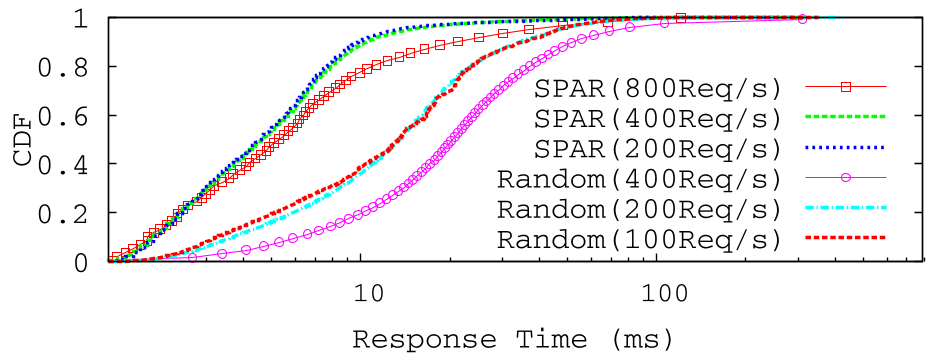 Fig 2: Response times show SPAR maintaining sub-100ms latency even at 800 req/s, whereas Cassandra spikes at 200 req/s.
Key Metrics:
- Throughput: SPAR handled 3x more requests per second than Cassandra.
- Network Efficiency: It reduced internal network traffic by 8x because it stopped the "shouting" across servers to fetch neighbor data.
- Replication Overhead: Even on the massive Orkut dataset with 223M edges, the overhead remained low and manageable, growing only sub-linearly with the number of servers.
Critical Insight: The Return of the RDBMS?
One of the most provocative takeaways from this research is that SPAR makes SQL viable for massive OSNs again.
By providing local semantics, the "distributed" problem is hidden. Developers can write standard MySQL queries with JOINs as if they were working on a single-server app. SPAR handles the underlying distribution. This allows teams to keep their robust RDBMS tools (like standard query optimizers and SQL) while scaling to hundreds of millions of users.
Limitations and Future Work
While SPAR is brilliant for OLTP (Online Transaction Processing) like fetching feeds, it is not a "silver bullet" for:
- Large Content: It doesn't handle video or large images (which still require CDNs).
- Graph Analytics: If you need to calculate the "PageRank" of the whole graph, SPAR doesn't help much as it focuses on one-hop locality.
- Extreme Writes: Massive bursts of status updates still require careful consistency management (though SPAR's single-master/multi-slave model simplifies this).
Conclusion
SPAR proves that the "hairball" can be untangled. By making servers socially aware, we can move away from the "lazy" scaling of random DHTs and toward a smarter, graph-informed architecture that saves both hardware costs and developer sanity.