
SocNNEL: Leveraging the Wikipedia Social Network for Precise Person Name Linking
With a Little Help from my Neighbors: Person Name Linking Using the Wikipedia Social Network
The paper introduces SocNNEL, a novel Named Entity Linking (NEL) approach specifically for person names, leveraging the "Wikipedia Social Network" (WSN). By analyzing co-occurrence patterns of over 800K individuals in Wikipedia, the method resolves name ambiguity through neighborhood similarity, achieving a SOTA precision of 94% on the AIDA CoNLL-YAGO dataset.
TL;DR
SocNNEL is a high-performance Named Entity Linking (NEL) system that treats Wikipedia as a massive social graph rather than just a collection of text. By calculating how "close" an ambiguous name mention is to its neighbors in a document—using a pre-built graph of 800,000 real-world individuals—it achieves a remarkable 94% micro-precision on standardized benchmarks.
Background: Within the landscape of Information Retrieval, this work sits at the intersection of Social Network Analysis (SNA) and Entity Disambiguation. It moves away from "what a person is" (descriptions) to "who a person knows" (network ties).
The "Neighborhood" Motivation
Why is linking "John Smith" so hard? Most systems try to read the sentences surrounding the name to find clues like "musician" or "London." However, these linguistic features are often noisy or absent.
The authors' core insight is that people exist in social contexts. If "John Smith" appears in a document alongside "Brian May," he is likely the "John Smith" who is a musician. The Wikipedia Social Network (WSN) formalizes this intuition by mapping millions of co-occurrences into a weighted graph where edges represent the strength of relationship based on how closely two people are mentioned across all of Wikipedia.
Methodology: The Power of Seeds and Graphs
The SocNNEL pipeline operates in three distinct phases:
- Network Construction: Using Wikidata and Wikipedia, the authors built a graph of 799,181 persons and 67.5M edges. Edge weights are determined by a "distance-decaying" measure—the closer two names appear in a Wikipedia article, the stronger their social link.
- Seed Identification: In a target document, some names are easy to identify (e.g., full names with unique matches). These become "Seed Persons" ().
- Ambiguity Resolution: For a name with multiple candidates (e.g., "Taylor"), the system calculates a score: It simply sums the relationship weights between a candidate and all identified seeds in the document.
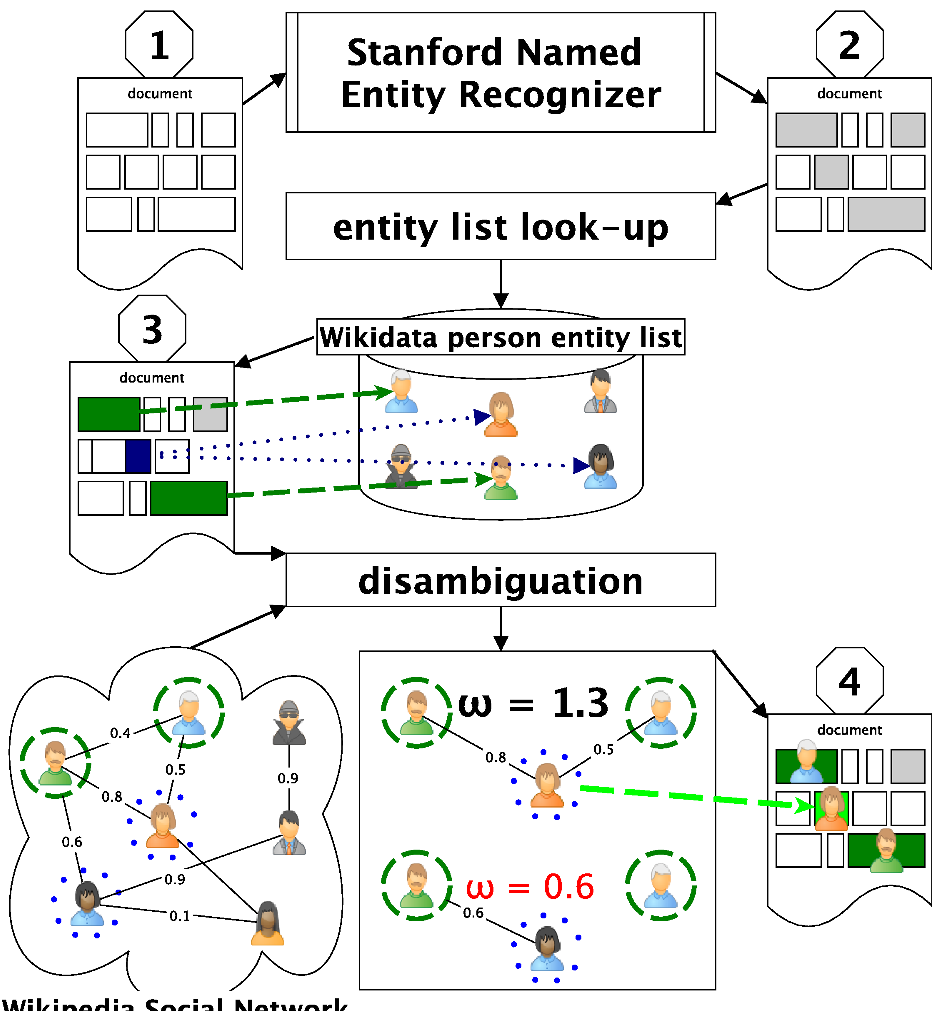 Figure 1: The flow from text mention extraction to candidate ranking via the Wikipedia Social Network.
Experiments: Breaking the SOTA
The researchers tested the system on the AIDA CoNLL-YAGO dataset, the gold standard for entity linking.
Key Performance Metrics:
- Micro Precision: SocNNEL achieved 94%, crushing the baseline AIDA system's 81.9%.
- Ambiguous Mentions: Even for the toughest cases where names were highly ambiguous, the precision remained high (reaching over 87% in some subsets).
- One-Word Mentions: The system is particularly robust at identifying people referred to only by their last name, provided prominent "seeds" exist in the same text.
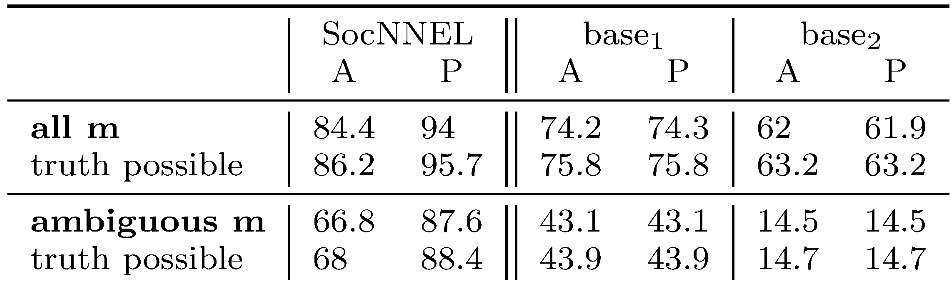 Table 1: Performance comparison showing the efficiency of SocNNEL across all mentions and ambiguous cases.
Critical Analysis & Conclusion
Takeaway
The success of SocNNEL proves that structural social data is often more discriminative than textual context. By distilling Wikipedia into a graph of human relationships, we can solve complex disambiguation problems with relatively simple ranking math.
Limitations
- Seed Dependency: The system relies heavily on "seed persons." If a document contains only one name and no other identifiable individuals, the social ranking cannot trigger.
- Knowledge Base Lag: Since it relies on a static crawl of Wikipedia, "emerging" entities (newly famous people) might not have established edges in the graph yet.
Future Outlook
This work paves the way for "Entity-Linkers-as-a-Service," where large-scale pre-computed graphs (like the WSN) can be used to augment RAG (Retrieval-Augmented Generation) pipelines, ensuring that LLMs link specific mentions to the correct underlying knowledge graph nodes with higher reliability.