
Live Avatar: Reaching 45 FPS and Infinite Length in 14B Diffusion-Based Talking Heads
Live Avatar: Streaming Real-time Audio-Driven Avatar Generation with Infinite Length
Live Avatar is a co-designed algorithm-system framework for real-time, streaming, and infinite-length audio-driven avatar generation using a 14B diffusion model. It achieves 45 FPS with a 1.21s Time-to-First-Frame (TTFF) on 5 H800 GPUs, maintaining stability for over 10,000 seconds of generation.
TL;DR
Live Avatar is a groundbreaking framework that solves the "impossible trinity" of talking head generation: Real-time speed, Streaming capability, and Infinite duration. By co-designing a 14B diffusion model with a novel pipeline parallelism strategy (TPP) and stabilization techniques like Rolling RoPE, it achieves 45 FPS and remains stable for over 10,000 seconds of continuous generation.
Positioning: This work moves beyond "video-to-video" or short-clip generation into the realm of true interactive AI telepresence.
The Bottleneck: Why Large Models Usually "Drift" and "Lag"
Generating a talking avatar from audio using Diffusion Transformers (DiTs) faces two massive hurdles:
- Computational Latency: Large models (14B) require many denoising steps (NFE), making "real-time" interaction a pipe dream.
- Autoregressive Drift: As the model generates frame after frame, small errors accumulate. After a few minutes, the face might melt, colors fade (desaturation), or the person's identity morphs into someone else.
Methodology: Algorithm-System Co-Design
1. The Distillation Logic (Algorithm)
To fix the speed, the authors don't just "compress" the model; they change how it thinks. They use Distribution Matching Distillation (DMD) to turn a slow, multi-step teacher into a student that can generate high-quality frames in just 4 steps.
They bridge the "bidirectional-to-causal" gap using a Motion-Frame Scaffold. During Stage 1, the model learns to look at future frames to understand motion; in Stage 2, it is taught to rely only on past history (Self-Forcing), ensuring it can stream audio as it arrives.
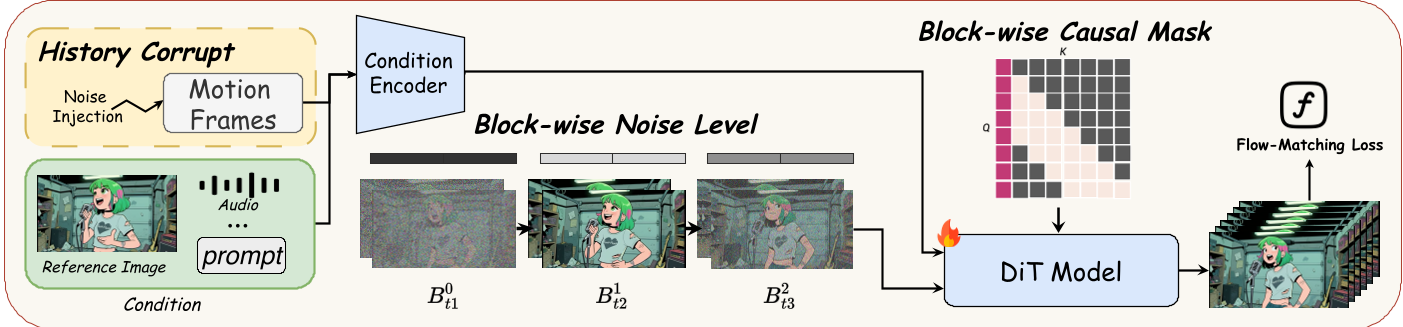 Fig 2: The Two-Stage Training Framework for Causal Distillation.
2. Timestep-forcing Pipeline Parallelism (System)
Standard pipeline parallelism splits layers across GPUs. Live Avatar's TPP splits timesteps.
- GPU 1 always handles the first denoising step.
- GPU 2 handles the second, and so on. Because each GPU is dedicated to a specific noise level, it can keep its own specialized KV Cache. This eliminates huge communication overheads and allows the system to output frames at a blistering 45 FPS.
Solving the "Infinite-Length" Problem
To prevent the avatar from "decaying" over hours of generation, the authors introduced a suite of stability tools:
- History Corrupt: Injecting noise into the KV cache during training acts as a regularizer, preventing the model from over-relying on perfect past frames which won't exist at inference.
- Adaptive Attention Sink (AAS): This anchors the model to a "Sink Frame" (the original identity photo) to prevent the appearance from changing over time.
- Rolling RoPE: Rotary Positional Encodings (RoPE) usually fail when sequence lengths become massive. Rolling RoPE periodically resets the relative distance, allowing the model to "forget" how much time has passed while keeping local motion smooth.
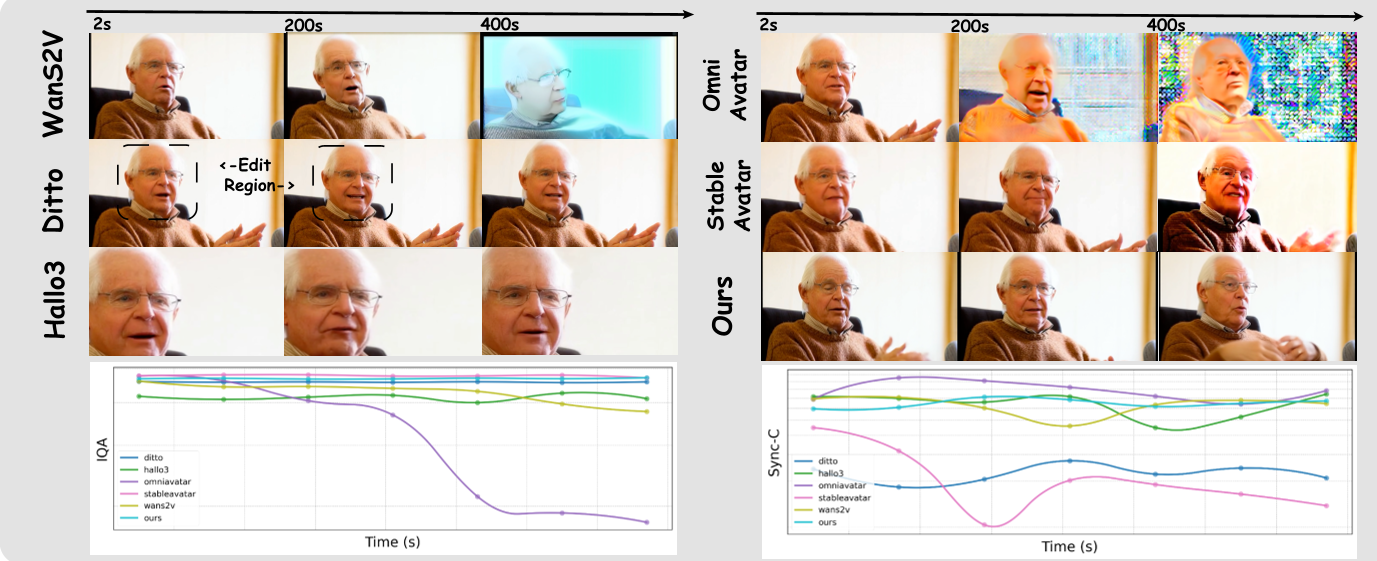 Fig 5: Qualitative comparison showing how AAS prevents desaturation and Rolling RoPE prevents identity drift.
Experimental Results: Breaking the Limits
The experimental results on the new GenBench benchmark are definitive. While previous SOTA models like Hallo3 or OmniAvatar struggle to exceed 1 FPS at large scales, Live Avatar maintains 45.2 FPS.
| Method | FPS | Infinite Length | Scale |
|---|---|---|---|
| Hallo3 | 0.26 | No | 5B |
| OmniAvatar | 0.16 | No | 14B |
| Live Avatar (Ours) | 45.2 | Yes | 14B |
Experiments showed that even at the 10,000-second mark, metrics like Dino-S (identity consistency) and Sync-C (audio-lip sync) remained almost identical to the first 10 seconds.
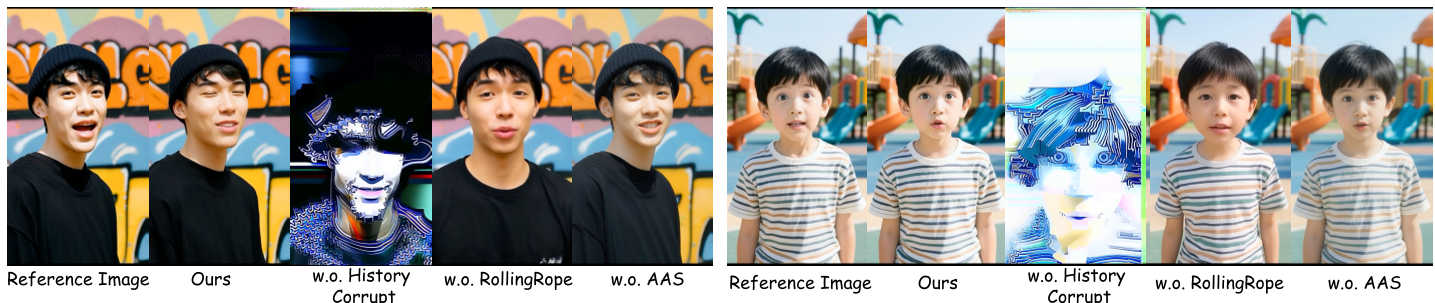 Fig 7: Identity and quality remain perfect even after 2.7 hours of continuous generation.
Critical Analysis & Conclusion
Takeaway: Live Avatar is a masterclass in combining high-level AI research with systems engineering. It proves that the "drift" in autoregressive models isn't an inevitable fate but a technical hurdle that can be solved with smart attention mechanisms and noise scheduling.
Limitations: Despite the high FPS, the Time-to-First-Frame (TTFF) is 1.21s. While fine for most broadcast streaming, for ultra-low latency Facetime-style conversations, the initial delay might still be noticeable. Additionally, the system currently requires a 5-GPU setup (H800s), which may be costly for edge deployment.
Future Work: We expect to see this "Timestep-forcing" logic applied to broader video generation tasks (text-to-video), potentially enabling real-time "infinite" AI-generated cinema or gaming environments.