
LiveCities: Decoding the Urban Pulse through Socially Aware Clustering
LiveCities: Revealing the Pulse of Cities by Location- Based Social Networks Venues and Users Analysis
LiveCities is a visual analytics platform that characterizes urban social dynamics by clustering city venues using Location-Based Social Networks (LBSNs) data. It introduces a "Socially Aware" clustering method that combines geographic coordinates, Foursquare categories, and users' Facebook interest profiles to reveal the hidden "pulse" of a city.
TL;DR
LiveCities is a research project and web application that redefines how we map urban dynamics. By processing over 120,000 check-ins and 400,000 user "likes" from Facebook, it moves beyond simple maps to create "socially aware" clusters of city areas. The core innovation lies in treating venues not just as physical points, but as reflections of the interests and lifestyles of the people who visit them.
Problem & Motivation: Beyond Flat Maps
Most location-based services treat a "Café" simply as a "Café." However, a café frequented by tech entrepreneurs in a startup district has a fundamentally different "pulse" than one popular with students in a historic neighborhood.
Prior works, such as the Livehoods project, utilized "bags-of-checkins" to cluster venues based on movement proximity. While effective for tracking mobility, these methods are "blind" to the identity and motivations of the users. The authors of LiveCities argue that to truly understand a city, we must integrate Contextual Semantics—the distribution of interests (music, sports, business, etc.) of the patrons—to refine how urban zones are classified.
Methodology: The Architecture of "Social Awareness"
The system's backbone is a multi-modal feature extraction process that bridges the gap between different social platforms.
1. Data Enrichment
The researchers combined data from two giants: Facebook (for rich user interest profiles and check-ins) and Foursquare (for standardized venue categorization). By mapping 216 Facebook interest categories to 397 Foursquare venue types, they created a high-dimensional representation of every location.
2. Semantic Correlation via Wikipedia (WLM)
To calculate how much a user's interest in "Classic Rock" relates to a "Pub" venue, the authors used the Wikipedia Link-based Measure (WLM). This treats Wikipedia as a giant semantic manifold, calculating the distance between concepts based on their cross-references.
3. Weighted Feature Vector
The "Socially Aware" clustering uses a modified TF-IDF formula to weight categories. It ensures that common interests (like "Music") don't overshadow niche, more descriptive interests that truly define an area's character.
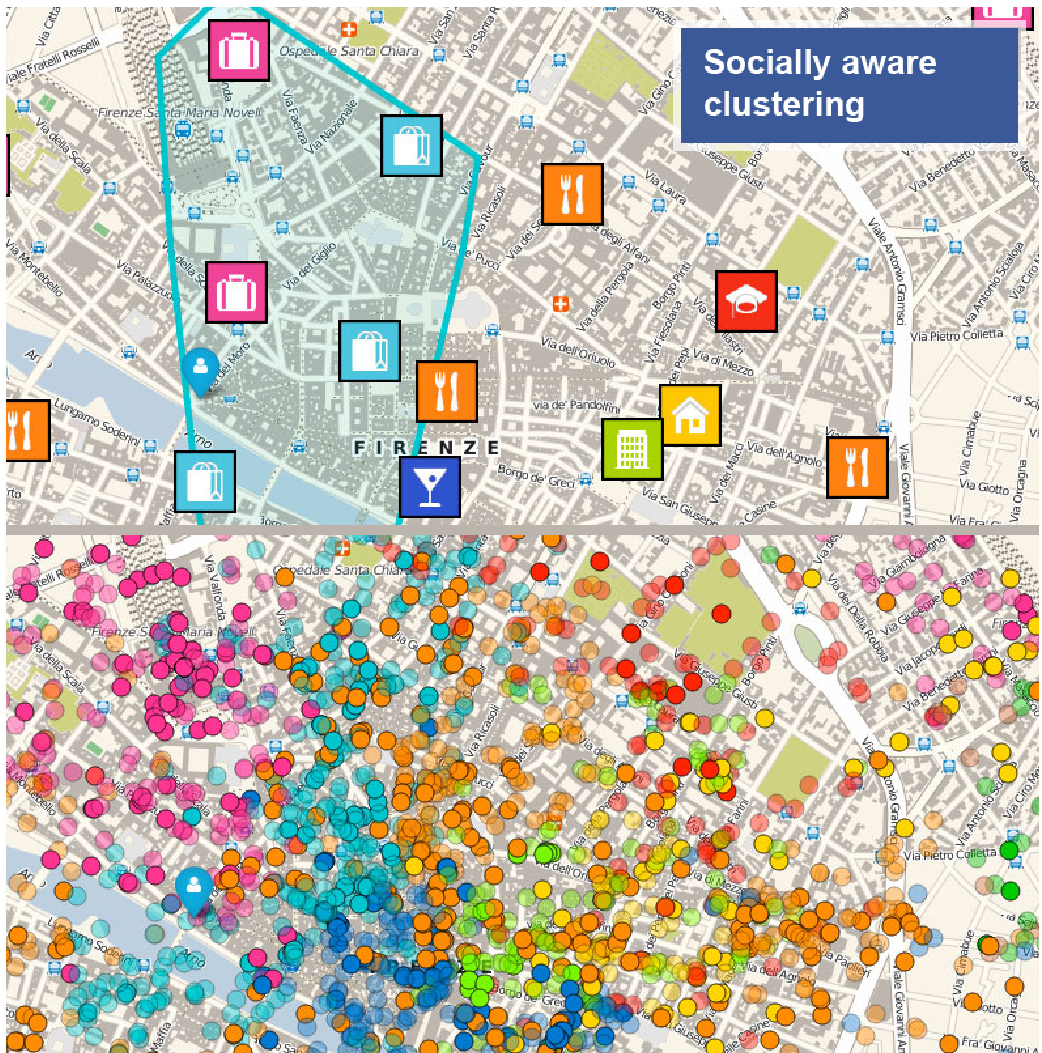 Figure 1: A comparison between standard Foursquare-based clustering (left) and the Socially Aware methodology (right) in Florence.
Experiments & Results: Validating the "Pulse"
The authors didn't just look at the math; they validated their results against the "mental maps" of 28 Florence residents.
SOTA Comparison
The study compared three clustering modalities using Mean Squared Error (MSE) relative to resident perceptions:
- Geographic Only: MSE 0.059
- Foursquare Categories: MSE 0.062
- Socially Aware (Proposed): MSE 0.046
Interestingly, using only venue categories (Foursquare) performed worse than simple geographic proximity, likely due to the noise in static labels. Only when user interests were added did the algorithm outperform the baselines, showing a significantly higher alignment with how humans actually categorize their neighborhoods.
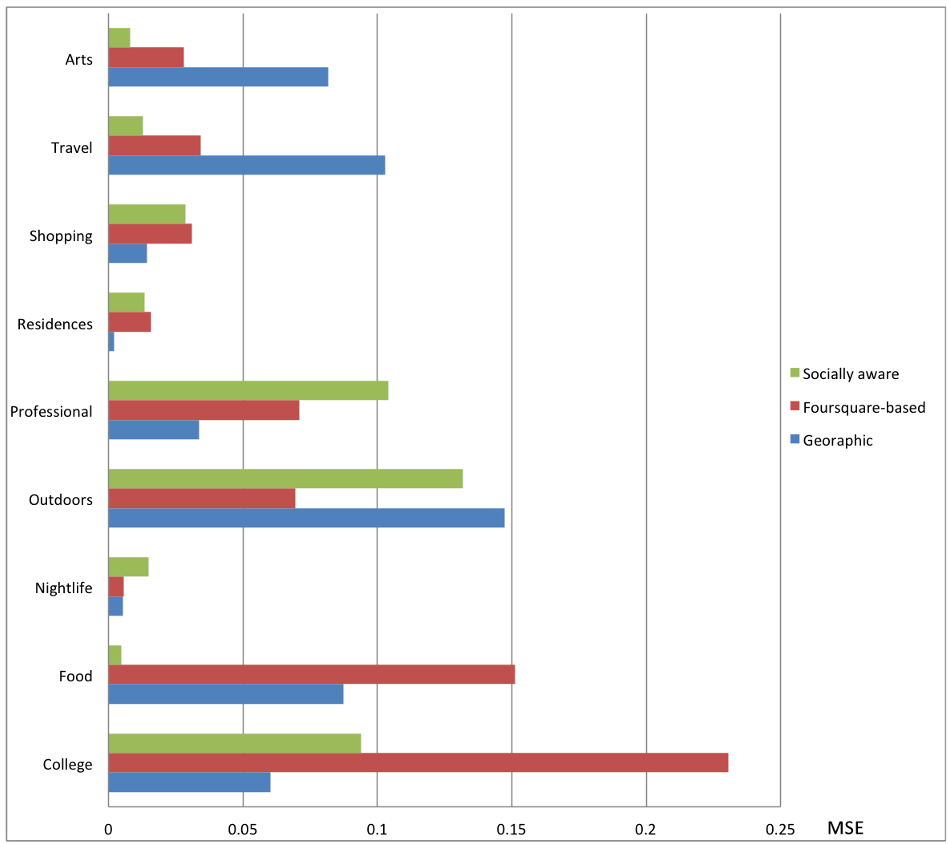 Figure 2: Intra-category MSE comparison showing the superior accuracy of the Socially Aware approach across different urban facets.
Critical Insight & Future Outlook
The brilliance of LiveCities is its recognition that a city is a living organism where physical space and social identity are inseparable.
Takeaway: The "Socially Aware" approach proves that user profiling is not just for targeted ads; it is a vital tool for urban computing.
Limitations: The study is limited by the "Facebook-centric" nature of its data. In an era of fragmented social media (TikTok for trends, LinkedIn for professional hubs, Instagram for aesthetics), a multi-platform "interest graph" would be necessary to capture the modern city's complexity.
Future research could replace the Wikipedia-based semantic distance with LLM-based embeddings (like Ada or Llama), which would allow for even more nuanced understanding of the evolving language of urban life.