
LLaDA2.0-Uni: Bridging Multimodal Understanding and Generation via Unified Discrete Diffusion
LLaDA2.0-Uni: Unifying Multimodal Understanding and Generation with Diffusion Large Language Model
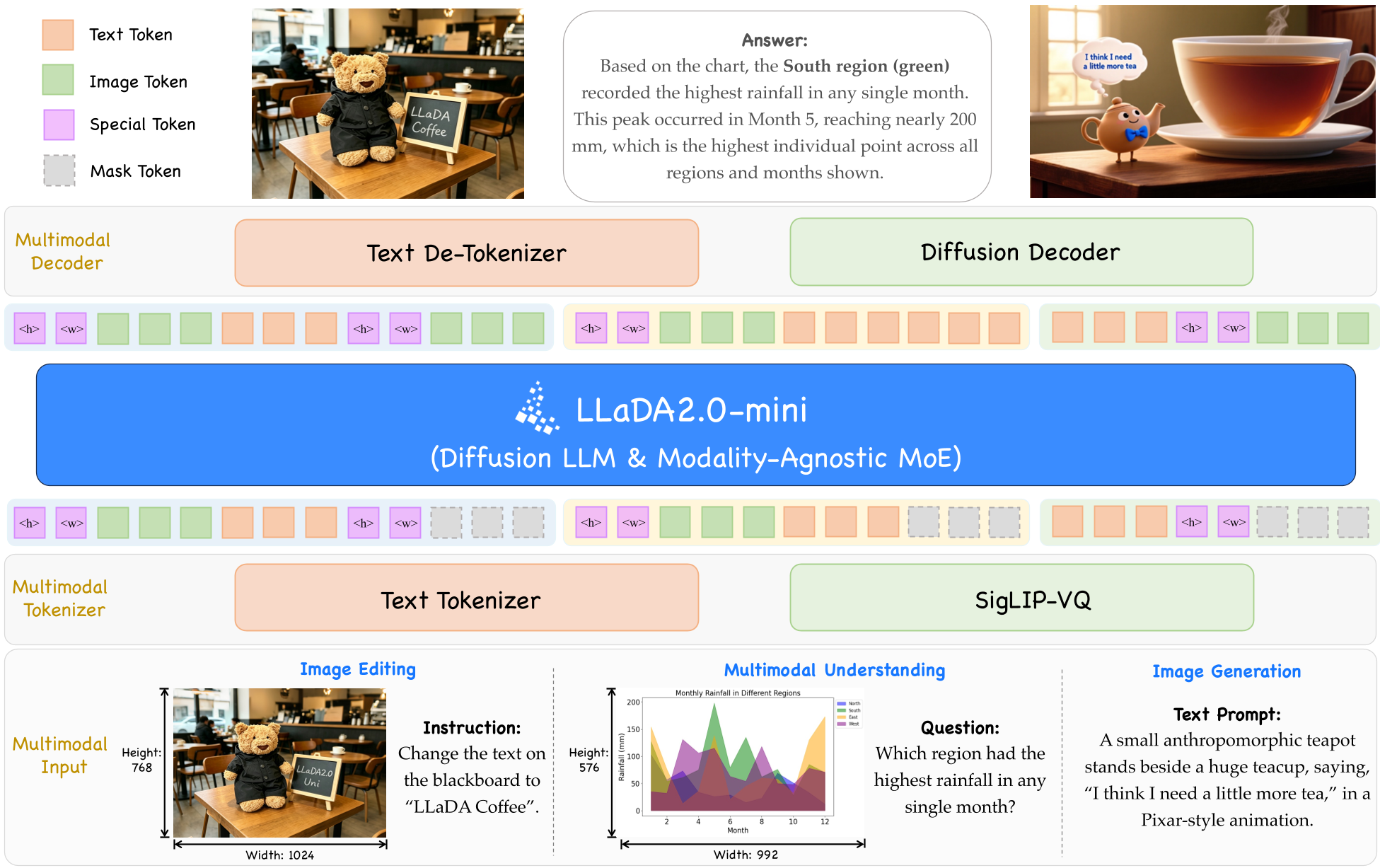
LLaDA2.0-Uni is a unified discrete diffusion Large Language Model (dLLM) that integrates multimodal understanding and generation into a single 16B MoE-based framework. It employs a SigLIP-VQ tokenizer to discretize visual inputs and a dedicated diffusion decoder to reconstruct high-fidelity images, matching specialized vision-language models like Qwen2.5-VL in understanding while excelling in generating and editing images.
TL;DR
LLaDA2.0-Uni is a breakthrough foundation model that finally unifies Multimodal Understanding and Image Generation under a single discrete diffusion framework. By using a 16B Mixture-of-Experts (MoE) backbone and a semantic-first tokenizer (SigLIP-VQ), it eliminates the architectural friction between "perceiving" and "acting." It matches SOTA specialized models in VQA benchmarks while providing high-fidelity, interleaved image-text generation.
The "Unified" Dilemma: Why Is This Hard?
Historically, AI models were specialists. You used a Vision Transformer (ViT) to understand an image and a Diffusion Model (like Stable Diffusion) to create one. Previous attempts to unify them usually fell into two traps:
- Heterogeneous Architectures: Using different "heads" for different tasks, leading to fragmented training objectives.
- Semantic Information Loss: Standard VQ-VAEs focus on pixel-perfect reconstruction, which is great for images but terrible for "understanding" what the image actually means (logic, math, OCR).
LLaDA2.0-Uni challenges this by treating both text and images as discrete semantic tokens that exist in the same mathematical space.
Methodology: The Three Pillars of LLaDA2.0-Uni
1. The SigLIP-VQ Tokenizer
Instead of a traditional VAE, the authors use SigLIP-VQ. It doesn't just compress pixels; it maps images to tokens that are already aligned with the LLM's semantic space. This ensures that the 16B backbone "sees" the image with the same depth of understanding as a specialized vision model.
2. MoE-based dLLM Backbone
The "brain" is a 16B parameter Mixture-of-Experts model. Using MoE allows the model to dynamically allocate computational power—using "text-expert" pathways for reasoning and "vision-expert" pathways for image synthesis—all while sharing the core transformer layers.
3. SPRINT Acceleration
Diffusion models are notoriously slow due to iterative sampling. LLaDA2.0-Uni introduces SPRINT (Sparse Prefix Retention with Inference-time Non-uniform Token Unmasking). By aggressively pruning redundant image tokens and selectively unmasking confident predictions, they achieve a 1.6x speedup in throughput with negligible performance loss.
Experimental Battleground
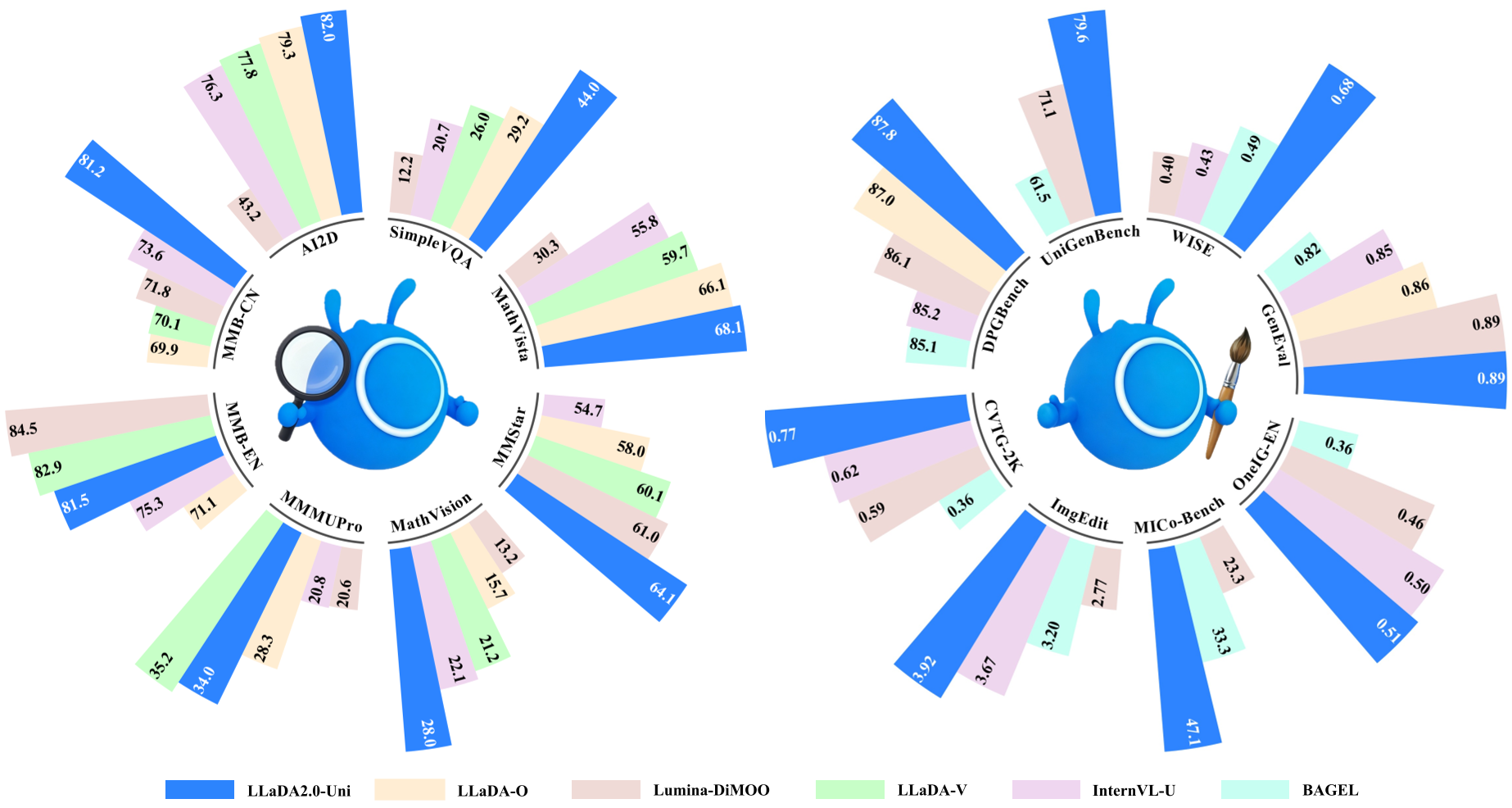
LLaDA2.0-Uni was tested across a gauntlet of benchmarks ranging from OCR to complex math reasoning and high-fidelity image composition.
- Understanding: On the MathVista benchmark, LLaDA2.0-Uni scored 68.1, nearly identical to the specialized Qwen2.5-VL-7B.
- Generation & Editing: It set a new Record on MICo-Bench (47.1), outperforming AR-based unified models like OmniGen2 and InternVL-U by a significant margin.
Ablation: The Diffusion Decoder Turbo
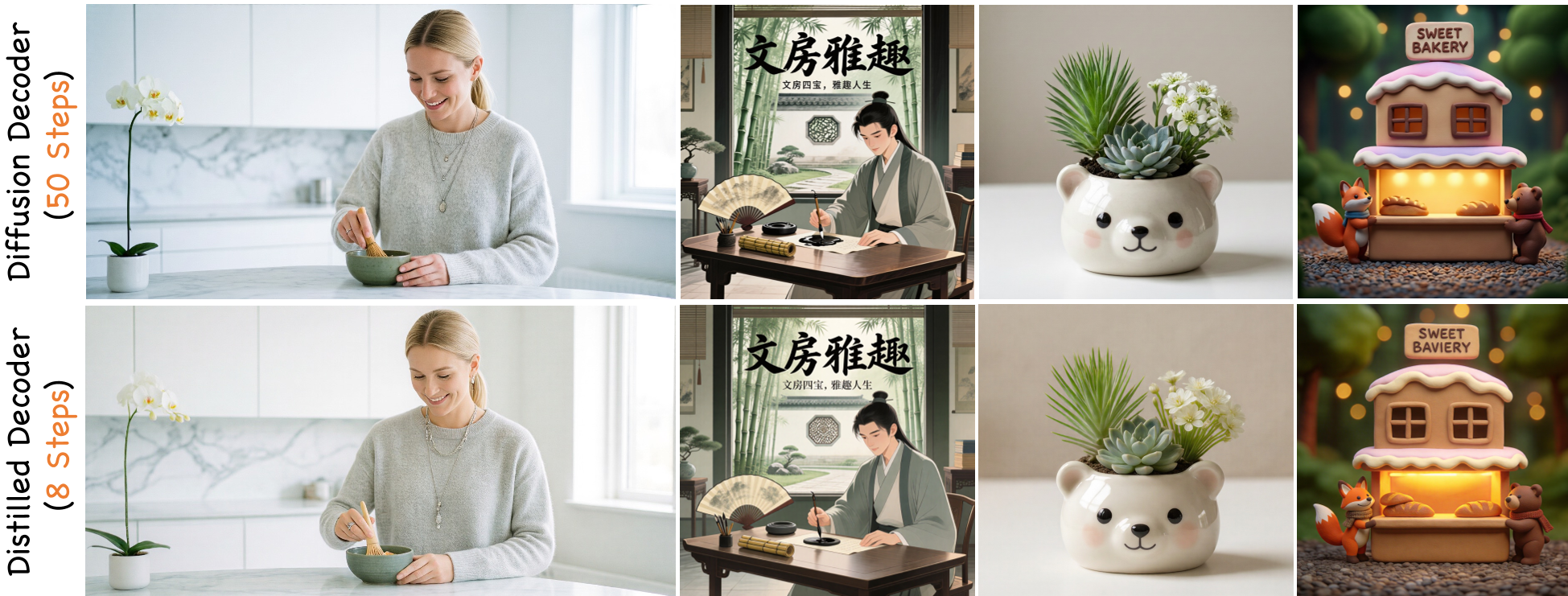
One of the standout features is the Diffusion Decoder Turbo. By applying distillation, the model reduces the required sampling steps from 50 to just 8 steps. This cuts inference time from 32 seconds per image to under 3 seconds, making real-time multimodal interaction a reality.
Deep Insight: Interleaved Reasoning
What makes LLaDA2.0-Uni "next-gen" is its support for Interleaved Generation. It can write a story, generate an image for that story, reason about the image it just created, and then generate the next frame. This "Chain-of-Thought" for multimodal tasks is a major step toward AGI-like capabilities.
Conclusion & Future Look
LLaDA2.0-Uni proves that a unified discrete diffusion objective is not just a theoretical curiosity but a powerful competitor to autoregressive models.
Future Directions:
- Fine-grained details: SigLIP-VQ is semantic-heavy; improving pixel-level reconstruction will further enhance its editing capabilities.
- Reinforcement Learning: The authors are currently exploring RL for unified dLLMs, which could lead to even more efficient and logical multimodal world models.
LLaDA2.0-Uni is now available on HuggingFace, marking a new chapter for open-source foundation models.