
LLaDA2.0-Uni: Cracking the Code of Unified Multimodal Diffusion
LLaDA2.0-Uni: Unifying Multimodal Understanding and Generation with Diffusion Large Language Model
LLaDA2.0-Uni is a unified discrete diffusion Large Language Model (dLLM) that integrates multimodal understanding and generation into a single 16B MoE backbone. By utilizing a semantic SigLIP-VQ tokenizer and a shared block-level masked diffusion objective, it achieves SOTA performance in both VLM benchmarks and high-fidelity image synthesis.
TL;DR
LLaDA2.0-Uni is a 16B Mixture-of-Experts (MoE) model that unifies multimodal understanding and generation through a discrete diffusion paradigm. By moving away from traditional autoregressive "next-token prediction" and pure pixel-reconstruction tokenizers, it achieves parity with specialized Vision-Language Models (VLMs) like Qwen2.5-VL while setting new benchmarks for high-fidelity image editing and generation.
Background: The Great Multimodal Divide
Historically, the AI community has treated Understanding (VQA, OCR) and Generation (Text-to-Image) as separate entities. Unified models usually choose one of two paths:
- Autoregressive (AR): Predicting the next token (e.g., Janus, Emu3). While intuitive, AR models often face parallelization bottlenecks and a lack of bidirectional context.
- Diffusion-based: Offering great generation but historically lagging in understanding due to "semantic-poor" tokenizers that focus on pixel reconstruction rather than conceptual meaning.
LLaDA2.0-Uni bridges this gap by proving that a discrete diffusion large language model (dLLM) can handle both if the underlying tokens are sufficiently semantic.
Methodology: The Three Pillars of LLaDA2.0-Uni
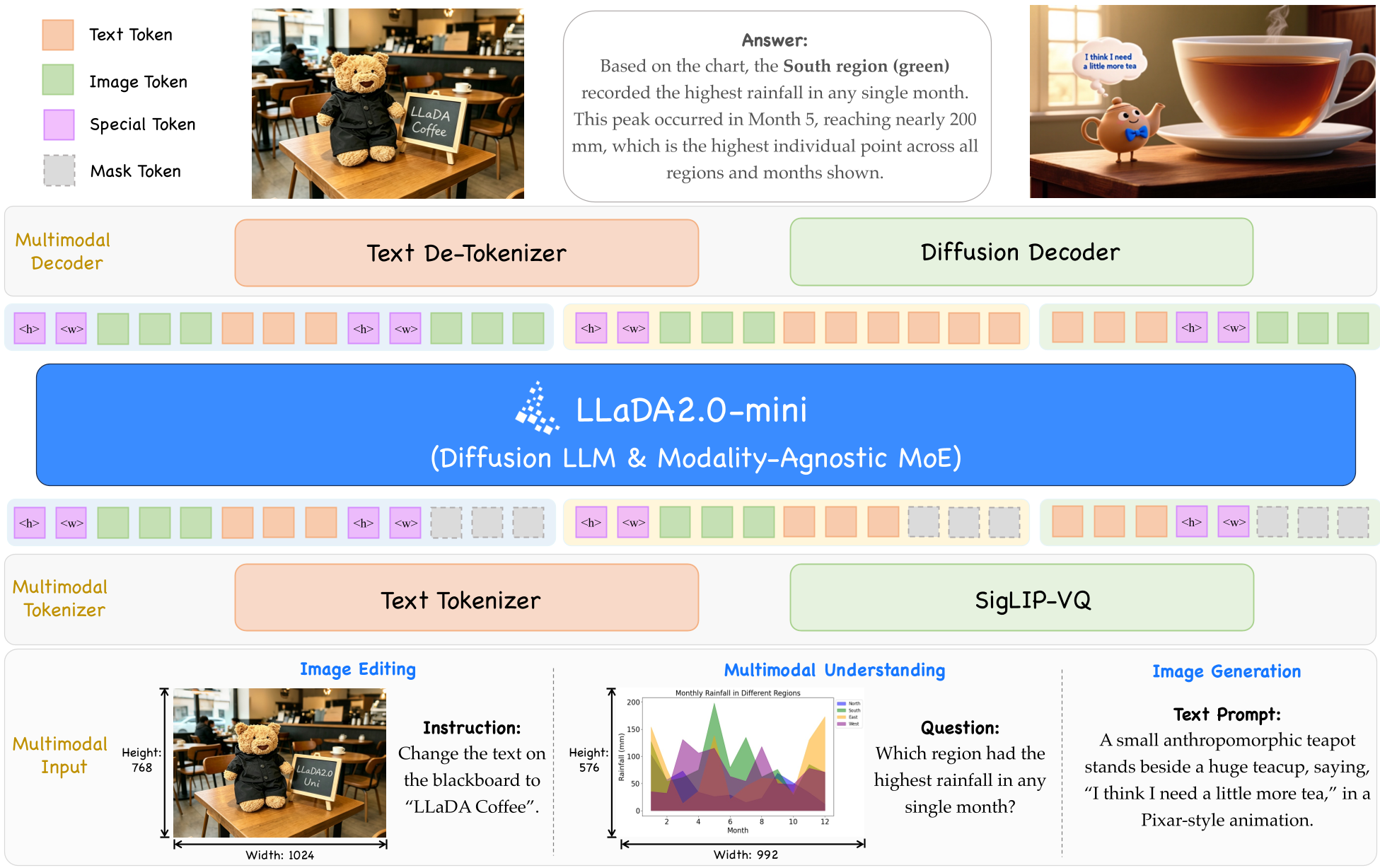
The model's architecture is built on three innovative components:
1. The SigLIP-VQ Tokenizer
Unlike standard VQ-VAEs that try to minimize pixel loss, SigLIP-VQ is trained on understanding tasks. This ensures that the discrete tokens generated from an image carry rich "semantic" weight, making it easier for the backbone to "read" the image like text.
2. 16B MoE Backbone with Block-wise Masked Diffusion
The core is a Mixture-of-Experts dLLM. Instead of standard bidirectional attention (which can be unstable for text), the authors use Block-wise Attention. This allows the model to maintain the parallel decoding benefits of diffusion while respecting the inherent order and structure of language.
3. SPRINT Acceleration
To solve the latency issues typical of diffusion models, the authors introduced SPRINT (Sparse Prefix Retention with Inference-time Non-uniform Token Unmasking).
- Sparse Prefix Retention: Prunes the KV cache based on token importance.
- Adaptive Unmasking: Instead of unmasking a fixed number of tokens per step, it unmasks tokens as soon as the model is confident (), leading to a 1.6x overall speedup.
Experimental Performance: Parity with Specialists
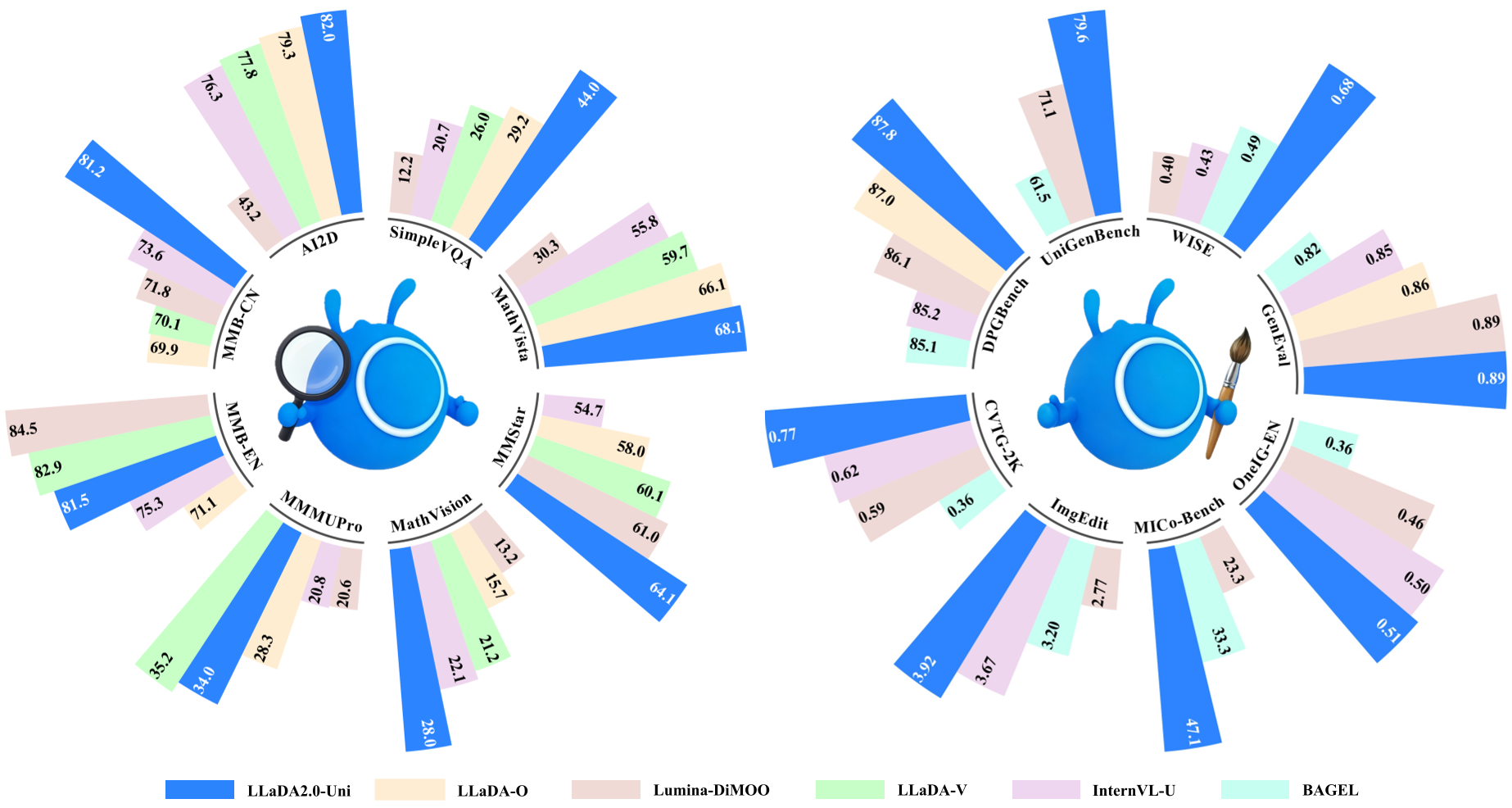
LLaDA2.0-Uni was tested across 21 benchmarks. In Multimodal Understanding, it directly competes with specialized models:
- MMStar: 64.1 (LLaDA2.0-Uni) vs. 63.9 (Qwen2.5-VL-7B).
- MathVista: 68.1 score, showing strong visual reasoning.
In Image Generation, the model shines in compositional tasks where AR models often struggle with spatial relationships.
The Diffusion Decoder Turbo achieves almost identical visual quality to the 50-step version in just 8 steps, reducing latency from 33 seconds to under 3 seconds per image.

Deep Insight: Why Discrete Diffusion?
The move to discrete diffusion represents a shift toward non-linear reasoning. Unlike AR models that are "trapped" in a left-to-right sequence, LLaDA2.0-Uni can refine its understanding and generation of a scene globally. The Interleaved Generation and Reasoning capability (e.g., solving a chess puzzle by reasoning through several steps before generating a move) points toward a future where "thinking" and "seeing" are the same process.
Conclusion: Toward Native Generalists
LLaDA2.0-Uni proves that the gap between specialized VLMs and unified models is closing. By unifying the representation space with semantic discrete tokens and optimizing inference with SPRINT, the authors have provided a scalable blueprint for AGI researchers.
Future Outlook: While the model is powerful, the authors note that the tokenizer still struggles with ultra-fine details (low-level texture reconstruction). Future iterations focusing on "pixel-perfect" semantic tokenization could make this the definitive architecture for all multimodal tasks.