
LLM-as-a-Tutor: Closing the Reward Collapse Gap in Non-Verifiable RL
LLM-as-a-Tutor: Policy-Aware Prompt Adaptation for Non-Verifiable RL
This paper introduces LLM-as-a-Tutor, a framework for non-verifiable reinforcement learning (RL) tasks. It employs a single LLM to act as both an examiner—judging the discriminative quality of prompts via pairwise rollout comparison—and a generator that dynamically appends atomic constraints to "easy" prompts, achieving SOTA performance on instruction-following benchmarks like FollowBench.
TL;DR
In the world of Reinforcement Learning for LLMs, a "judge" is only as good as the "test" it administers. If the prompts are too easy, all students (rollouts) get an A+, and the judge has nothing to reward. LLM-as-a-Tutor solves this by evolving the LLM from a passive reward-giver into an active tutor that detects "saturated" prompts and appends new, atomic constraints to keep the policy challenged.
The "Saturated Prompt" Problem
Most RL pipelines for instruction following use static datasets like WildChat. As the model (the "policy") improves during training, it begins to master these prompts perfectly.
When every rollout from the policy is equally high-quality, the standard deviation of reward scores drops to zero. This is Reward Signal Collapse. Even the most sophisticated LLM judge cannot provide a useful gradient for optimization if there is no variance to distinguish. Previous attempts tried to fix this by changing the rubrics (the grading criteria), but the authors argue that the problem is the test (the prompt) itself.
Methodology: From Judge to Tutor
The research team proposes a dual-role framework where a single model (e.g., Qwen3-8B) manages the training difficulty.
1. Pairwise Saturation Detection
Instead of checking if a prompt is "hard" in isolation, the tutor looks at two actual outputs from the current policy. If the LLM tutor finds them indistinguishable in quality, the prompt is marked as "non-challenging." This pairwise approach is more robust than absolute scoring.
2. Append-Only Difficulty Scaling
When a prompt is too easy, the tutor appends an atomic constraint.
- Original: "Define humanistic techniques."
- Adapted: "...Additionally, cite and explain how TPR, Silent Way, and Suggestopedia illustrate these principles."
This "append-only" strategy is crucial. It ensures that the task difficulty increases monotonically without shifting the original intent of the prompt, unlike "rewriting" methods which often cause distribution drift.
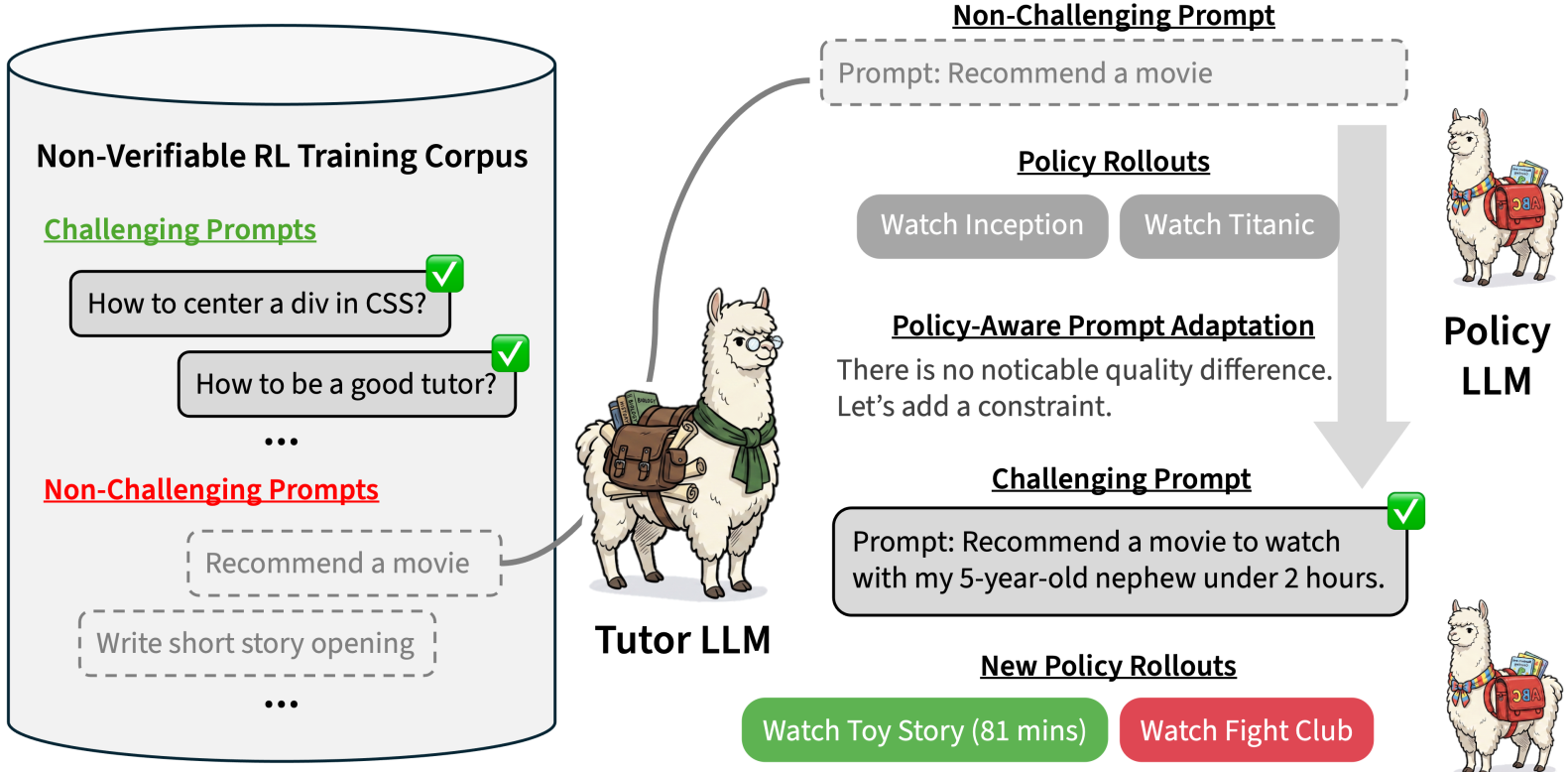 Figure 1: The Tutor monitors policy rollouts and dynamically injects constraints when the policy hits a performance ceiling.
Experimental Breakthroughs
The framework was tested on three major benchmarks: FollowBench, AdvancedIF, and InfoBench.
- Performance: LLM-as-a-Tutor achieved the highest average scores, beating both fixed-prompt baselines and "Policy-Adaptive Rubrics."
- The Scalability Insight: As the policy model size increased (from 0.6B to 4B), the Tutor automatically reacted by increasing the "Constraint-Added Ratio" from 8.1% to 40.5%. This proves the framework is truly self-calibrating.
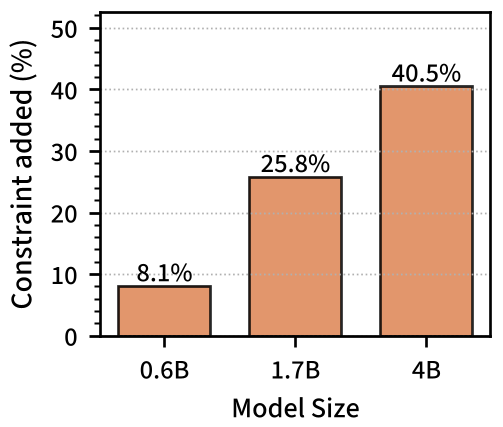 Figure 2: Analysis showing that non-challenging prompts (red) indeed have higher mean reward but dangerously low variance, which the Tutor corrects by adding constraints.
Qualitative Evidence: Why it Works
In one example, the policy effectively mastered an "OSCOLA Footnote" prompt. All rollouts were perfect. The Tutor then added a constraint: "Specify if the journal name should be italicized." Suddenly, the rollouts diverged—some correctly handled the italics, while others failed. This reinstated the discriminative signal, allowing the RL process to refine the model's precision even further.
Critical Analysis & Conclusion
The genius of LLM-as-a-Tutor lies in its simplicity: it treats RL as a dynamic conversation between a teacher and a student.
Key Takeaways:
- Rubrics aren't enough: You cannot fix a zero-variance signal by just changing how you grade; you must change the task to elicit a response difference.
- Append vs. Rewrite: Appending constraints preserves the "DNA" of the original prompt while raising the bar, making it superior to rewriting.
- Future Potential: This framework can easily extend to reasoning (adding more steps) or coding (adding edge cases).
While the tutor adds some inference cost, it is a negligible fraction compared to the overall RL budget, making it a highly practical recipe for the next generation of LLM alignment.