LLM-as-a-Verifier: Unlocking the New Scaling Axis for Autonomous Agents
LLM-as-a-Verifier: A General-Purpose Verification Framework
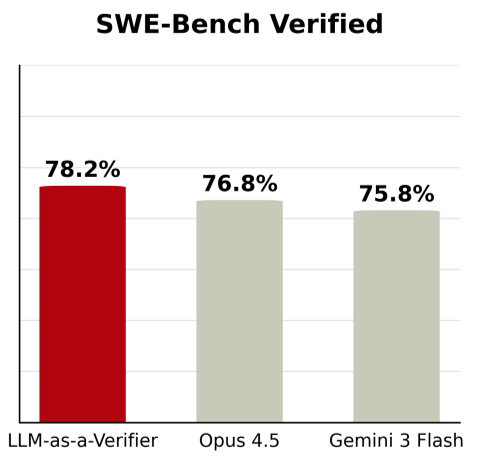
The paper introduces LLM-as-a-Verifier, a training-free framework that treats verification as a new scaling axis for LLMs. By extracting scoring-token logit distributions instead of discrete values, it achieves SOTA performance on Terminal-Bench V2 (86.5%), SWE-Bench Verified (78.2%), and RoboRewardBench (87.4%).
TL;DR
While scaling pre-training and test-time generation has seen massive progress, verification—the ability to judge if a solution is actually correct—has lagged behind. Stanford and UC Berkeley researchers have introduced LLM-as-a-Verifier, a framework that ditches discrete "pass/fail" scores for continuous rewards derived from token logit distributions. This method allows verification to scale, setting new SOTA benchmarks in coding, robotics, and medicine without any fine-tuning.
The Bottleneck: The "Tie" Problem in Coarse Judging
Current LLM-based evaluation typically uses a "Judge" prompt where the model outputs an integer (e.g., 1 to 5). This approach suffers from two fatal flaws:
- Coarseness: Distinct solutions often get the same score, leading to a high "tie rate" (up to 27% on complex terminal tasks).
- Calibration: Discrete tokens don't capture the model's internal uncertainty or "hedged" confidence.
The authors argue that we are leaving performance on the table. If we had an "Oracle" verifier capable of picking the best from a pool of candidates (Pass@N), we could solve nearly 99% of tasks on benchmarks like Terminal-Bench V2.
Methodology: The Three Axes of Verification Scaling
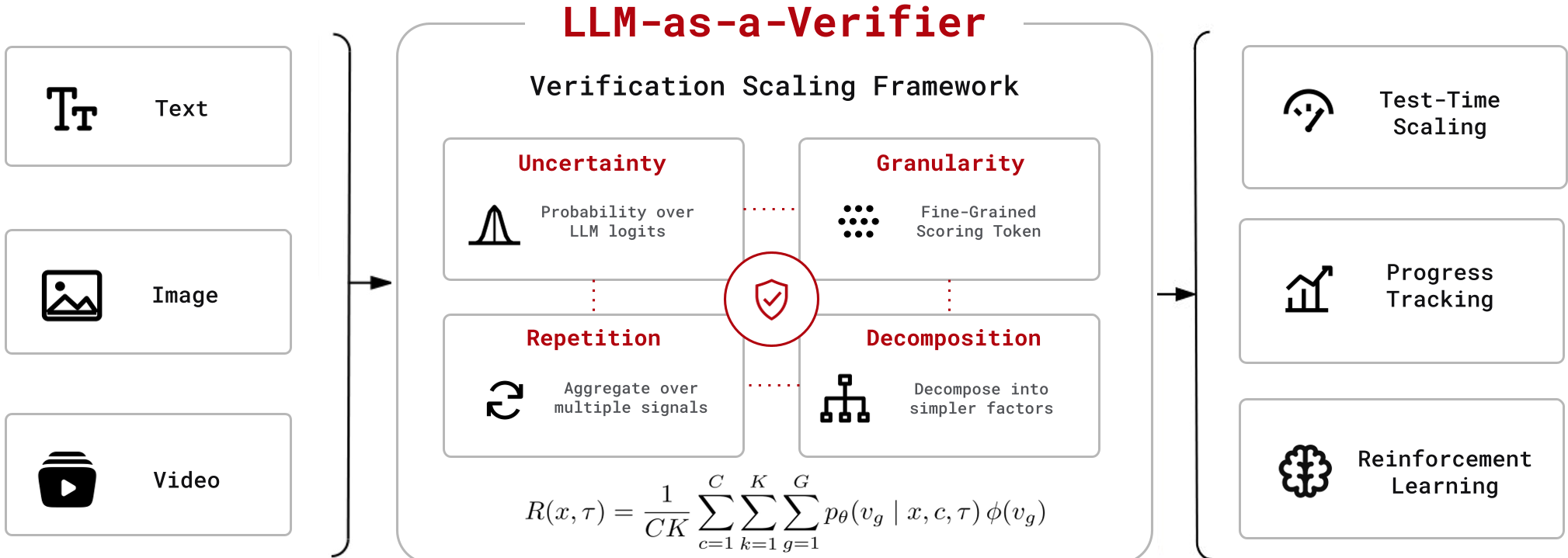
The core innovation is shifting from a discrete reward to a probabilistic expectation:
This formula unlocks three leverage points for performance:
- Score Granularity (G): Instead of just picking the most likely token, the verifier looks at the top-20 logit probabilities. This sharpens the signal-to-noise ratio (SNR) and allows for fine-grained differentiation.
- Repeated Evaluation (K): Monte Carlo averaging across multiple passes reduces variance caused by prompt bias.
- Criteria Decomposition (C): Breaking a monolithic "is this correct?" prompt into sub-rubrics like "Technical Specification," "Output Format," and "Error Logs."
Efficiency at Scale: Probabilistic Pivot Tournament (PPT)
Comparing candidates usually costs in pairwise evaluations—a nightmare for latency. The researchers solved this with a Probabilistic Pivot Tournament.
- Ring Pass: A random cycle compares adjacent pairs to cancel out "Position Bias" (where models favor the first solution shown).
- Pivot Selection: The top performers from the ring become "pivots."
- Tournament: Remaining candidates only battle the pivots, slashing complexity to .
Experiments: SOTA Across the Board
The framework was tested on four diverse benchmarks, showing it is truly general-purpose:
- Coding: High-stakes software engineering (SWE-Bench Verified) reached 78.2%.
- Robotics: Integrating video context, it achieved 87.4% accuracy, beating models trained specifically on millions of robotics comparisons.
- Reinforcement Learning: When used as a dense reward signal, it increased the sample efficiency of SAC (robotics) by 1.8x and GRPO (reasoning) by 1.1x.
Critical Insight: Progress Tracking
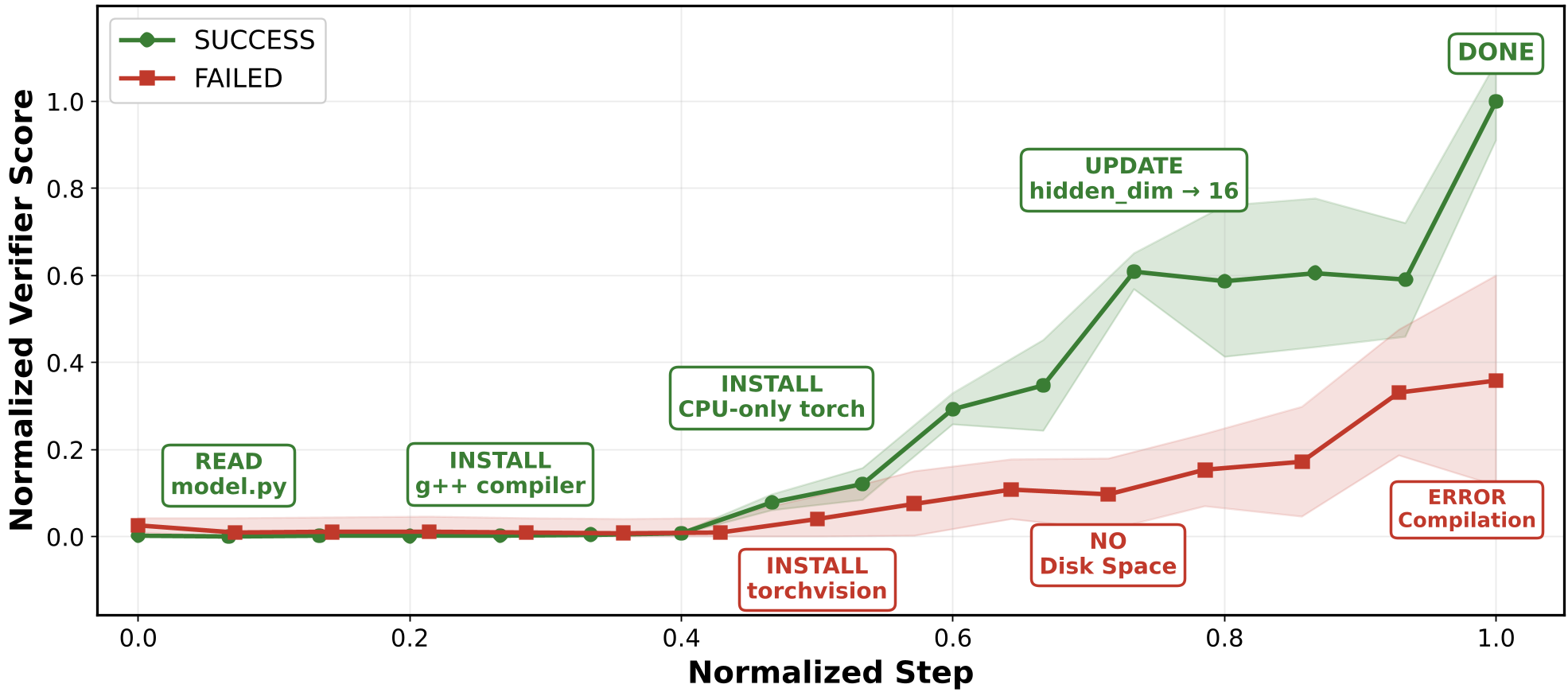
An unexpected "free lunch" of this method is Task Progress Tracking. The continuous scores correlate strongly with chronological progress (Spearman VOC ~0.85). In practice, this means developers can use these scores as a "HUD" for agentic systems, identifying exactly where an agent begins to "drift" or fail before the task ends.
Limitations
- API Accessibility: The method requires logprobs. Closed APIs (like GPT-4o) that hide logits require a two-stage "workthrough" (using the closed model for reasoning and a smaller open model for scoring), which, while effective, adds complexity.
- Latency: Even with PPT, repetitions and criteria increase inference cost.
Conclusion
LLM-as-a-Verifier marks a shift from LLMs as "Creative Generators" to LLMs as "Rigorous Proof-Checkers." By scaling verification, we significantly narrow the gap between "what a model can generate" and "what a model will successfully achieve."