
LLM-RUBRIC: Decoding Human Subjectivity in Automated Text Evaluation
LLM-Rubric: A Multidimensional, Calibrated Approach to Automated Evaluation of Natural Language Texts
This paper introduces LLM-RUBRIC, a framework for automated evaluation of natural language texts that aligns Large Language Model (LLM) predictions with human judgments. By combining LLM-generated probability distributions across multiple rubric-based criteria—such as naturalness, conciseness, and citation quality—the system trains a small calibration network to predict personalized human scores, achieving SOTA results in dialogue evaluation.
TL;DR
LLM-RUBRIC is a sophisticated framework that transforms Large Language Models from inconsistent "black-box" judges into calibrated evaluators that mirror human subjectivity. By evaluating text across multiple rubric dimensions (e.g., naturalness, conciseness) and passing these through a personalized neural calibration layer, the system predicts human satisfaction scores with twice the accuracy of standard LLM prompts.
Background Positioning
While the industry is racing to use "LLM-as-a-Judge," this paper identifies a critical flaw: LLMs are often poorly aligned with the idiosyncratic ways humans actually grade. This work moves beyond simple zero-shot prompting into the realm of calibrated multidimensional measurement, positioning itself as a robust tool for system monitoring and RLFH (Reinforcement Learning from Human Feedback).
The Core Friction: Why LLMs Struggle with "Overall" Quality
Evaluation is inherently subjective. Two human judges might agree that a response is "technically correct" but disagree on whether it was "too wordy." Most automated metrics fail because they attempt to find a single "Ground Truth" where none exists.
The authors discovered that when you ask an LLM "Is the user satisfied?" (Q0), the correlation with humans is abysmal (often worse than a constant mean). However, when you ask the LLM about 8 auxiliary dimensions—like redundancy, citation suitability, and tone—it extracts the "DNA" of the dialogue. The calibration network then learns how a specific human judge "assembles" these traits into a final satisfaction score.
Methodology: The Multidimensional Calibration Engine
1. Rubric Construction
The system uses a manually authored rubric covering:
- Naturalness (Tone)
- Grounding (Did it use the provided documents?)
- Citation Quality (Are the links accurate and optimal?)
- Efficiency & Conciseness (Did it take too many turns?)
2. The Calibration Network
Instead of taking the LLM's text output, LLM-RUBRIC takes the probability distributions of the LLM's responses.
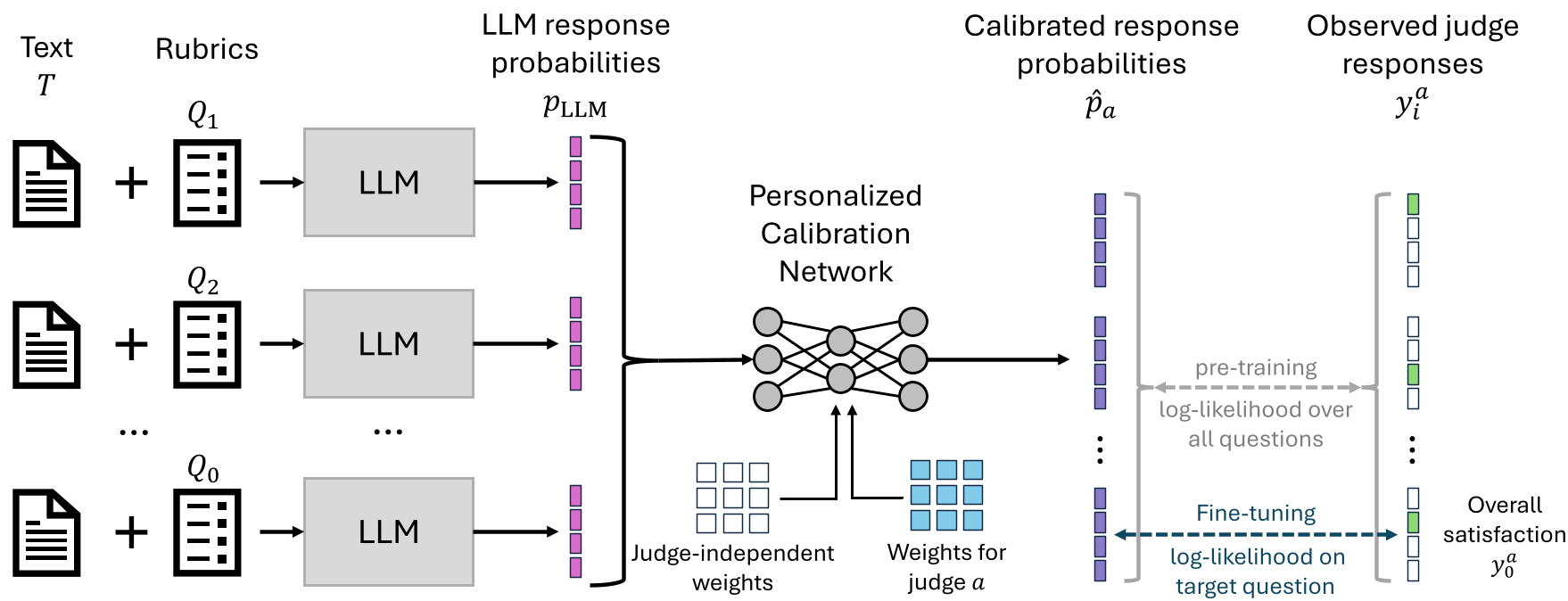
The architecture uses:
- (Shared Weights): To learn general relationships between criteria.
- (Judge-specific Weights): To capture how Judge A differs from Judge B.
- Multi-task Learning: Pre-training on all rubric questions ensures the internal representation is rich with evaluation-specific features.
Experiments and Breakthroughs
The team tested this on "IT Help" dialogues (Microsoft Azure domain), comparing synthetic dialogues with real human-AI interactions.
Key Findings:
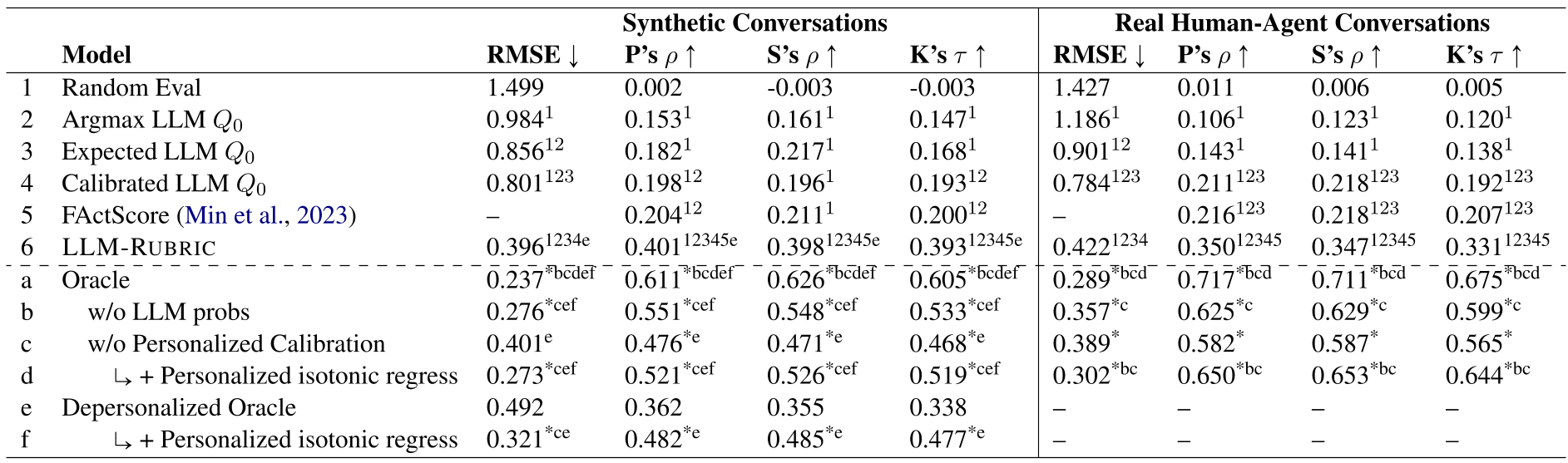
- Uncalibrated LLMs are "Blind": The raw LLM expected score for satisfaction had an RMSE of ~0.90. LLM-RUBRIC slashed this to 0.422.
- Personalization is Paramount: Table 2 shows that removing "personalization" from the model causes the most significant performance drop, proving that evaluation is not one-size-fits-all.
- Zero-shot vs. Calibrated: On difficult dimensions like "Efficiency" (Q8), LLMs have near-zero correlation with humans zero-shot, but the rubric-calibrated model predicts them effectively by looking at the broader context of the dialogue.
Deep Insight: "Disagreement is Signal"
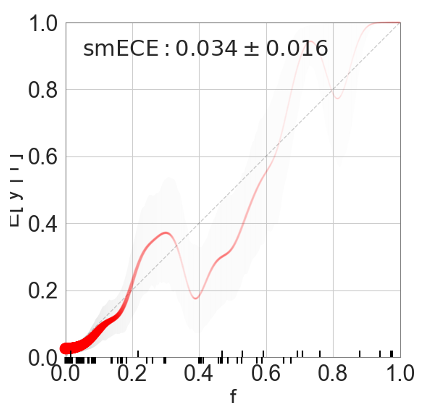
The most profound takeaway from the LLM-RUBRIC approach is the treatment of human disagreement. By using a distribution-based model and judge-specific parameters, the researchers show that human variance isn't just "noise" to be averaged out—it is a measurable pattern. As shown in the reliability diagrams below, the model becomes exceptionally well-calibrated, meaning the predicted probability of a score matches the empirical frequency of that score.
Future Outlook and Limitations
While highly effective, LLM-RUBRIC is compute-intensive, requiring multiple LLM calls per text. Future iterations may use Adaptive Rubrics—where the system dynamically decides which question to ask next based on "Information Gain," effectively stopping once it can predict the human's satisfaction with high confidence.
Conclusion
LLM-RUBRIC provides a blueprint for the next generation of AI evaluation: one that is multidimensional, personalized, and mathematically calibrated. It moves us away from brittle "hero scores" and toward an evaluation stack that truly reflects the complexity of human preference.