
The Invisibility Cloak of OpenAI: Why Some LLMs are Harder to Detect Than Others
Which LLMs are difficult to detect? A Detailed Analysis of Potential Factors Contributing to Difficulties in LLM Text Detection(1)
This paper investigates the detectability of AI-generated (AIG) texts across various LLM families (such as Llama, OpenAI, and Mistral) and writing domains. By training 92 DistilRoBERTa classifiers using the LibAUC library for imbalanced data optimization, the study reveals that OpenAI-generated texts consistently present the greatest challenge for detection systems, particularly in scientific and academic contexts.
TL;DR
Not all AI text is created equal. A new study reveals that while models like Llama and Mistral leave clear "digital fingerprints," OpenAI's GPT-3.5 and GPT-4o generate text that is significantly more difficult to distinguish from human writing. By analyzing entropy and vocabulary patterns, researchers found that OpenAI models mimic the complexity of human thought more closely than their open-source counterparts, posing a major challenge for academic integrity and misinformation detection.
Problem & Motivation: The Detection Gap
As LLMs become ubiquitous in scientific and creative writing, the "arms race" between AI generators and AI detectors has intensified. However, most existing research treats "AI text" as a monolith. The authors of this paper noticed a critical gap: Are some model architectures fundamentally more "human" than others?
Most detectors fail when they encounter "out-of-distribution" models—meaning a detector trained to find Llama text might be completely blind to Claude or GPT-4o. This study seeks to map these blind spots across domains like Reddit opinion pieces, scientific papers, and student essays.
Methodology: Training for Imbalance
The researchers employed DistilRoBERTa as their backbone classifier. To handle the natural imbalance between human and AI samples, they used the LibAUC library, which optimizes the Area Under the Curve (AUC) directly rather than simple accuracy. This is crucial in high-stakes fields like education, where a "false positive" (accusing a student of cheating) is a catastrophic failure.
The RIP Dataset and Rewriting Attacks
Beyond standard generation, the authors created the Rewritten Ivy Panda (RIP) dataset. Instead of simple prompting, they used a "rewriting attack," asking models to imitate a specific human essay's habits. This mimics how users actually use AI to bypass detectors.
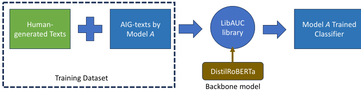 Figure 1: The experimental framework used to evaluate how classifiers trained on one model family perform against others.
Why OpenAI Models Stand Out
The results were striking. While the "super-classifiers" (trained on all data) performed well, individual cross-family testing revealed a massive vulnerability.
- The OpenAI Exception: Classifiers trained on Llama or Mistral data essentially "guessed" (AUC ~0.55) when faced with GPT-4o text.
- Domain Sensitivity: Scientific writing proved the most difficult domain for detection, likely because the technical vocabulary of science is naturally more constrained, masking the "robotic" nature of AI.
The Logic of Complexity: Entropy and OOV
To understand why OpenAI is harder to catch, the authors looked at Shannon Entropy (text complexity) and Out-of-Vocabulary (OOV) ratios.
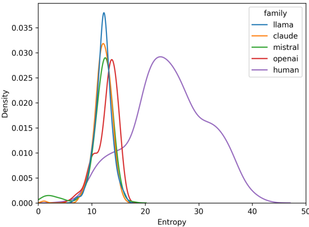 Figure 2: Probability density of Entropy. Note how the OpenAI curve (red) shifts right, nestling much closer to the Human curve (black) than Llama or Mistral.
Human text is unpredictable and complex. Most LLMs produce "flatter," more predictable text. However, OpenAI's models generate higher entropy and use a wider variety of "human-like" vocabulary (lower OOV scores relative to humans), effectively "borrowing" the stylistic richness often missing in other models.
Experiments & Results: The Performance Breakdown
The study's tables show a clear "diagonal" of success: models are best at detecting their own kind. However, the off-diagonal performance for OpenAI is dismal.
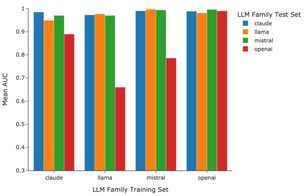 Figure 3: Cross-model performance. The "OpenAI" row shows high performance on others, but other rows show catastrophic drops when testing against OpenAI (the column).
Critical Analysis & Conclusion
Takeaway
The takeaway is sobering: If you haven't trained your detector specifically on OpenAI data, it is likely useless against GPT-4o. OpenAI models have successfully bridged the "complexity gap," making simple statistical detectors obsolete.
Limitations
The study focused on longer texts (essays and papers). Shorter texts, like social media posts or product reviews, remain an open question. Furthermore, as "Top-P" and "Temperature" settings change, the statistical fingerprints change, suggesting that a static detector will always be one step behind a dynamic user.
Future Outlook
The industry must move toward multi-model, multi-domain ensemble detectors. Relying on a single "SOTA" detector is a recipe for failure in an era where the most advanced models are actively mimicking the very entropy that defines human language.