
LBR: Balancing the Social Load in Delay Tolerant Networks
A Load Balanced Social-Tie Routing strategy for DTNs based on queue length control
This paper introduces Load Balanced Social-Tie Routing (LBR), a novel DTN routing strategy that integrates social-tie analysis with a queue length control mechanism. It aims to mitigate the inherent load imbalance in socially-aware routing by diverting traffic from highly-connected "popular" nodes to less congested peers.
TL;DR
Socially-aware routing in Delay Tolerant Networks (DTNs) often falls into the trap of "the rich get richer," where highly connected nodes become overwhelmed with traffic. This paper proposes Load Balanced Social-Tie Routing (LBR), which combines social-tie metrics with a simple yet effective Queue Length Control mechanism. The result? A network where traffic is distributed 50% more evenly than traditional methods like BubbleRap, while maintaining superior delivery ratios.
The "Popularity" Trap in DTNs
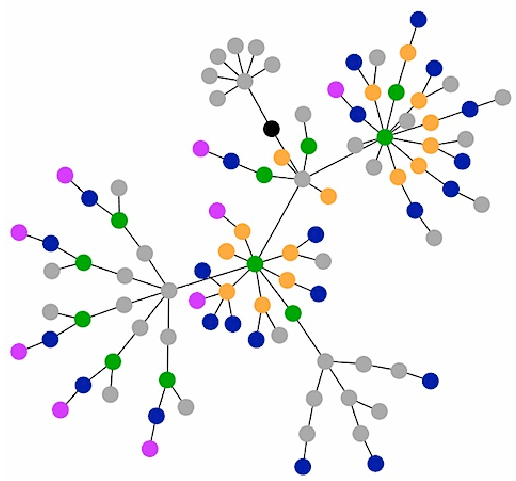
In a sparse mobile ad-hoc network, finding a path to a destination is like finding a friend through a chain of acquaintances. Most existing protocols treat popular "social hubs" (nodes with many encounters) as the ultimate relays.
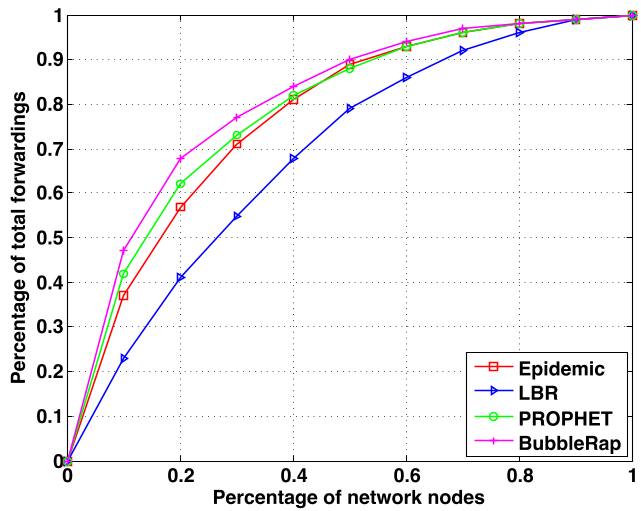
However, there is a fundamental flaw: Social networks follow a fat-tailed distribution. If every node tries to pass its data to the most popular person, those few popular nodes experience massive congestion, leading to dropped packets and network inefficiency. The authors observe that while Epidemic routing (flooding) is inefficient, it actually distributes load better than specialized social protocols simply because it doesn't "over-think" the best path.
Methodology: Social Preference + Congestion Awareness
LBR solves this by introducing a two-step verification before any message is forwarded.
1. The Social Tie Metric
Instead of just looking at who a node knows, LBR calculates a "Social Tie" value based on the frequency and recency of encounters. It uses a weighting function: This ensures that a node that met the destination 5 minutes ago is weighted more heavily than one that met it 5 days ago.
2. Queue Length Control (The Secret Sauce)
This is the core innovation. A node will only forward a message to node if:
- Node has a better social tie to the destination.
- AND Node has a queue length smaller than or equal to node .
By adding this constraint, traffic is naturally "pushed" away from congested hubs and toward alternative nodes with similar social potential but more available resources.
Experimental Results: True Load Balancing
Using real-world mobility data from San Francisco taxi cabs, the researchers compared LBR against Epidemic, PROPHET, and BubbleRap.
- Load Distribution: In BubbleRap, the top 10% of nodes handle nearly half (47%) of all traffic. In LBR, that number drops to 23%. This represents a much healthier, more distributed network.
- Delivery Success: Despite being more "selective" about where it sends packets, LBR achieved a 48.7% delivery ratio, outperforming the SOTA social-heuristics (BubbleRap and PROPHET).
Critical Insight & Conclusion
The genius of LBR lies in its Inductive Bias. It acknowledges that while social popularity is a strong signal for routing, it is also a signal for potential congestion. By treating the queue length as a dynamic "cost," LBR forces the network to find "hidden" social paths that are just as effective but much less crowded.
For future DTN designs, this work suggests that high delivery probabilities should not be used in a vacuum. Integrating local resource state (like buffer space) into the selection heuristic is essential for building robust, scalable mobile networks.
Limitations
- Single-Copy Model: The paper focuses on single-copy routing. In a multi-copy (quota-based) environment, the interplay between queue control and replication might be more complex.
- Dynamic λ: The study uses a fixed decay parameter λ. In highly volatile environments, an adaptive λ might be necessary.