
Beyond Global Knowledge: Precision Local Community Detection via the L-Metric
LOCAL COMMUNITY IDENTIFICATION IN SOCIAL NETWORKS
The paper introduces a novel metric "L" and a two-phase greedy algorithm for local community identification in social networks. Unlike global methods, it operates with limited local information to extract dense subgraphs while effectively filtering out outliers, achieving near-perfect precision on real-world benchmarks.
TL;DR
This paper tackles the challenge of finding social communities when you only see a fraction of the network (e.g., a web crawler’s view). By introducing the L-metric—a ratio of internal to external link density—and a two-phase "Discovery and Examination" algorithm, the authors provide a way to identify clusters with high precision, effectively ignoring the "noise" of outliers that plague traditional greedy algorithms.
Background: The Problem with Greedy Crawling
In a world of massive, dynamic graphs like the World Wide Web or Facebook, we rarely have the luxury of seeing the "whole picture." Most community detection algorithms (like Louvain) require the full adjacency matrix. Local versions exist, but they suffer from a fatal flaw: The Outlier Trap.
As an algorithm "crawls" outward from a starting node, it often picks up "Outliers"—nodes that have very few connections but happen to link back to the community. Standard metrics like Clauset’s or Modularity reward adding these nodes because they increase the "internal edge count" without necessarily making the community stronger.
The Insight: Density over Counts
The authors argue that a community isn't defined by the number of edges, but by the connection density.
The L-Metric
The core of the paper is the metric, defined as:
- : The average internal degree of nodes in the discovered set.
- : The average external degree of the boundary nodes.
By focusing on the average degree, the metric penalizes nodes that bring in a "loose" connection. If a node connects to the community but brings no other internal links, it lowers the average density, and the score drops.
The Two-Phase Algorithm
Identifying a community isn't just about growing; it's about cleaning. The authors propose a two-step process:
- Discovery Phase: A greedy expansion where nodes are added to the candidate set if they satisfy specific criteria (strengthening internal relations or potentially acting as a gateway to an enclosing group).
- Examination Phase: A rigorous "audit." Every node in the candidate set is re-evaluated. If a node's presence doesn't uniquely strengthen the internal-over-external density ratio in its final context, it is discarded.
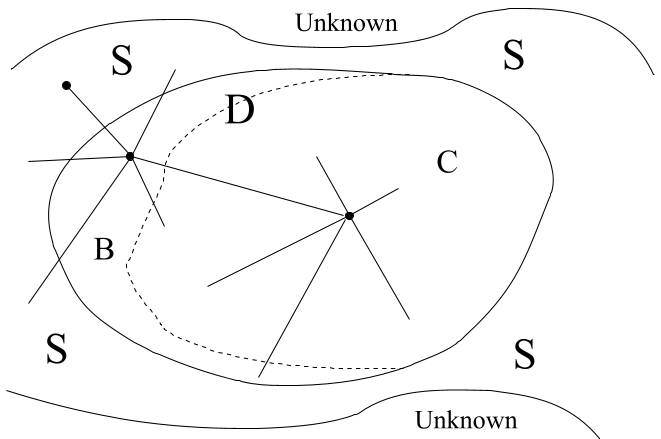 Figure 1: Conceptual visualization of Core (C), Boundary (B), and Shell (S) nodes during the detection process.
Experimental Proof: NCAA and Amazon
The authors compared their work against the baseline (Algorithm R) on two distinct scales:
1. The NCAA Football Network
With 180 universities representing 11 "conferences," this dataset has a clear ground truth. The results were stark:
- Algorithm R: High recall (0.783) but low precision (0.488). It was "greedy" to a fault, sucking in noise.
- The L-Metric: Near-perfect precision (0.927) and a total F-measure of 0.952.
2. Amazon Co-purchase Network (585k Nodes)
When starting from the book The Lord of the Rings, the L-metric successfully built a community of Tolkien-related scholarly reviews and thematic fantasy. In contrast, the standard metric was distracted by "outliers"—children's books and calendars that shared the author's name but lacked the structural "clique" density of the core fantasy community.
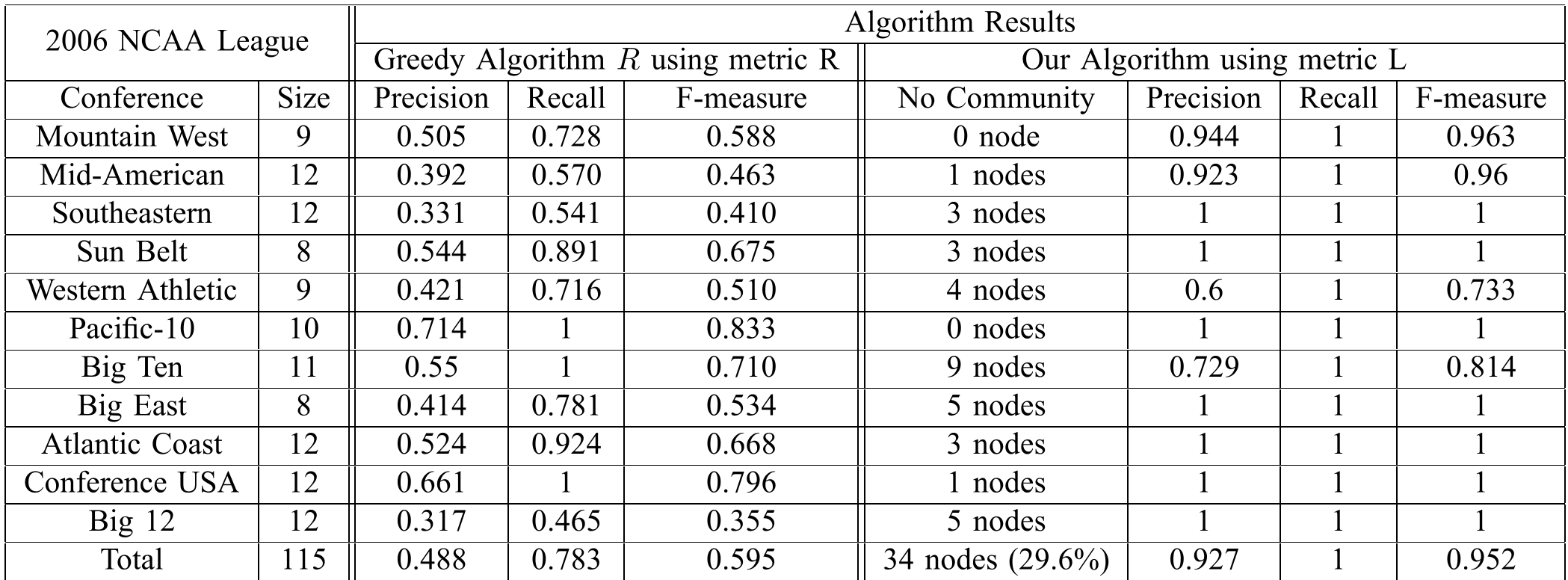 Table 1: Quantitative comparison showing the L-metric's massive jump in Precision and F-measure over Algorithm R.
Critical Analysis & Takeaways
The brilliance of this work lies in its Examination Phase. Most local algorithms are "one-way streets"—once a node is in, it stays. By allowing the algorithm to "regret" its decisions after seeing more of the local neighborhood, the authors solve the problem of "hubs" and "peripheries" that usually lure crawlers off-path.
Limitations:
- The algorithm sometimes concludes "No Community Found" (29.6% of cases in NCAA). While the authors view this as a feature (refusing to return a low-quality result), it suggests that for "periphery" starting nodes, the algorithm needs a more robust initialization, perhaps starting with a small seed set of nodes rather than just one.
Future Outlook: This density-based logic is highly relevant today for Real-time Graph Analysis and Fraud Detection, where identifying a dense "collusion ring" quickly without having to index the entire global network is a critical production requirement.