
Breaking the Utility-Privacy Trade-off: Local DP via Hierarchical Random Graphs
17370_Local Differential Privately Anonymizing Online Social Networks Under HRG-Based Model.
The paper proposes a Group-Based Local Differential Privacy (GLDP) framework for anonymizing Online Social Networks (OSNs) using Hierarchical Random Graph (HRG) models. By transitioning from global to local graph feature extraction and employing a grouping strategy for users with similar local structures, the method achieves significantly higher data utility than previous SOTA global differential privacy approaches.
TL;DR
Publishing social network data often requires a choice: protect user privacy and get a useless graph, or keep the graph useful and risk deanonymization. This paper introduces a Group-Based Local Differential Privacy (GLDP) framework. By focusing on 1-neighborhood subgraphs and using Hierarchical Random Graphs (HRG), it injects significantly less noise than global methods, maintaining essential network properties like clustering and influence patterns.
The Motivation: Why Global DP Fails OSNs
Existing Differential Privacy (DP) techniques provide strong theoretical guarantees, but they have a "noise problem." In a global setting, to hide a single edge, noise must be added relative to the entire network size . For a graph with millions of nodes, the resulting "anonymized" graph becomes a chaotic mess of random edges, losing features like high-degree hubs and tight-knit communities.
The authors' key insight is that deanonymization is local. Attackers usually look at a target's immediate friends (1-hop neighbors). Therefore, anonymization only needs to make a node indistinguishable from a group of "structurally similar" peers, rather than every other node in the existence.
Methodology: Focus on the Neighborhood
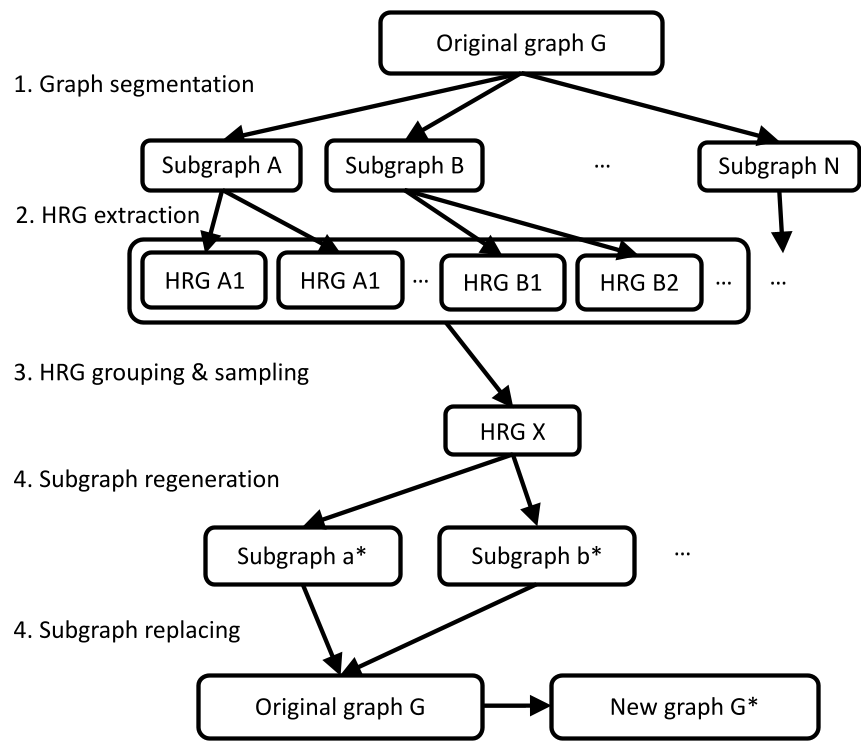
The proposed pipeline consists of four sophisticated steps:
- Maximum Independent Set Discovery: The system finds a set of non-adjacent central nodes. This ensures that subgraphs can be processed and "pasted" back into the global structure without overlapping conflicts.
- Local HRG Extraction: Instead of modeling the whole graph, an HRG is built for each 1-neighborhood subgraph. Using a Markov Chain Monte Carlo (MCMC) process, the algorithm samples HRGs that represent the local topology.
- The Grouping Strategy: This is where the "Local" becomes "Group-Based." Similar subgraphs are grouped together. A representative HRG is chosen for each group to ensure that nodes within that group become indistinguishable to an attacker.
- Virtual Nodes & Outliers: To handle groups where subgraph sizes differ, the authors use "Virtual Nodes" to balance node counts or "Outlier Distinction" to treat unique high-degree nodes with specialized care.
Mathematical Intuition: Reducing Sensitivity
The core of Differential Privacy is Sensitivity (). In the HRG model, the sensitivity is logarithmic to the number of nodes. By moving from the global graph size to the local neighborhood size , the authors mathematically reduce the upper bound of noise required to satisfy the -privacy requirement.
As shown in their derivation: By replacing with a much smaller , the utility is vastly improved for the same .
Experimental Showdown: Local vs. Global
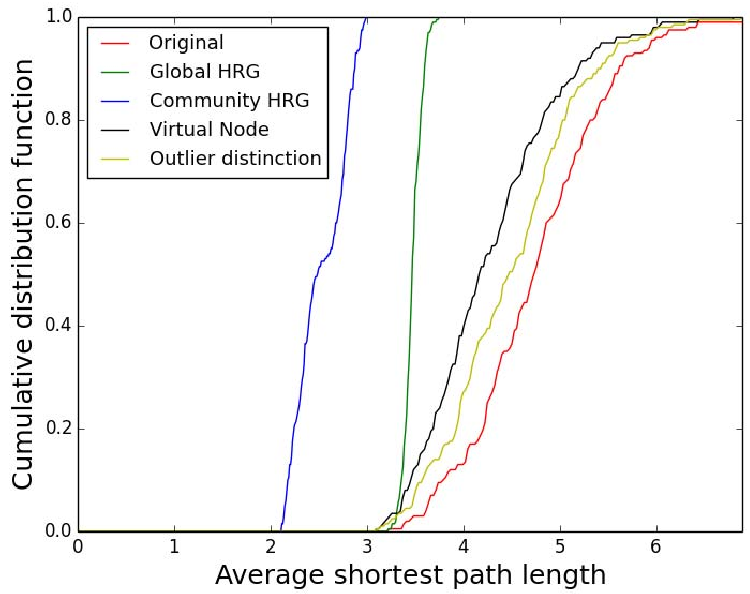
The authors tested their approach against "Global HRG" and "Community HRG" methods using datasets like Facebook and Enron.
- Preserving Clustering: In the Enron dataset (Fig. 8), the Original graph has many nodes with high clustering coefficients (close to 1.0). Global DP flattened this to near zero. The "Outlier Distinction" method (red line) almost perfectly mirrored the original distribution.
- Efficiency: The local approach is significantly faster. Because the complexity of building HRGs scales with graph size, splitting the network allowed the researchers to process 10,000 nodes while Global methods were still struggling with exponential state spaces.
Critical Insights & Future Outlook
This paper proves that topology matters. By respecting the hierarchical nature of social relationships (via HRG) and the local nature of privacy threats, we can achieve high-fidelity data publishing.
Limitations: While the 1-neighborhood model is powerful, it might still be vulnerable to "Fingerprinting" attacks that look at 2-hop or 3-hop structures if an attacker has extensive knowledge. Future work could investigate expanding these local models to -neighborhoods without hitting the "noise wall" again.
Takeaway: For engineers building privacy-preserving systems, this work suggests: Don't anonymize the ocean if you only need to hide a fish in a school; focus on local groups.