
LGSM: Redefining Community Detection via Local Greedy Search and Core-Periphery Structures
A Local Greedy Search Method for Detecting Community Structure in Weighted Social Networks
This paper introduces the Local Greedy Search Method (LGSM), a novel community detection algorithm for weighted social networks that distinguishes between "community cores" and "peripheries." By utilizing a heuristic expansion strategy starting from maximal weighted cliques, LGSM achieves state-of-the-art performance in both overlapping and non-overlapping community detection with a highly efficient time complexity of O(|E|log|V|).
TL;DR
Community detection in massive social networks remains a balancing act between accuracy and computational cost. LGSM (Local Greedy Search Method) breaks this trade-off by modeling communities as a combination of a dense "core" and a sparse "periphery." It achieves high-fidelity results for both overlapping and non-overlapping structures with a lean O(|E|log|V|) complexity, making it a powerful tool for modern, large-scale graph analysis.
The Intuition: Not All Members are Created Equal
Most community detection algorithms treat a community as a single uniform cluster of nodes. However, real-world social groups (like research collaborations or friend circles) naturally have a core-periphery structure.
Think of a research lab: the primary investigators and senior students form a densely connected "core," while visiting scholars or occasional collaborators sit at the "periphery." Current SOTA methods often struggle because they either:
- Over-simplify: Ignore edge weights and node roles.
- Over-compute: Use global optimization (like Modularity ) which becomes intractable ( or ) as the network grows.
Methodology: The Local Greedy Approach
LGSM sidesteps global bottlenecks by focusing on local expansion. The process follows a three-stage pipeline:
1. Seeding with Weighted Cliques
Instead of starting with a single node, LGSM identifies the node with the highest Weighted Degree and derives a maximal weighted clique to serve as a high-density "seed."
2. Heuristic Expansion
LGSM expands the seed into a Community Core using two specific rules:
- Internal Weighted Degree (): Nodes from the boundary set are added based on their connection strength to the current core.
- Weighted Edge Density (WED): Expansion continues until the density falls below a threshold .
- Overlap Control (): A parameter allows nodes to join multiple communities if their internal connection is significantly stronger than their external connection.
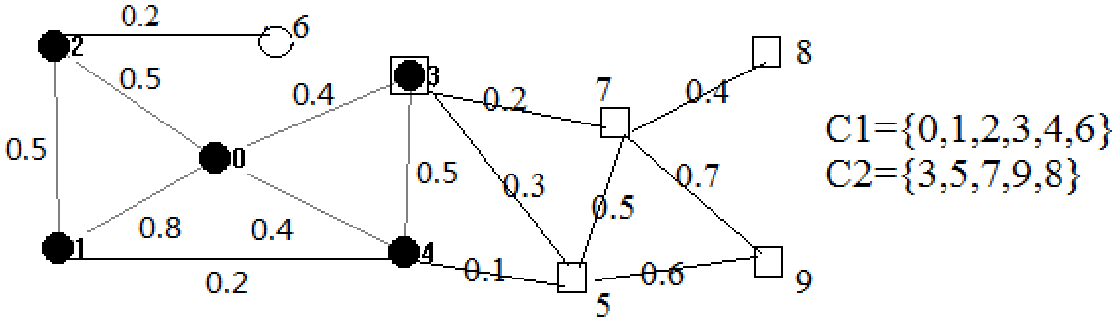 Figure 1: Conceptual illustration of core-periphery structure where Node 3 acts as an overlapping member between two cores.
3. Modularity Optimization
To prevent over-segmentation, LGSM performs a final optimization by merging communities that result in the maximum gain of Modularity ().
Performance & Scalability
The true strength of LGSM is revealed in its scalability. While classical methods like Spectral Mapping (SM) or Extremal Optimization (DA) struggle with growth, LGSM’s dependency on local connections allows it to process large social graphs efficiently.
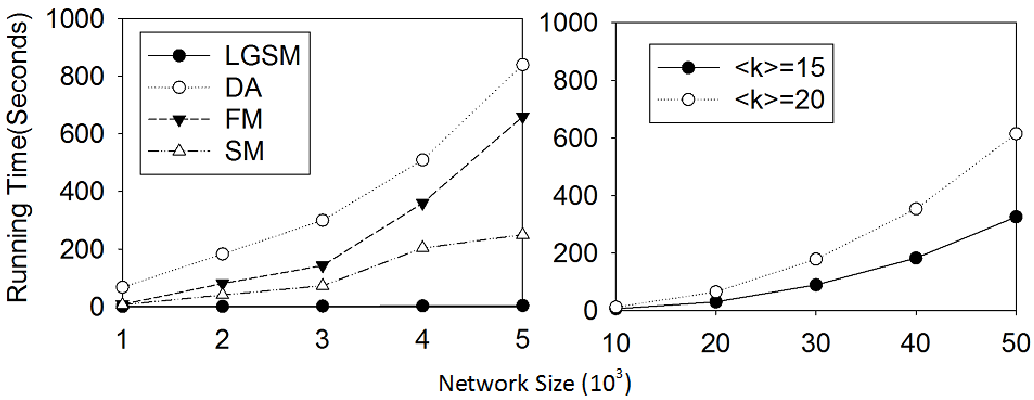 Figure 2: Running time comparison showing LGSM processing 50,000 nodes in roughly 800 seconds, significantly outperforming modularity-based baselines.
Key Findings from Experiments:
- Accuracy: In LFR synthetic benchmarks, LGSM consistently yielded higher Normalized Mutual Information (NMI) than CFinder and EAGLE, particularly as the number of community memberships () per node increased.
- Robustness: The algorithm proved stable across varying thresholds of and , suggesting the heuristic is grounded in the inherent structural properties of the network rather than hyperparameter tuning.
Critical Analysis & Future Outlook
The "Local Greedy" nature of LGSM makes it an "embarrassingly parallelizable" candidate for distributed graph processing frameworks like Spark GraphX or Giraph.
Limitations:
- Threshold Sensitivity: While the authors suggest should be 5x the average network density, very heterogeneous networks might require more adaptive thresholding.
- Initial Seeds: The performance still relies heavily on the quality of initial weighted cliques. In extremely sparse graphs where cliques are rare, the seeding phase might need fallback heuristics.
Takeaway: LGSM moves us away from expensive global computations toward a more "physical" understanding of communities—where membership is defined by local density and specific node roles.