
L-HIC: Taming the Divergence of Social Influence with Localized Harmonic Centrality
An index for the “local” influence in social networks
The paper introduces Local-Harmonic Influence Centrality (L-HIC), a novel node centrality index for social networks that generalizes Harmonic Influence Centrality (HIC) by incorporating an external "bias" factor. It provides a distributed Message Passing Algorithm (MPA) to estimate L-HIC, proving its convergence on graphs with at most one cycle (unicyclic graphs).
TL;DR
Researchers have developed Local-Harmonic Influence Centrality (L-HIC), a new way to identify the most influential members of a social network. By borrowing concepts from electrical circuit theory—specifically how voltage decays when a circuit is grounded—they created a "local" measure that prevents individual influence from being over-calculated in large groups. Crucially, they developed a distributed algorithm that allows nodes to calculate their own importance just by "talking" to their neighbors.
Background: When Influence Goes Out of Bounds
In social network analysis, identifying "stubborn agents" (those who never change their minds) and their impact is critical for understanding opinion dynamics. Prior work on Harmonic Influence Centrality (HIC) was a breakthrough, but it had a flaw: in a long chain of people, HIC suggests that a person at the end of the chain exerts an equal amount of influence on everyone behind them, no matter how far away they are. In the real world, influence decays. Without this decay, the mathematical model "diverges" (reaches infinity) as the network grows.
The Insight: Social Networks as Electrical Circuits
The authors solve this by treating the social network as an electrical grid:
- Nodes are junctions.
- Stubborn agents are voltage sources (holding a fixed "opinion" or potential).
- The "Bias" is a connection to a reference ground.
By introducing a bias factor (), every agent has a slight "anchor" to a baseline opinion. Mathematically, this acts like a resistor connected to the ground. This simple addition ensures that the influence of a stubborn agent decays as it travels through the network, making the metric "Local."
Methodology: Distributed Message Passing
Calculating centrality usually requires a "god-like" view of the entire network to invert large matrices. To avoid this, the authors propose a Message Passing Algorithm (MPA).

In this decentralized approach, nodes exchange two values:
- (Weighting): An estimate of the potential (opinion) transmitted.
- (Influence): An estimate of the cumulative influence within a subgraph.
Breaking the Cycle
The biggest technical challenge in message passing is loops. If a message travels in a circle, it can cause the algorithm to spin out of control or never settle on a value. This paper provides a rigorous proof that for unicyclic graphs (graphs with only one loop), the algorithm is guaranteed to converge to a stable answer.
Experiments and Results
The authors compared the standard HIC with their L-HIC on a line graph of 50 nodes.
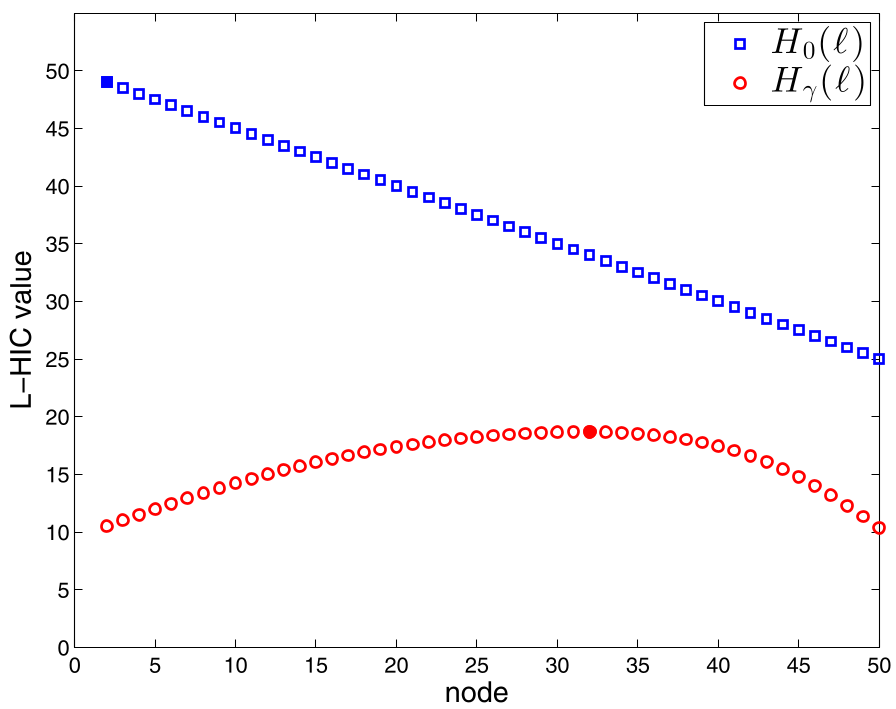 Fig 1: Circles represent L-HIC (localized), while squares represent the old HIC. Note how HIC values remain high/unbounded, while L-HIC shows a distinct decay.
Even though the MPA is an approximation, the study found it highly effective at ranking nodes. In a random graph simulation, the ranking produced by the distributed algorithm had a Spearman correlation of over 0.99 with the true mathematical values.
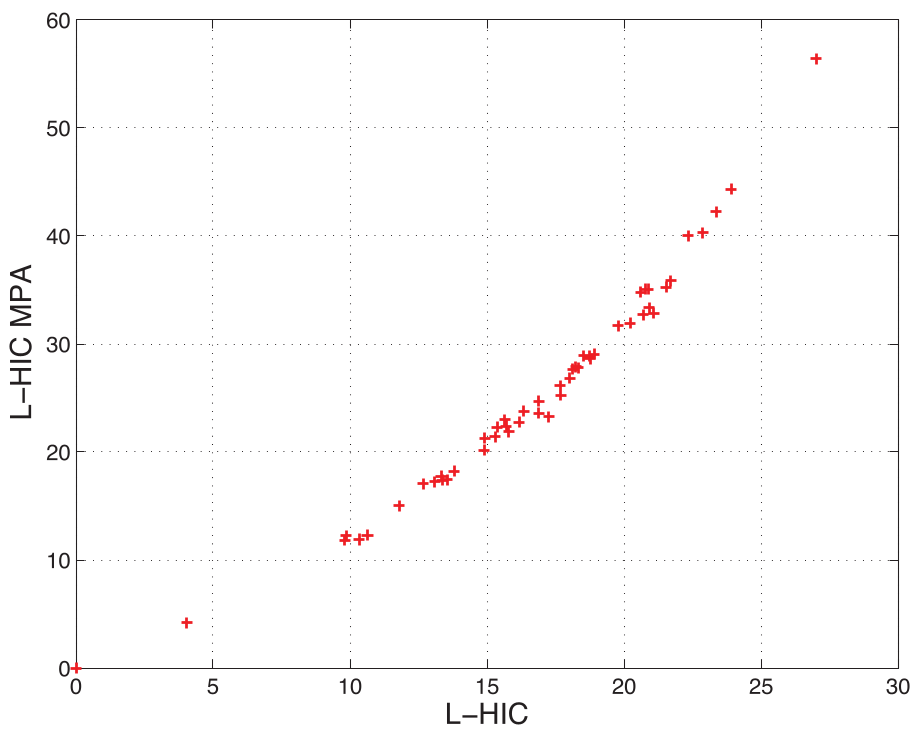 Fig 2: The correlation between true L-HIC and MPA estimates is nearly a straight line, proving that the distributed method is reliable for identifying top influencers.
Conclusion and Future Outlook
The Local-Harmonic Influence Centrality represents a more realistic and computationally efficient lens for social dynamics. By proving convergence on unicyclic graphs, the authors have laid the groundwork for applying these algorithms to more complex, "loopy" real-world networks like Twitter or Facebook.
Takeaway for Practitioners: When modeling influence, always account for external "noise" or "bias." Not only does it make your model more accurate to human behavior (where we aren't purely influenced by our immediate peers), but it also makes the math more stable and suitable for distributed computing.