
Beyond Local Pixels: Mastering Pattern Collocations via Regional Co-occurrence Factorization
Local Pattern Collocations Using Regional Co-occurrence Factorization
The paper introduces a novel regional co-occurrence framework for describing local pattern collocations in image and object categorization. It leverages superpixel segmentation and a factorization scheme (SVD) to capture spatial relationships between visual primitives across wider neighborhoods, achieving state-of-the-art performance when combined with traditional descriptors and Deep CNNs.
TL;DR
While modern computer vision is dominated by deep learning, the "intuition" of how visual primitives (colors, shapes, textures) relate to each other spatially remains a potent cue. This paper proposes a Regional Co-occurrence Framework that uses superpixels and SVD factorization to capture these relationships. By looking at how patterns in one region "collocate" with neighbors, the researchers achieved significant performance boosts across diverse datasets, from ancient Dunhuang paintings to fine-grained animal classification.
The Missing Link: Spatial Context
Standard local descriptors are often "blind" to the bigger picture. A SIFT descriptor knows about a local gradient; a Color Name descriptor knows the hue of a patch. However, a human recognizes a panda not just by "black" and "white," but by the specific collocation of black ears next to a white head. Prior attempts to capture this (like 8-connected pixel co-occurrence) were too local, while "visual phrases" were often too sparse or computationally expensive.
Methodology: The Power of Regional Factorization
The authors' approach can be broken down into four sophisticated steps:
- Superpixel Partitioning: Using SLIC to create homogeneous regions that respect object boundaries better than rigid grids.
- Feature Quantization: Transforming raw features (SIFT, CN, LBP) into histograms within each superpixel.
- Cross-Regional Co-occurrence: Mathematically defined as the Kronecker product of pattern frequencies between neighboring superpixels. This captures the probability that "Pattern A" appears next to "Pattern B."
- SVD Factorization: To handle the high dimensionality of co-occurrence matrices (especially when mixing different features like shape and color), SVD is used to find the most discriminative latent patterns.
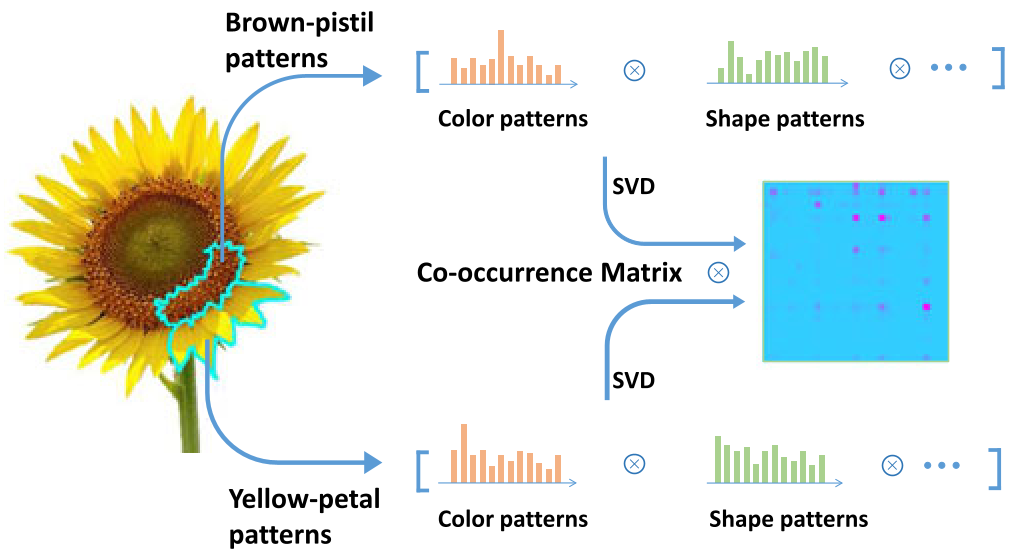 Figure 1: The proposed regional co-occurrence framework illustrating the flow from superpixels to the final descriptor.
Why Factorization?
The dimensionality of a co-occurrence matrix grows quadratically with the codebook size. By applying factorization, the model doesn't just store raw counts; it learns a "basis" for how different visual styles (like the curves and colors in a Baroque painting) interact.
Experimental Results: Quantitative Superiority
The team tested the framework on eight challenging datasets. The results consistently showed that adding the Regional Co-occurrence (RC) module improved every base descriptor.
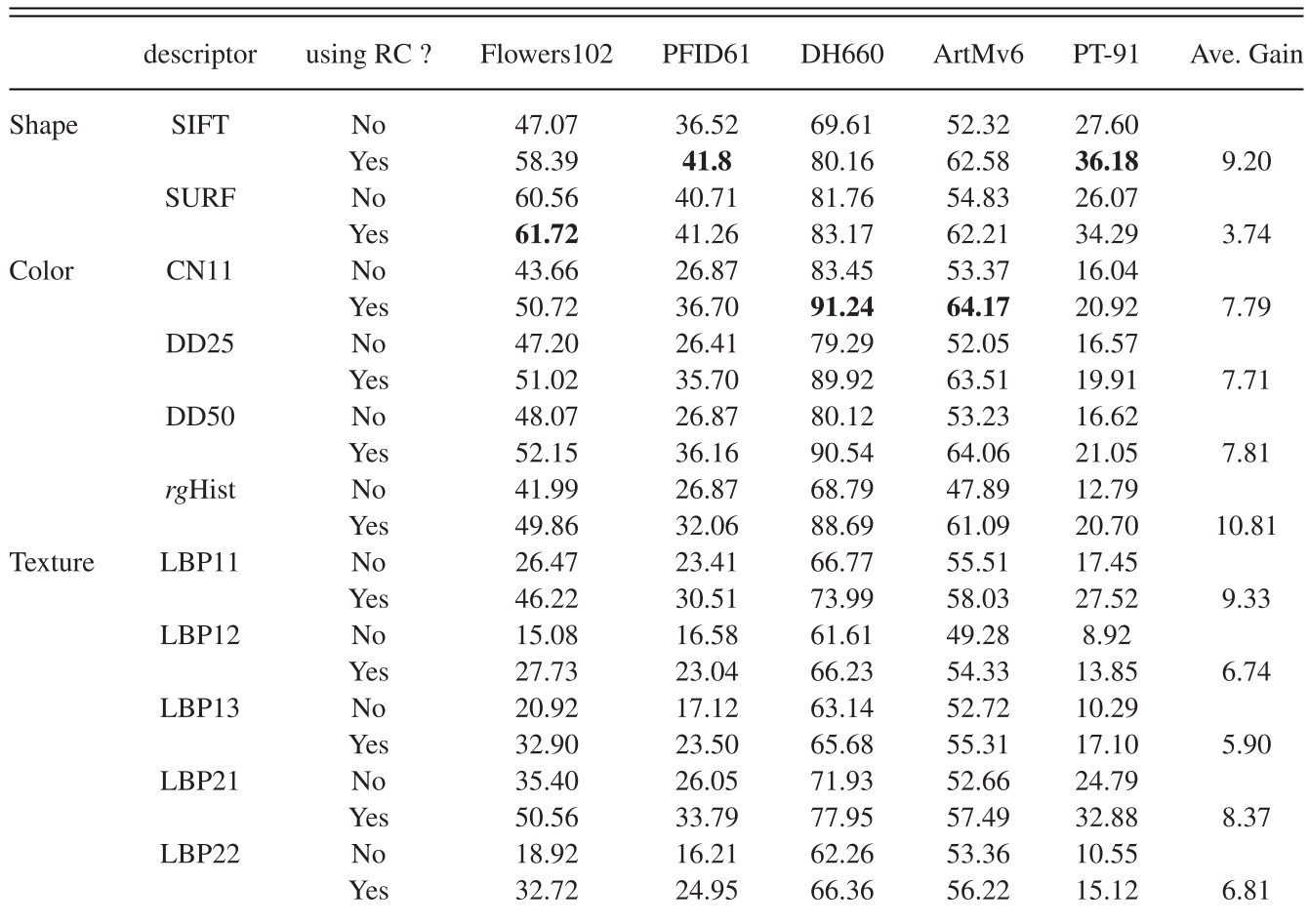 Table 2: Significant gains (Ave. Gain up to 10.81%) across shape, color, and texture descriptors.
Key insights from the experiments include:
- Art Style Recognition: In the DH660 (Dunhuang paintings) dataset, color collocations are key. The regional approach (RCC) outperformed standard Color Names by nearly 8%.
- Additivity to Deep Learning: Perhaps most impressively, even when using powerful models like GoogLeNet, adding the Regional Co-occurrence features provided a steady 1.5% accuracy increase. This proves that DCNNs do not yet perfectly capture all the spatial "logic" that explicit co-occurrence modeling provides.
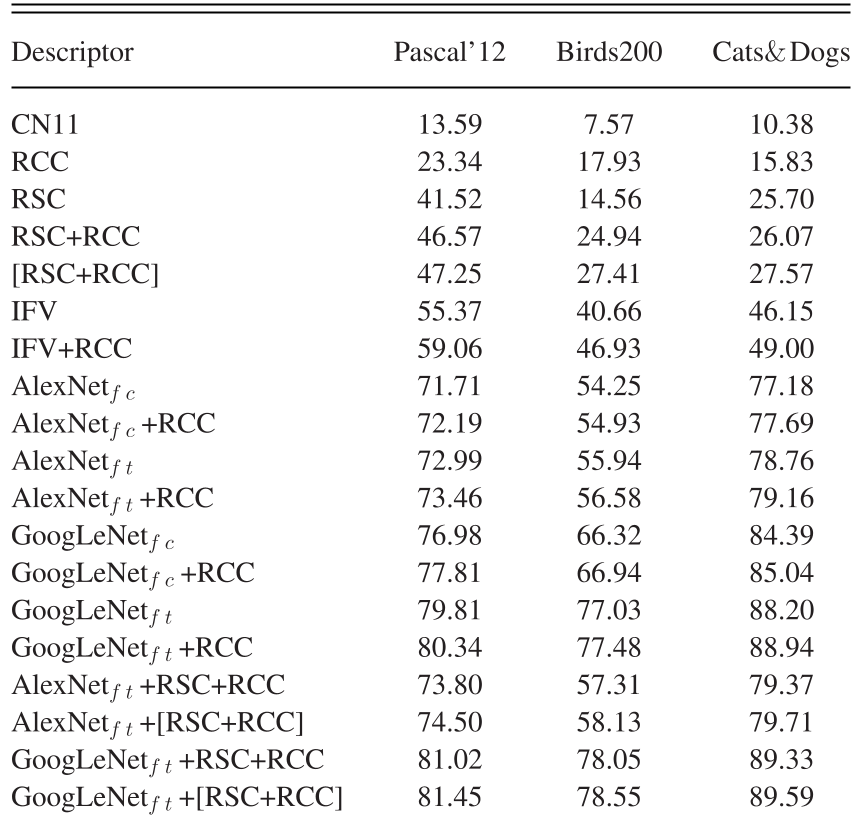 Table 4: Integration with DCNNs (AlexNet/GoogLeNet) shows the "additivity" of this structural information.
Critical Insight: The "Compactness" Trade-off
The paper highlights a fascinating detail: if superpixels are too square (like a grid), they lose the benefit of following natural object boundaries. If they are too "irregular," they fail to form meaningful neighborhoods. The optimal "compactness" is a sweet spot that allows the co-occurrence matrix to capture the true underlying geometry of the scene.
Conclusion
This research bridges the gap between low-level local features and high-level semantic understanding. By formalizing "pattern collocations" through regional co-occurrence and solving the resulting dimensionality issues with SVD, the authors have provided a robust tool that complements both classical Bag-of-Words and modern Deep Learning pipelines. For practitioners, the takeaway is clear: spatial structure matters, and looking at the neighbors is the best way to see it.