
LOCAl: Bridging Recommendation and Caching in Location-Based Social Networks
LOCAl: a personalized cache mechanism for location-based social networks
LOCAl is a personalized proactive caching framework designed for Location-Based Social Networks (LBSNs). It utilizes a probabilistic POI-to-POI graph and user preference modeling to predict future visits and pre-fetch relevant data objects (images, reviews) onto mobile devices via WiFi.
TL;DR
LOCAl (Location-Based Caching) is a strategic framework that doesn't just tell you where to go next—it ensures the photos, reviews, and menus for that venue are already waiting on your phone before you even get there. By predicting user movement through a transition graph and matching it with personal category preferences, LOCAl minimizes latency and saves expensive mobile data by pre-fetching content over WiFi.
Background: The Latency Gap in LBSNs
Modern Location-Based Social Networks (LBSNs) like Foursquare or Yelp have evolved from simple check-in apps to rich media platforms. However, there is a fundamental disconnect: recommendation engines suggest Points of Interest (POIs), but the high-resolution images and videos associated with them often lag or fail to load on spotty 4G/5G connections.
The authors identify that current systems treat recommendation and data delivery as separate problems. LOCAl treats them as one, using the "Inductive Bias" that a person's movement patterns and past category interests are the strongest predictors of what data objects will soon be "useful."
Methodology: From Transitions to Objects
The core of LOCAl is a dual-layered probabilistic model.
1. The POI-to-POI Graph (PTPG)
Instead of a simple "nearby" search, LOCAl builds a global directed graph where nodes are venues and edges represent historical transitions between them. The transition probability is calculated as: This captures the flow of urban movement—for instance, the high likelihood of moving from a "Museum" to a "Cafe."
2. Personalized Selection
The system then applies a "Personalization Filter." It looks at a user’s specific category preferences (e.g., someone who checks into "Bars" 70% of the time) and calculates the Final Selection Probability for specific objects (like a photo or a menu) at the predicted POI: where represents the popularity of that specific piece of content.
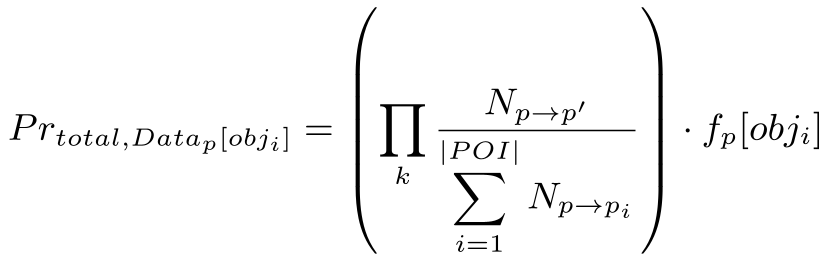 Figure: The formula for total selection probability, combining movement and content popularity.
Experimental Evidence
The authors utilized a real-world dataset from Foursquare containing over 227,000 check-ins in NYC.
Key Findings:
- The Long Tail of Curiosity: The data shows that 80% of users frequent only about 50 distinct POIs (see Figure 4 below), highlighting that "habitual" movement makes proactive caching highly feasible.
- Precision vs. Recall: While precision reached 35% for active users, the authors noted that even "low" numbers in POI prediction outperform standard recommendation baselines because the cost of "mis-caching" (caching a photo the user doesn't see) is lower than the cost of a "cache miss" (user waiting 5 seconds for a photo to load).
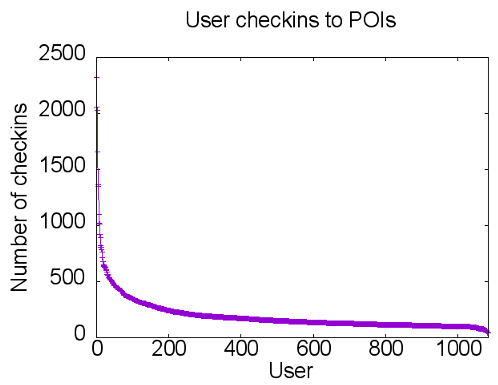 Figure: Dataset characteristics showing the distribution of check-ins across distinct POIs.
Critical Insights & Future Outlook
Why it works: LOCAl succeeds because it exploits the "spatial-temporal regularity" of human behavior. We aren't as unpredictable as we think. By solving the object selection problem as a Knapsack constraint, LOCAl maximizes the "Utility-per-MB" of local storage.
The Limitations: The current model uses a common graph for all users. While efficient, it may miss hyper-local personal habits. Future iterations could benefit from Federated Learning, allowing the model to learn personal transition habits without uploading sensitive GPS history to a central server.
Final Takeaway: LOCAl transforms the mobile device from a reactive terminal into a proactive agent, proving that the future of the mobile web lies in anticipatory computing.