
BVD: Boosting Social Network Compression via Diagonal Locality
On the Effect of Locality in Compressing Social Networks
The paper introduces a hybrid graph compression method named BVD that enhances the state-of-the-art BV (WebGraph) framework by explicitly exploiting locality of reference in reordered social networks. By representing the dense diagonal stripe of an adjacency matrix with a bit vector and the remainder with standard BV compression, it achieves superior space efficiency across various social network datasets.
TL;DR
Social networks are massive and growing, but compressing them is harder than compressing the Web. This paper introduces a hybrid compression scheme called BVD that isolates the "dense diagonal" of a graph's adjacency matrix. By using a simple bit vector for local edges and the standard BV framework for the rest, the authors achieve up to a 10% improvement in storage efficiency without sacrificing retrieval speed.
Context: The Social Network Challenge
In web graphs, nodes (pages) have a natural order—the URL. Lexicographic sorting of URLs naturally groups similar pages together, creating Locality of Reference. Social networks (Facebook, YouTube, etc.) lack this intrinsic hierarchy. Researchers have turned to algorithms like Layered Label Propagation (LLP) to reorder nodes artifically, creating dense clusters. However, even with LLP, traditional compression methods often miss the opportunity to simplify the densest parts of the resulting structure.
Problem: One Size Does Not Fit All
Current state-of-the-art methods, primarily the BV (Boldi-Vigna) framework, treat the graph consistently as a series of adjacency lists. While BV is excellent at handling "Similarity" (copying neighbor lists from previous nodes), it treats all edges with the same mechanism.
The authors observed that after applying LLP reordering, a massive concentration of edges appears around the main diagonal of the adjacency matrix. Using a complex compression scheme for these highly predictable "local" edges is actually less efficient than a simple, direct representation.
Methodology: The Hybrid Stripe Approach
The core innovation is the Diagonal Stripe.
- Identification: Define a -diagonal stripe where an edge exists if .
- Hybrid Storage:
- Bit Vector: All possible pairs within the -stripe are mapped to a bit vector. If a bit is 1, an edge exists. This provides O(1) (constant time) lookup for the most frequent edges.
- BV Component: All edges falling outside this stripe are handled by the standard BV compression engine.
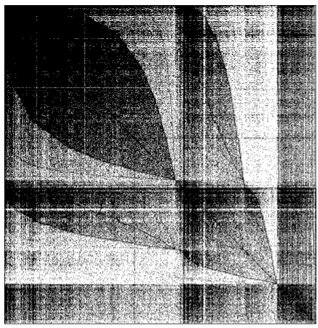 Figure 1: The effect of reordering on a YouTube social graph. (a) Before reordering (b) After reordering, notice the heavy concentration along the diagonal.
By extracting the diagonal, the remaining "sparse" part of the graph becomes even more amenable to traditional compression because the "noisy" local edges have been removed from the adjacency list processing.
Experimental Results
The authors tested BVD on six datasets, ranging from bibliographic networks (DBLP) to social sites (Flickr, LiveJournal).
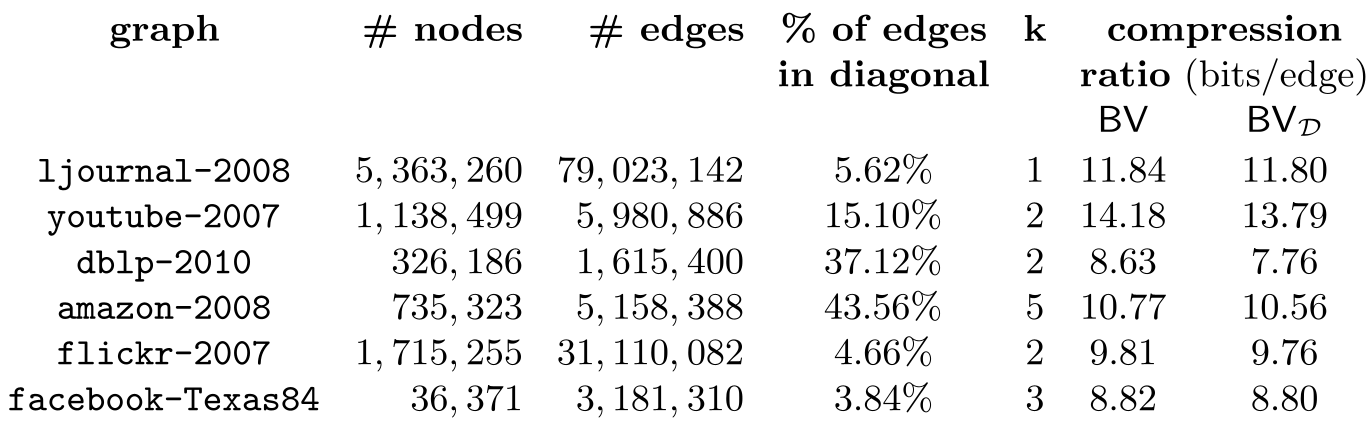 Table 1: Compression performance comparison. BVD consistently uses fewer bits per edge than the BV baseline.
Key Findings:
- Density Matters: In the
dblp-2010dataset, where 37% of edges reside in the diagonal, BVD improved compression by roughly 10%. - Parameter k: The optimal stripe width is usually small (between 1 and 5). As increases, the stripe covers more edges but becomes sparser, eventually hitting a point of diminishing returns.
- Zero Overhead: Because mapping the stripe is a linear operation, the computational complexity is equivalent to the baseline, while potentially speeding up queries due to the bit vector's constant-time access.
Critical Insight & Future Work
The beauty of this work lies in its simplicity. It recognizes that Inductive Bias—the assumption that nodes close in an ordering are likely connected—is so strong in reordered social networks that we don't need fancy entropy encoding for local edges; a raw bit vector is more efficient.
Limitations:
- The method is highly dependent on the quality of the initial reordering (LLP). If the reordering fails to "diagonalize" the graph, BVD offers little benefit.
- The optimal must be determined per graph, though the authors suggest a narrow search range ().
Conclusion: BVD proves that even in "sparse" social networks, there are "dense" pockets that merit specialized data structures. This hybrid philosophy could likely be extended to other types of graph data, such as biological networks or recommendation systems, where local community structures dominate.