
Location Affiliation Networks: Bonding Social and Spatial Information
Location Affiliation Networks: Bonding Social and Spatial Information
This paper introduces Location Affiliation Networks to model the bridge between social ties and spatial check-in data in Location-Based Social Networks (LBSNs). Using the Gowalla dataset, it proposes using venue-specific metrics—specifically Clustering Coefficient (CC) and Entropy—to accurately predict social friendships with significant performance gains over simple frequency-based methods.
TL;DR
Researchers from the University of Pittsburgh have moved beyond simple "co-location" tracking to understand how the nature of the places we visit predicts our friendships. By modeling LBSNs (like Gowalla) as affiliation networks, they discovered that sharing a visit to a niche local coffee shop is a much stronger indicator of a social tie than bumping into someone at a massive international airport. Using "Venue Entropy," they boosted friendship prediction accuracy by nearly 4x.
Problem & Motivation: The "Airport Paradox"
In the early days of Location-Based Social Networks (LBSNs), researchers assumed that if two people hit the same spots, they were likely friends. However, this ignores a fundamental reality of urban life: we all go to the same grocery stores, train stations, and airports.
The authors argue that existing work focuses too much on the social part of the graph or requires perfect temporal data (knowing exactly when someone left a building). Since LBSN data is often "noisy" and lacks check-out times, we need a way to distinguish between coincidental co-location and intentional social similarity.
Methodology: The Power of Affiliation Networks
The researchers re-imagined the LBSN as a Social-Affiliation Network. In this bipartite graph, users (S) and venues (F) are connected. A link between a user and a venue represents a check-in.
The Core Insight: Venue Entropy
To solve the "Airport Paradox," the paper introduces Venue Entropy ().
- High Entropy: A place visited by many different people in equal proportions (e.g., LAX Airport).
- Low Entropy: A place visited frequently by a small, specific group of people (e.g., a private office or a local dive bar).
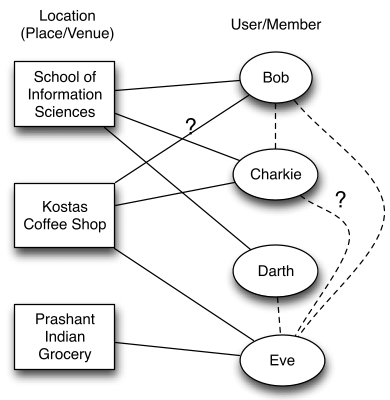 Fig 1: Modeling users and venues as a bipartite affiliation network.
By calculating the Clustering Coefficient (CC) of a venue—the probability that two people visiting the spot are already friends—the authors found a direct correlation: low-entropy venues have higher CCs. Essentially, niche spots "bond" the social and spatial planes.
Experiments & Results: Proving Location Homophily
Analyzing 6.4 million check-ins from Gowalla, the study found clear evidence of Location Homophily. Even if friends live 2,000 miles apart, they are statistically more likely to visit the same specific venues than two strangers living in the same neighborhood.
Performance Comparison
The authors tested their metrics using unsupervised learning (K-means). The results were striking when comparing entropy-based features against the baseline "Number of Common Venues":
| Metric | Precision | Recall |
|---|---|---|
| # Common Venues (Baseline) | 0.11 | 0.016 |
| Min/Avg Entropy | 0.42 - 0.44 | 0.59 - 0.63 |
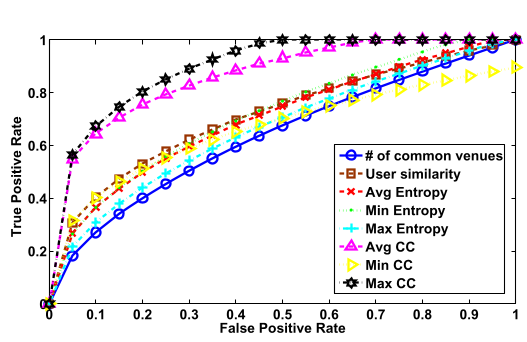 Fig 2: ROC curves showing that Entropy and CC outperform simple check-in counts in predicting friendships.
The data proves that the quality of a shared location matters more than the quantity of shared check-ins.
Critical Insight & Conclusion
Takeaway
This research demonstrates that our spatial footprint is a mirror of our social identity. The introduction of Venue Entropy provides a robust, time-independent metric to link human mobility with social structure. It suggests that if you want to find your "tribe," look at the specialized places you frequent, not the transit hubs you pass through.
Limitations & Future Work
While powerful, the model is currently based on a static snapshot of data. Social networks are dynamic; friendships form and break, and venues evolve. Future research should look at longitudinal data—tracking how check-in patterns change after a friendship is formed to distinguish between selection (meeting because of similar tastes) and social influence (visiting a place because a friend recommended it).
Furthermore, the high predictive power of niche locations raises significant privacy concerns. If a single check-in at a low-entropy venue can reveal a social tie with 44% precision, the risk of "de-anonymizing" users in spatial datasets is higher than previously thought.