
Bridging Online Ties and Offline Events: The GIB-FR Approach to Friend Recommendation
Location-aware Friend Recommendation in Event-based Social Networks: A Bayesian Latent Factor Approach
The paper introduces GIB-FR, a Bayesian latent factor model designed for event-oriented friend recommendation in Event-based Social Networks (EBSNs). By integrating geographical information, implicit ratings, and user event behaviors into a unified matrix factorization framework, it achieves SOTA performance on Plancast datasets.
TL;DR
Socializing in the digital age is increasingly driven by real-world interaction. This paper presents GIB-FR, a Bayesian latent factor model that fuses geographical data and offline event behaviors to recommend friends in Event-based Social Networks (EBSNs). By moving beyond simple link prediction, it optimizes for both event promotion and user experience.
Context: Why EBSNs are Different
In platforms like Meetup or Plancast, a "follow" isn't just a digital subscription—it's often a precursor to meeting at a physical venue. Existing recommendation algorithms often fall short because they ignore the "Area Homophily" principle: the fact that users frequenting the same geographical concentration areas are significantly more likely to connect.
The Problem: The Sparsity of Implicit Feedback
Most EBSN data is implicit (we know who a user follows, but not who they dislike). Furthermore, the data is tripartite:
- Online Socializing: Who follows whom?
- Geographical Footprints: Which regions do users frequent?
- Event Participation: Which specific gatherings do users attend?
Methodology: The GIB-FR Framework
The researchers developed the GIB-FR (Geographical, Implicate, and Behavioral Friend Recommendation) model. The core innovation lies in its unified objective function that learns shared latent factors across three interaction matrices.
1. Latent Factor Representation
Each user is represented by two vectors: (as a follower) and (as a followee). The probability of a follow relationship is modeled as .
2. Incorporating Geography and Behavior
The model doesn't just look at user-to-user ties. It maps:
- Locations (): Clustered via k-Means to identify "concentration areas."
- Events (): Individual offline meetups.
The overall likelihood function combines the social ranking loss with Gaussian priors on the geographical and behavioral interactions.
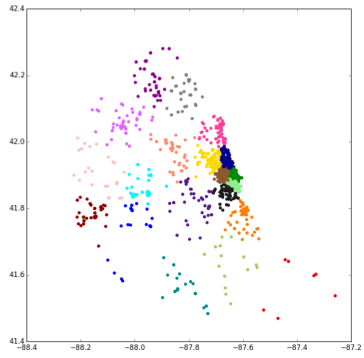 Figure 1: Comparison of event distribution and user homophily based on common areas.
Experimental Validation
The model was tested across five major US cities using Plancast data. The results were measured using AUC, Precision@k, and MAP.
Performance Highlights:
- Superior Ranking: GIB-FR consistently beat 7 baselines, including Adamic Adar (AA) and Factor-Rank (FR).
- Effectiveness of Fusion: The ablation-style comparison shows that adding location clusters (k-Means regions) provides a stronger signal than raw coordinate data.
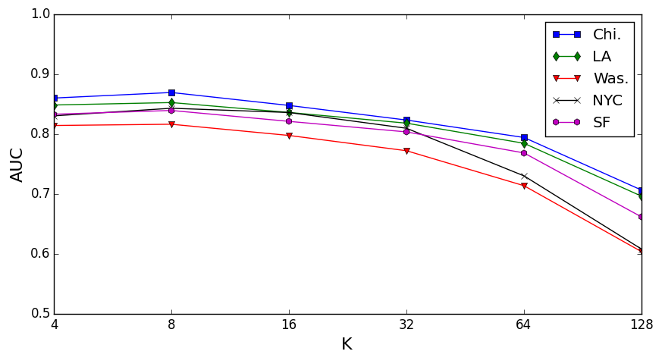 Table 1: AUC results across different urban datasets.
Critical Insight: The "Area Homophily" Advantage
The study proves that the number of common geographical areas shared between two users is a powerful predictor of social connection. As shown in the paper's preliminary analysis, the probability of "following" increases almost linearly with the number of shared concentration areas (Fig 1b).
Conclusion and Future Directions
GIB-FR demonstrates that for modern social platforms, the "Social Graph" is inseparable from the "Spatial Graph." By using a Bayesian framework, the authors successfully mitigated the noise inherent in implicit feedback.
Future Outlook: While GIB-FR uses static latent factors, the next frontier is likely Temporal EBSN modeling—predicting friendships based on where users will be, rather than just where they have been.
Source: Yao Lu et al., "Location-aware Friend Recommendation in Event-based Social Networks: A Bayesian Latent Factor Approach", CIKM '16.