
Location-Aware Influence Maximization: Taming the Dynamic Social Stream
13797_Location-aware Influence Maximization over Dynamic Social Streams.
This paper introduces the Sparse Influential Checkpoints (SIC) and Location-based SIC (LSIC/LSIC+) frameworks to solve the Stream Influence Maximization (SIM) and Location-aware SIM (LSIM) problems. By maintaining a logarithmic number of checkpoints and integrating Quadtree spatial indexing, the method achieves near-SOTA influence quality with up to 178x speedup over static algorithms like IMM.
Executive Summary
TL;DR: This paper tackles the challenge of identifying influential users in real-time as social media actions (tweets, retweets) flow in with geographic tags. By introducing Sparse Influential Checkpoints (SIC), the authors move beyond static graph analysis to a dynamic sliding window model, achieving near-optimal influence results with a staggering 178x speedup.
Background: In the landscape of Social Media Advertising, the ability to target "active" and "locally relevant" users is worth billions. While Influence Maximization (IM) is a well-studied problem, most solutions are designed for static snapshots, making them too slow for the "now-or-never" nature of social streams.
The Problem: Static Models in a Dynamic World
Traditional IM algorithms (like IMM or RIS-based methods) typically require a fixed graph. If the network changes—say, a trending topic suddenly shifts the influence weights—you have to rerun the entire process. This is computationally prohibitive for streams. Furthermore, they often ignore spatial constraints; a restaurant in New York doesn't care about a "global" influencer in Singapore; they need a "local" influencer active right now.
Methodology: Engineering Real-Time Influence
1. Sparse Influential Checkpoints (SIC)
The core innovation is the SIC framework. Instead of maintaining an influence solution for every possible window, SIC keeps a logarithmic number of "checkpoints" based on the age of actions.
- Physical Intuition: Think of it as periodic "save points." If a new action arrives, your latest save point updates. If an old one expires, you fall back to the next available sparse checkpoint.
- Theoretical Bound: By ensuring that neighboring checkpoints don't differ in influence value by more than a factor of , the system guarantees an approximation ratio.
 Figure 1: Example of checkpoint maintenance in SIC over sliding windows.
2. LSIC and LSIC+: Adding the "Where"
To handle Location-aware SIM (LSIM), the authors integrate SIC with a Quadtree.
- Continuous Queries: A specific region is monitored by an SIC instance registered in a Quadtree node.
- Ad Hoc Queries: When a user asks for influencers in a random rectangle, the system finds the best-matching precomputed SIC instance in the Quadtree and "patches" the remaining actions in real-time.
- LSIC+ Improvement: It identifies the top- candidates and uses a Thresholding algorithm (Algorithm 3) to refine the seed set, pushing the approximation closer to the theoretical limit.
Experimental Evidence
The authors tested their frameworks on massive datasets like Reddit (48M actions) and geo-tagged Twitter data from New York and Singapore.
- Efficiency: SIC is roughly two orders of magnitude faster than static IMM and the dynamic baseline UBI.
- Quality: In the SIM task, SIC maintains 96%+ of the influence value of the computationally expensive Greedy algorithm.
- Scalability: As the window size grows, the throughput of SIC remains stable, whereas static methods' performance craters.
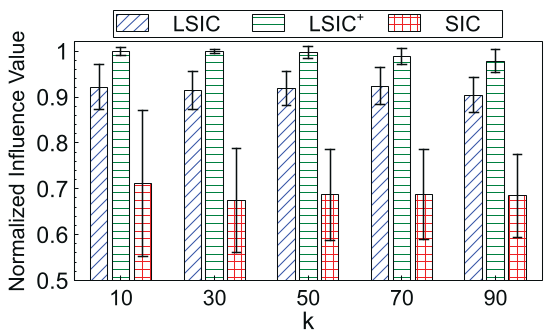 Figure 2: Throughput comparison showing SIC's massive efficiency gains over IMM and Greedy.
Critical Insight: Why This Works
The secret sauce lies in the Subadditivity and Monotonicity of the influence function. By recognizing that social influence follows a "diminishing returns" (submodular) property, the authors can safely prune information. The "sparse" in SIC isn't just a heuristic; it's a mathematically grounded way to skip redundant computations while staying within a proven error margin.
Conclusion & Future Outlook
This paper bridges the gap between Spatial Databases and Social Network Analysis. The LSIC+ framework is particularly impressive because it allows for real-time, ad hoc spatial queries—something previous IM research avoided due to complexity.
Future Directions: The authors suggest incorporating User Preferences (topic-aware IM). Imagine combining this spatial stream with NLP to find "The most influential person in Brooklyn talking about vegan pizza in the last hour." That is the "Holy Grail" of hyper-local digital marketing.